



Written By: Mansi Bhatt, MSc Food and Nutrition
Medically Reviewed By: Dr. Gagandeep Singh, MBBS
Last Updated: 1 October 2026 · Redial Clinic, Green Park, New Delhi
Lowering insulin resistance with diet is less about eliminating roti and rice, and more about rebalancing the plate around them.
| Key Takeaways Lowering insulin resistance with diet is about rebalancing the Indian plate, not banning roti and rice: portion size, what you pair the carbohydrate with and the order you eat in all change the glucose response of the same meal. Dal and other legumes are usually low-GI [1], but cereals vary widely by variety and preparation: in one Indian study, bajra, jowar and ragi preparations tested high-GI, so “whole grain” does not automatically mean “low-GI” [2]. In a small study of 15 adults with prediabetes, eating protein and vegetables before carbohydrate lowered post-meal glucose peaks by more than 40% compared with eating the carbohydrate first [3]. A practical starting template, and our own clinical model, is a plate of roughly half non-starchy vegetables, a quarter protein and a quarter roti, rice or millet. This is a diet-specific deep dive; it complements, not replaces, the broader two-lever (diet + resistance training) approach, see our companion guide on reversing insulin resistance naturally. Dietary change alone is not medical treatment: if you are on insulin, sulfonylureas, or other glucose-lowering medication, do not adjust doses based on diet changes without your physician’s guidance. |
For most of us, the day runs on some version of roti at lunch, rice at dinner, and poha or upma for breakfast, a pattern so routine it rarely gets a second thought. But this everyday roti-rice-poha cycle quietly keeps insulin levels elevated for a large part of the day, meal after meal, year after year. If you have been told your fasting insulin, HOMA-IR, or blood sugar trend is creeping upward, diet is one of the highest-leverage places to start, not by cutting out the Indian plate, but by rebalancing it toward protein and fibre.
This guide is written by Mansi Bhatt, clinical nutritionist at Redial Clinic, and medically reviewed by Dr. Gagandeep Singh. It is a deliberately diet-specific deep dive: portioning roti, rice, poha and dal, sequencing a meal to blunt the glucose spike, and reading the glycaemic load of common Indian staples. For the fuller two-lever picture, diet plus resistance training, see our companion guide, how to reverse insulin resistance naturally.
How does diet lower your insulin resistance?
Diet lowers insulin resistance mainly by reducing the glucose load your pancreas has to respond to at each meal, smaller, slower glucose rises need less insulin to clear them. Over weeks to months, consistently lower insulin demand allows cells to become more responsive to the insulin that is released, which is the essence of improved insulin sensitivity.
Insulin resistance develops when cells, particularly in muscle, liver and fat tissue, stop responding efficiently to insulin’s signal to take up glucose from the blood. The pancreas compensates by producing more insulin, which can control blood sugar for years while insulin levels themselves climb, often long before glucose numbers look abnormal on a routine test. Diet is the most direct lever here because carbohydrate quantity and quality are the primary driver of how much insulin a meal demands in the first place.
This is the carbohydrate-insulin framework described by Ludwig and Ebbeling, who argue that processed, high-glycaemic-load carbohydrate drives hormonal changes that promote fat storage and hunger, and that a low-glycaemic-load diet is a practical alternative to focusing on calories alone. [4]
Three diet levers matter most, and this article covers all three in Indian-plate terms: lowering the glycaemic load of the carbohydrate portion, sequencing the meal so protein and fibre arrive before the carbohydrate, and building the plate around protein and non-starchy vegetables rather than around rice or roti.
What is the glycaemic load of common Indian staples?
Dal and other legumes are usually low-GI [1], while cereals vary widely by variety and preparation. In our table, polished white rice and poha rank higher and wheat roti sits in the middle, but some Indian millet preparations (bajra, jowar, ragi) tested high-GI [2]. The same plate can demand very different amounts of insulin depending on staple and portion.
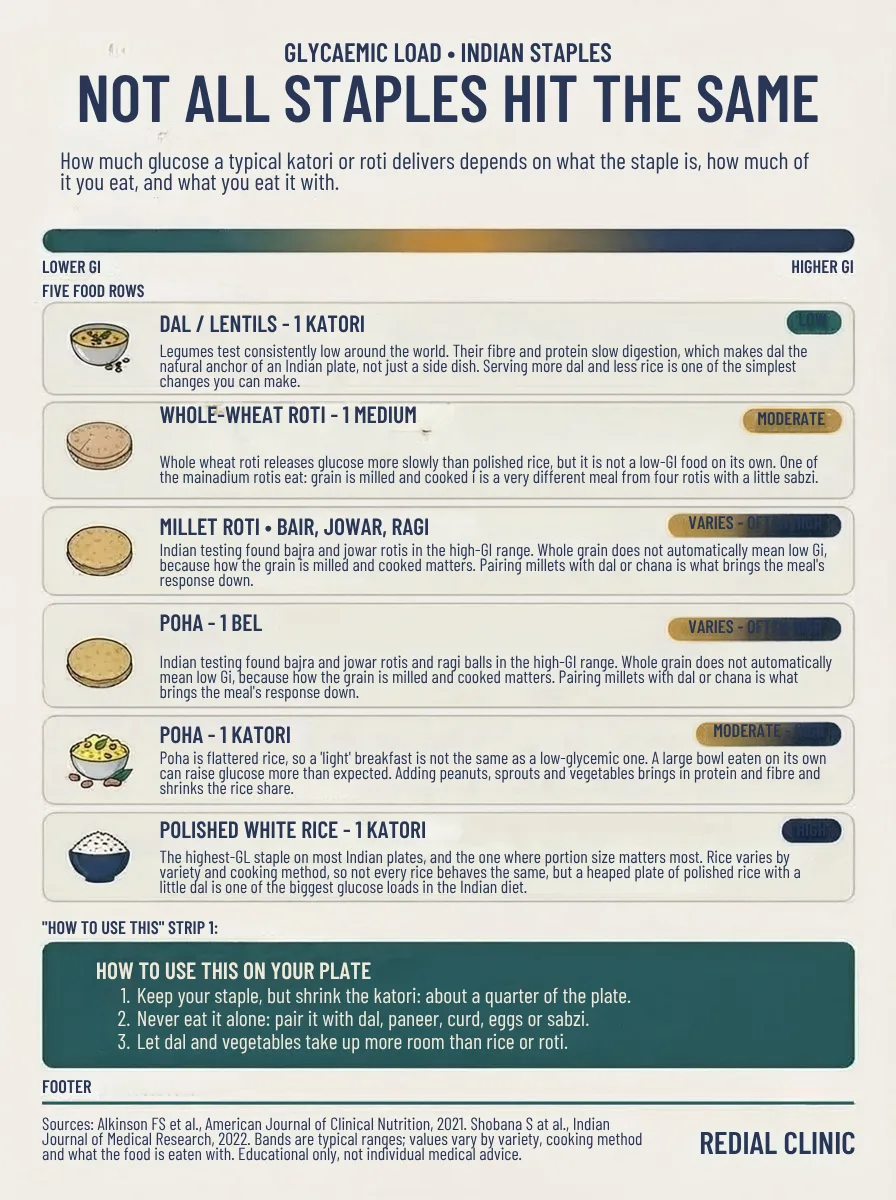
Glycaemic load of common Indian staples, from lower to higher. GI varies by variety and preparation: in one Indian study, bajra, jowar and ragi preparations tested high-GI [2].
Glycaemic index (GI) measures how quickly a food raises blood glucose compared with pure glucose; glycaemic load (GL) adjusts that for a typical portion size, which is the more clinically useful number for meal planning. The table below is based on the internationally recognised 2021 GI/GL reference tables and Indian-specific glycaemic testing of traditional foods [1] [2]. Values vary: cereals show wide variation in GI between varieties and manufacturing methods [1], and the way a food is processed and prepared can change its GI [2].
| Staple (typical serving) | Glycaemic index | Glycaemic load* | Practical note |
| White rice, polished, cooked (~1 katori) | High | High | Among the highest-GL staples in the Indian diet; portion size matters more here than for most other foods |
| Poha (flattened rice), cooked (~1 katori) | Moderate–high | Moderate–high | Often assumed “light,” but processing can raise a food’s glycaemic response; pairing with peanuts or vegetables lowers its impact |
| Whole-wheat roti/chapati (1 medium) | Moderate | Moderate | Fibre and protein in whole wheat slow digestion versus polished rice, but it is not a “low-GI” food on its own |
| Millet roti (bajra, jowar, ragi) | Varies; high in one Indian study | Depends on portion | In one Indian study, bajra, jowar and ragi preparations tested high-GI; being a whole grain does not make a food low-GI [2]. Pair with protein and fibre and watch the portion |
| Dal / lentils, cooked (moong, chana, masoor; ~1 katori) | Low | Low | Fibre and protein together make dal one of the lowest-GL staples on an Indian plate — a natural anchor food |
*Glycaemic load reflects both the carbohydrate’s quality (GI) and the amount eaten in a typical serving. Individual GI/GL values vary by variety, ripeness, cooking method and what the food is eaten alongside, these are typical ranges, not fixed numbers for every batch of rice or roti.
Two practical takeaways follow directly from this table. First, dal is not a side dish nutritionally, it is one of the lowest-GL, highest-protein-and-fibre items on most Indian plates, and increasing its portion relative to rice or roti is one of the simplest changes available. Second, poha’s reputation as a “light” breakfast is not the same as “low-glycaemic”: processing and preparation can raise a food’s glycaemic response [2], so poha eaten alone, especially in a large bowl, can produce a bigger glucose response than expected. Pairing it generously with peanuts, sprouts or vegetables blunts this.
| From the clinicA patient in her mid-40s came to us with a fasting insulin in the upper range and a diet built almost entirely around poha for breakfast, rice for lunch, and roti for dinner; protein was an afterthought on most days. Without removing any of these staples, we restructured her plate to lead with dal or paneer and vegetables first, and roughly halved her rice and poha portions while keeping meal timing the same. Her fasting insulin and triglycerides both improved over the following months on repeat testing. Individual results vary. |
What is the best Indian diet for insulin resistance?
In our approach, the best Indian diet for insulin resistance is not a named diet but a plate ratio: roughly half the plate as non-starchy vegetables, a quarter as protein (dal, paneer, eggs, fish, chicken, curd), and a quarter as roti, rice or millet, eaten together rather than the carbohydrate portion dominating the plate.
This is a reconstruction of the traditional thali, not a replacement for it. Most Indian home-cooked meals already contain the right building blocks: dal, sabzi, curd, roti, rice, the issue is usually proportion, not ingredient choice. A typical insulin-resistance-friendly plate looks like this:
- Half the plate: non-starchy vegetables and salad: bhindi, lauki, palak, cauliflower, cucumber, tomato for fibre and volume with minimal glucose impact.
- A quarter of the plate: protein (dal, rajma, chana, paneer, curd, eggs, fish or chicken), which can help slow gastric emptying and blunt the insulin response to the meal.
- A quarter of the plate: roti, rice or millet, portion-controlled (in our approach, roughly 1–2 medium rotis or about 1 katori of cooked rice), not eliminated.
In India, 15.3% of adults have prediabetes and 11.4% have diabetes [5], which is why we favour practical, sustainable patterns built on familiar foods over restrictive elimination diets. An ICMR-INDIAB analysis of 18,090 Indian adults likewise recommended reducing carbohydrate and increasing protein as shares of energy, both for diabetes remission and for preventing progression from prediabetes [6]; it did not test a plate ratio like ours.
This diet-specific approach is distinct from and complements our broader guide on the Indian diet to reverse diabetes, which addresses already-diagnosed type 2 diabetes. This article is written for the earlier, prevention-oriented stage of insulin resistance, before diabetes has developed. The plate-ratio principles are similar, but the clinical stakes and monitoring needs differ.
Should you cut carbs to reverse insulin resistance?
You do not necessarily need to eliminate carbohydrates. A sensible starting point is to reduce the glycaemic load and portion of refined carbohydrates (white rice, maida, sugary snacks) while keeping fibre-rich ones such as dal, vegetables and whole grains in controlled portions. Stricter low-carbohydrate eating can lower insulin demand sharply but needs medical guidance if you take glucose-lowering medicines.
Very-low-carbohydrate approaches can lower insulin demand sharply and work well for some individuals, particularly in the short term, but they are harder to sustain on a typical Indian plate and are not necessary for everyone. The more broadly sustainable approach and the one this article focuses on is reducing glycaemic load through smarter carbohydrate choices and portioning, not zero-carbohydrate elimination. Cutting carbohydrate quantity sharply also carries a specific medication-safety issue:
A note on medication: If you are on insulin, a sulfonylurea, or any other glucose-lowering medication, reducing carbohydrate intake substantially can increase the risk of hypoglycaemia (low blood sugar) unless your medication is adjusted alongside the diet change. Any dose adjustment or deprescribing must be a physician-guided decision, made with monitoring: never a self-directed change based on a diet plan alone.
For readers specifically managing diagnosed diabetes rather than earlier-stage insulin resistance, foods that help reverse diabetes: the complete Indian low-carb guide goes deeper into a lower-carbohydrate food list with that medication-safety context built in.
Does eating more protein help insulin resistance?
Possibly. In a small six-week randomised trial of 21 adults, a calorie-restricted high-protein diet (about 125 g a day) improved insulin resistance more than a conventional-protein diet (about 80 g a day) [7]. Protein should replace some refined carbohydrate on the plate, not stack on top of it.
In that trial, weight loss was similar in both groups, but fat-free mass rose in the high-protein group, and the improvement in HOMA-IR (a calculation from fasting glucose and fasting insulin that estimates insulin resistance) was related to the gain in fat-free mass [7]. Dietary fibre works alongside protein in a related but distinct way: a systematic review and meta-analysis of 12 randomised trials (609 adults with overweight or obesity) found that isolated soluble fibre supplements reduced fasting glucose and fasting insulin compared with placebo, although the authors urge caution because results varied considerably between studies [8].
Both trials used specially formulated high-protein foods or fibre supplements, not Indian home cooking, so the suggestions here are a practical application rather than a tested protocol. On an Indian plate, this means leaning on dal, paneer, curd, eggs, fish and chicken for protein, and vegetables plus whole legumes for fibre, both categories that are already familiar, just underused relative to the carbohydrate portion.
It is worth being precise about what this evidence does and does not say: small controlled trials suggest protein and fibre can improve markers of insulin resistance over weeks to months, but this is meaningfully different from a guarantee of reversal, and results vary between individuals. For readers focused specifically on fibre as a category, fibre for diabetes and obesity reversal covers fibre sources and targets in more depth.
How do you reorder a roti-rice-poha meal to lower its glucose impact?
Eating vegetables and protein before the roti, rice or poha portion of the same meal can lower the post-meal glucose rise. In a small crossover study of 15 adults with prediabetes, this order cut glucose peaks by more than 40% compared with eating the carbohydrate first [3]. Insulin excursions were also lower when vegetables came first [3].
This is called food order, or sequencing. Slower stomach emptying and a stronger incretin response are the mechanisms usually proposed, but the study measured glucose and insulin, not these mechanisms, so treat the explanation as likely rather than proven.
Practically, on a typical thali, this means eating the salad and sabzi first, dal or paneer next, and finishing with roti or rice rather than the common habit of mixing rice, dal and sabzi together from the first bite.
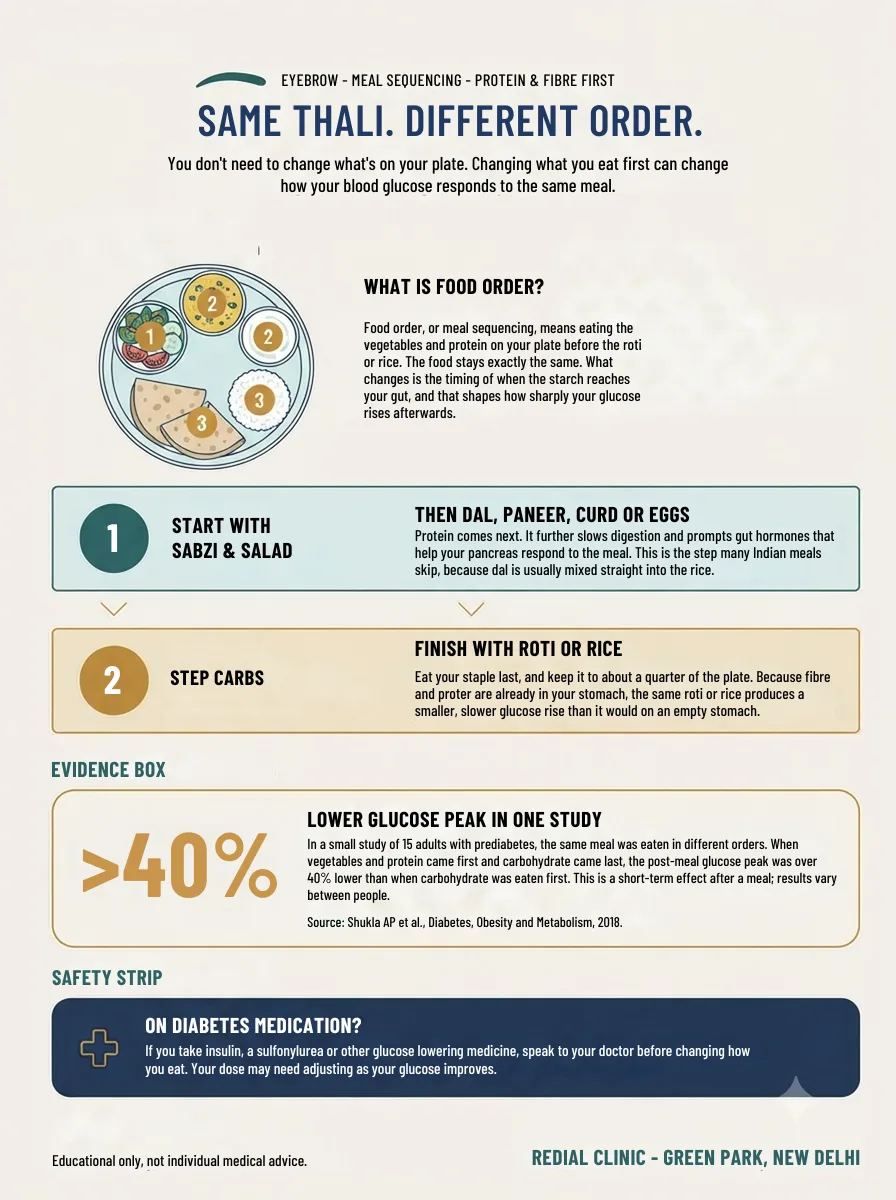
Eating protein and vegetables before carbohydrate lowered post-meal glucose peaks by more than 40% in a small study of 15 adults with prediabetes [3].
| From the clinicWe often see patients surprised that changing the order they eat their existing thali, not the food itself, makes a measurable difference on their continuous glucose readings when they trial it. One patient with a strong family history of diabetes and a borderline HOMA-IR kept his meals almost identical but began eating sabzi and dal before rice; his post-meal glucose readings on a short home-monitoring trial were visibly flatter within two weeks. This is a pattern we observe clinically, not a substitute for individualised testing, and individual results vary. |
For readers who want the fuller lifestyle picture, diet sequencing alongside resistance training, sleep and stress management, our companion guide how to reverse insulin resistance naturally covers the complete two-lever protocol. This article intentionally stays diet-specific: the roti/rice/poha portioning, protein-first ordering, and glycaemic load detail that the broader guide only touches on.
If your goal is weight loss alongside improving insulin resistance, weight loss for insulin resistance: a metabolic approach that actually works builds on these same diet principles with a weight-management lens, and what is insulin resistance explains the underlying mechanism, including what causes it, that this diet approach is designed to correct.
Want a plate plan built around your own numbers?
| We review your insulin, glucose and lipid markers alongside your actual daily plate: roti, rice, dal and all, and build a portioning and sequencing plan around it, not a generic diet sheet.
Book a Metabolic Assessment at Redial Clinic, Green Park, New Delhi. |
Frequently asked questions
How to lower insulin resistance with diet?
Foods that lower the glucose and insulin demand of a meal are most helpful: dal and other legumes, paneer, curd, eggs, fish, chicken, non-starchy vegetables, and whole fruit eaten in reasonable portions. These work by adding protein and fibre, which slow digestion and blunt post-meal glucose spikes, rather than by any single food having a special metabolic effect on its own.
What is the best Indian diet for my insulin resistance?
The best approach is a plate-ratio built on the traditional thali: roughly half non-starchy vegetables, a quarter protein (dal, paneer, eggs, fish), and a quarter roti, rice or millet in controlled portions. This works with familiar Indian foods rather than requiring an entirely different diet, and focuses on rebalancing proportions rather than eliminating staples.
Should I cut carbs to reverse insulin resistance?
You do not necessarily need to eliminate carbohydrates. A sensible starting point is to reduce the portion and glycaemic load of refined carbohydrates like white rice and maida, while keeping fibre-rich carbohydrates such as dal and vegetables. Stricter low-carbohydrate eating can lower insulin demand sharply but needs medical guidance. If you are on glucose-lowering medication, any significant carbohydrate reduction should be discussed with your doctor first, as it can increase the risk of low blood sugar.
Does eating more protein help insulin resistance?
Possibly. In a small six-week randomised trial, a calorie-restricted higher-protein diet improved insulin resistance more than a conventional-protein diet [7], but the evidence is limited and results vary. Protein should replace some refined carbohydrate volume on the plate rather than being added on top of an unchanged portion.
Medical Disclaimer
This article is for educational purposes and does not replace individualised medical advice. Insulin resistance presentations, dietary needs, and medication regimens vary widely between individuals. Do not stop or change any prescribed medication, including insulin, sulfonylureas, or other glucose-lowering drugs, based on dietary changes alone, any such adjustment must be made by your treating physician, with monitoring.
If you have diagnosed diabetes, are pregnant, or have a history of eating disorders, consult a qualified doctor or dietitian before making significant changes to your carbohydrate intake.
References
- Atkinson FS, Brand-Miller JC, Foster-Powell K, Buyken AE, Goletzke J, “International Tables of Glycemic Index and Glycemic Load Values 2021: A Systematic Review,” American Journal of Clinical Nutrition, 2021. https://doi.org/10.1093/ajcn/nqab233
- Shobana S, Geetha G, Bai MR, et al., “Carbohydrate Profiling & Glycaemic Indices of Selected Traditional Indian Foods,” Indian Journal of Medical Research, 2022. https://doi.org/10.4103/ijmr.IJMR_1935_19
- Shukla AP, Dickison M, Coughlin N, et al., “The Impact of Food Order on Postprandial Glycaemic Excursions in Prediabetes,” Diabetes, Obesity and Metabolism, 2019. https://doi.org/10.1111/dom.13503
- Ludwig DS, Ebbeling CB, “The Carbohydrate-Insulin Model of Obesity: Beyond ‘Calories In, Calories Out,'” JAMA Internal Medicine, 2018. https://doi.org/10.1001/jamainternmed.2018.2933
- Anjana RM, Unnikrishnan R, Deepa M, et al., “Metabolic Non-Communicable Disease Health Report of India: The ICMR-INDIAB National Cross-Sectional Study (ICMR-INDIAB-17),” Lancet Diabetes & Endocrinology, 2023. https://doi.org/10.1016/S2213-8587(23)00119-5
- Anjana RM, Srinivasan S, Sudha V, et al., “Macronutrient Recommendations for Remission and Prevention of Diabetes in Asian Indians Based on a Data-Driven Optimization Model: The ICMR-INDIAB National Study,” Diabetes Care, 2022. https://doi.org/10.2337/dc22-0627
- Johnston CS, Sears B, Perry M, Knurick JR, “Use of Novel High-Protein Functional Food Products as Part of a Calorie-Restricted Diet to Reduce Insulin Resistance and Increase Lean Body Mass in Adults: A Randomized Controlled Trial,” Nutrients, 2017. https://doi.org/10.3390/nu9111182
- Thompson SV, Hannon BA, An R, Holscher HD, “Effects of Isolated Soluble Fiber Supplementation on Body Weight, Glycemia, and Insulinemia in Adults with Overweight and Obesity: A Systematic Review and Meta-Analysis of Randomized Controlled Trials,” American Journal of Clinical Nutrition, 2017. https://doi.org/10.3945/ajcn.117.163246

 LinkedIn