




Written By: Dr. Gagandeep Singh, MBBS
Medically Reviewed By: Dr. Gagandeep Singh, MBBS
Last Updated: 29 September 2026 · Redial Clinic, Green Park, New Delhi.
| Key Takeaways Obesity has been formally classified as a chronic disease by the American Medical Association (2013), the World Health Organization (via ICD-11 codes), and the World Obesity Federation — this is a clinical consensus, not an opinion. Body weight is 40–70% heritable. Genes governing the leptin-melanocortin pathway strongly influence hunger, satiety, and how the body defends its “set-point” weight. “Just eat less” misunderstands the biology: hormonal signals from fat tissue, gut, and brain actively resist sustained weight loss in most people — this is measurable, not an excuse. Calling obesity a willpower failure is medically inaccurate and clinically counter-productive — it delays people from seeking the metabolic treatment that actually works. Disease classification does not mean lifestyle is irrelevant. Diet and activity remain central levers — they just aren’t the whole story, and blame isn’t a treatment plan. Because obesity is a regulated biological condition, it responds to structured medical evaluation and treatment — not just to being told to try harder. |
Is obesity a disease or a lifestyle problem?
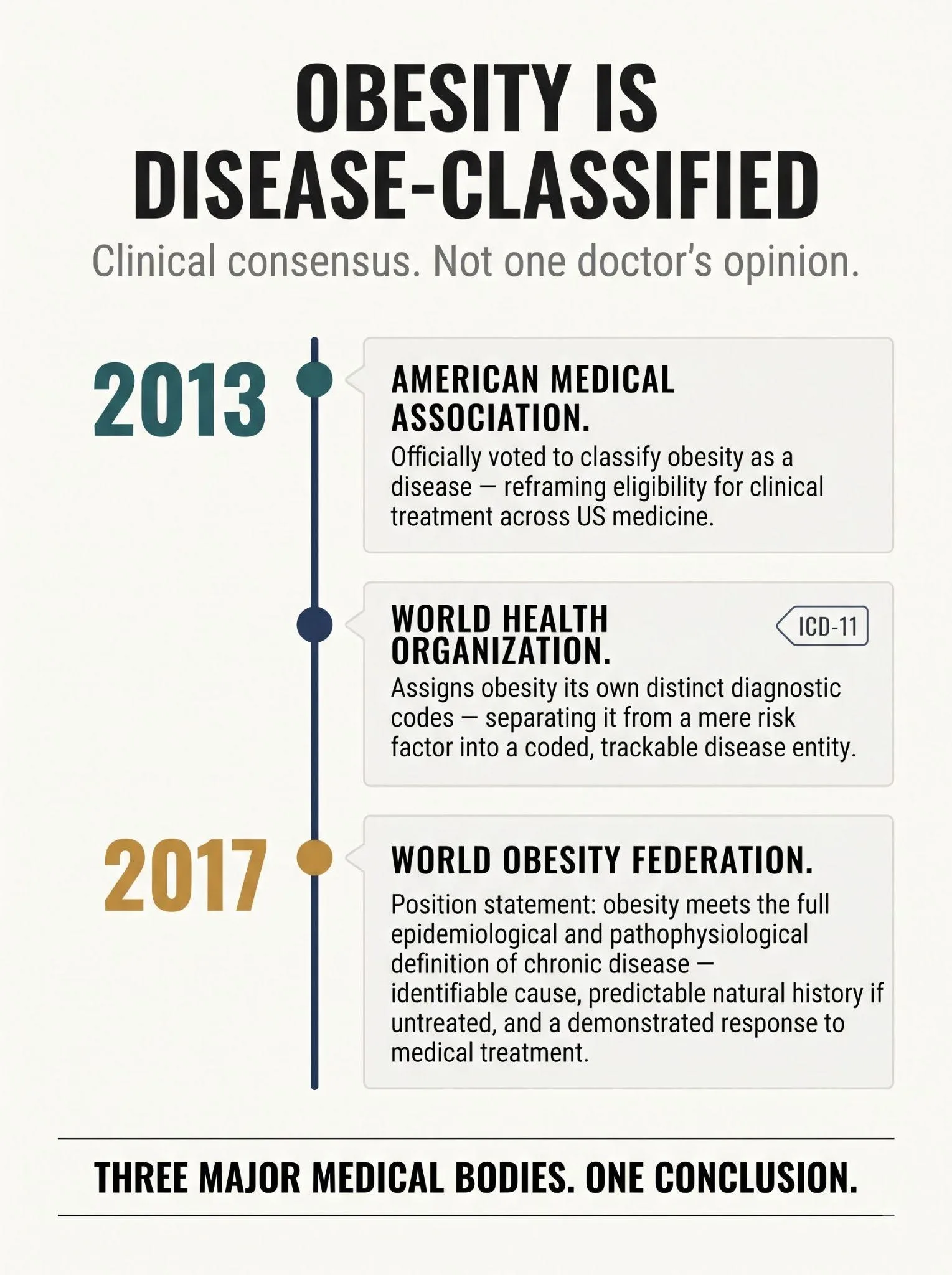
Major medical bodies that classify obesity as a chronic disease — this is clinical consensus, not a fringe position.
Obesity is a recognised chronic disease of hormonal and metabolic regulation, not simply a lifestyle problem. The American Medical Association classified it as a disease in 2013, the World Health Organization assigns it distinct diagnostic codes under ICD-11, and the World Obesity Federation defines it as a chronic relapsing disease process. Lifestyle still matters — it just isn’t the whole explanation.
This framing sometimes gets misread as “biology excuses everything.” It doesn’t. What the disease classification actually says is narrower and more useful: obesity involves a measurable, reproducible set of hormonal and neural mechanisms — the hypothalamic circuits that regulate hunger, the hormones (leptin, ghrelin, insulin) that report the body’s energy state to the brain, and a tendency for the body to defend a higher “set-point” weight once it is reached. These mechanisms exist and function the same way whether or not a person eats reasonably or exercises.
At Redial Clinic, we see this distinction play out daily. A patient who has tried five diets and regained weight after each one is not failing at self-control — they are running into biology that most weight-loss advice was never designed to address. Our approach to obesity reversal treats the underlying insulin and hormonal drivers, not just the calorie count.
The World Obesity Federation’s 2017 position statement lays out the clinical case plainly: obesity meets the epidemiological and pathophysiological definition of a chronic disease — it has an identifiable cause (energy-regulating systems malfunctioning under modern conditions), a predictable natural history if untreated, and it responds to specific medical treatment. That is the same logic used to classify hypertension or type 2 diabetes as diseases rather than as failures of character.
Is obesity genetic?
Yes, to a substantial degree. Twin, family, and genome-wide studies consistently estimate that 40–70% of the variation in body weight between individuals is heritable, driven largely by genes in the leptin-melanocortin signalling pathway that governs hunger and energy expenditure. Genetics is not destiny, but it strongly shapes how a given food environment affects each person.
Genes don’t usually cause obesity on their own — rare single-gene disorders (like congenital leptin deficiency) are uncommon. What genetics mostly does is set an individual’s susceptibility: how strongly the brain’s appetite centres respond to food cues, how efficiently the body stores versus burns energy, and how high or low the body’s defended “set-point” weight tends to sit. Two people can eat the same diet in the same city and end up with very different body weights because their underlying biology processes that intake differently.
This is also why identical environments produce very different outcomes within the same family. A landmark body of genetics research — including large-scale genome-wide association studies — has identified dozens of gene regions linked to body weight regulation, most converging on brain pathways that control appetite rather than on metabolism alone.
- Family and twin studies: heritability estimates typically fall between 40% and 70% for body weight.
- Most genetic influence acts on appetite and satiety signalling in the brain, not directly on fat storage.
- Genetics sets susceptibility — it does not remove the role of food environment, sleep, stress, or muscle mass, which is why treatment still requires a full metabolic assessment, not a genetic test alone.
It is equally inaccurate to say “it’s all genetics, nothing can be done.” Genetic susceptibility interacts with environment — identical genes produce different outcomes in different food and activity environments. That interaction is exactly where medical treatment and structured lifestyle change make a measurable difference, which is why a genetic predisposition is a reason to seek evaluation earlier, not a reason to give up.
Is obesity really about willpower?
No — sustained weight regulation is governed by hormonal feedback loops largely outside conscious control, not by discipline alone. Leptin (from fat tissue) and ghrelin (from the gut) signal hunger and fullness to the hypothalamus; when the body loses weight, these signals shift to actively increase hunger and reduce energy expenditure, working against the very willpower being asked of the patient.
This is the biological reason most calorie-restriction diets fail over the long term — not because people lack discipline, but because the body interprets sustained weight loss as a threat and mounts a coordinated hormonal response to regain it. Ghrelin rises, leptin falls, resting energy expenditure drops more than body size alone would predict, and hunger becomes measurably harder to override. This is sometimes called the “set-point” or “settling-point” phenomenon: the body defends a weight range it has become accustomed to.
| From the clinicA patient in our clinic lost roughly 8 kg and reduced his waist circumference by about 2 inches over several months of structured dietary and lifestyle intervention — a reminder that once the underlying metabolic dysfunction is addressed directly, under supervised care, the body responds. Individual results vary. |
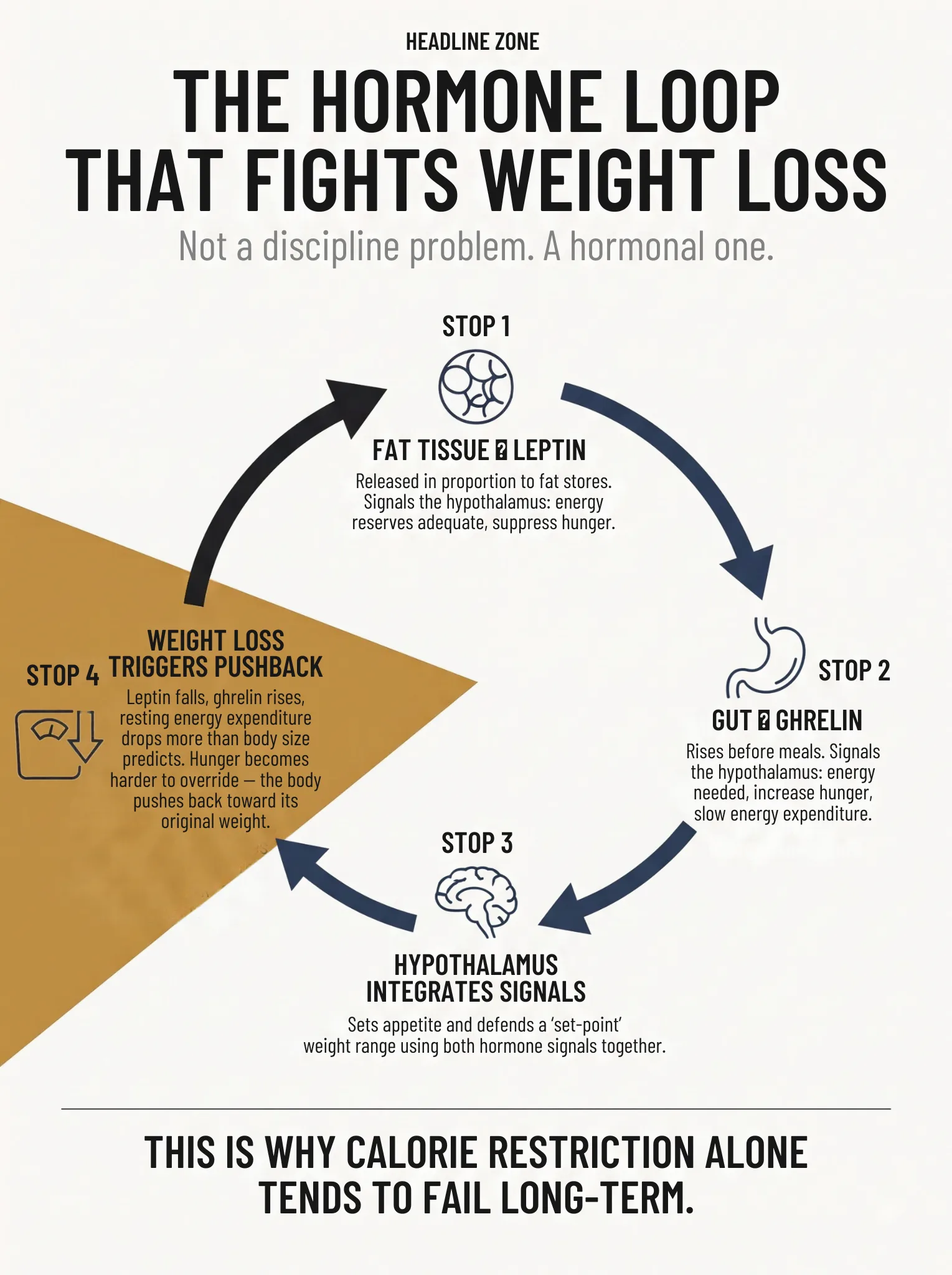
The leptin-ghrelin-hypothalamus loop: the biological feedback system that makes sustained weight loss harder than “eat less, move more” suggests.
We want to be precise here, because compassion without honesty doesn’t help patients either: biology explaining why weight loss is hard is not the same as saying food choices and activity don’t matter. They do — diet quality, meal timing, sleep, and resistance training (which builds insulin-sensitive muscle mass) all influence these same hormonal pathways. The point is that these levers work best inside a medical framework that accounts for the hormonal resistance, rather than pretending it doesn’t exist.
| From the clinicA patient in her forties once told us, “I know exactly what to eat — I’ve known for twenty years. I just can’t seem to hold on to it.” Her bloodwork showed significant insulin resistance and a fasting insulin level well above what her BMI alone would suggest. She wasn’t short on knowledge or discipline — her hormonal signalling was working against her at a level no amount of willpower addresses directly. Treating the insulin resistance, not just counselling her on food choices, was what finally moved the needle. |
Can obesity be treated medically?
Yes. Because obesity involves identifiable hormonal and metabolic mechanisms, it can be evaluated and treated medically — through structured nutrition and resistance training that improve insulin sensitivity, and, where appropriate and physician-supervised, medication. Treatment addresses the biology driving weight gain, not just the number on the scale.
A medical approach starts with assessment, not a diet sheet: fasting insulin, HbA1c, lipid profile including TG:HDL ratio, thyroid function, and a clinical history that looks for patterns like PCOS, sleep disruption, or medication-induced weight gain. This matters because obesity is rarely one thing — it is usually a cluster of drivers (insulin resistance, low muscle mass, disrupted hunger signalling, sleep debt) that responds better to a coordinated plan than to a single lever pulled harder.
The table below summarises the main levers used in a medically supervised approach and what each one does mechanistically.
| Treatment lever | What it targets | How it helps |
| Structured nutrition (protein-forward, lower glycaemic load) | Insulin secretion and glucose supply | Reduces the glucose/insulin surges that drive fat storage and hunger swings |
| Resistance training | Skeletal muscle — the body’s largest glucose sink | Increases glucose demand and improves insulin sensitivity independent of weight change |
| Sleep and stress management | Cortisol and hunger-hormone regulation | Poor sleep raises ghrelin and lowers leptin, directly increasing hunger |
| Physician-supervised medication (where indicated) | Appetite-regulating hormonal pathways (e.g. GLP-1 pathway) | Can help recalibrate hunger signalling in selected patients under medical supervision |
| Medication review | Drug-induced weight gain (certain steroids, some psychiatric or diabetes medications) | Identifies and, where safe, adjusts contributing medications — a physician decision only |
Table 1. Core levers in a medically supervised obesity treatment plan. Any medication change, including deprescription of existing drugs, is a physician decision only and must never be self-directed.
Any medication used to support weight loss — including GLP-1 receptor agonists — requires physician supervision, careful patient selection, and monitoring; these are not standalone fixes and are not appropriate for everyone. Similarly, if a patient is already on insulin, sulfonylureas, SGLT2 inhibitors, or blood pressure medication and begins losing weight through diet and training, medication doses often need to come down — but that adjustment must be made by the treating physician, never self-directed. This is exactly the assessment we run for every patient who comes in through our obesity and metabolic assessment.
| From the clinicOne of our patients had been told by three different sources that his weight was “all about portion control.” When we ran a full metabolic panel, his TG:HDL ratio and fasting insulin both pointed to significant insulin resistance driving his hunger and fat storage. Structured resistance training and a lower-glycaemic diet, combined with monitoring, brought measurable improvement over several months — not because he suddenly found willpower he didn’t have before, but because the treatment addressed the mechanism that was working against him. |
What does the disease classification actually change?
Recognising obesity as a disease changes how it is evaluated and treated — it shifts care from blame and generic advice toward structured metabolic assessment, and it supports insurance and clinical pathways for medical treatment. It does not remove personal agency from the picture; it adds medical tools alongside it.
There is a real debate worth naming honestly: some clinicians and commentators worry that calling obesity a disease removes incentive for behaviour change. In practice, the opposite tends to be true in our clinical experience — patients who understand that their hunger signalling and metabolism are working against them engage more consistently with treatment, not less, because they stop blaming themselves for a mechanism they were never going to out-discipline. Compassionate, mechanism-first framing is not the same as telling people nothing they do matters.
This is also where obesity connects to other conditions we treat — insulin resistance sits upstream of both obesity and type 2 diabetes, and untreated obesity is a major driver of hypertension through the same insulin resistance pathway. For a deeper look at the specific mechanisms — environment, muscle mass, hormones — that cause obesity day to day, see our companion article on what causes obesity.
Frequently Asked Questions
Is obesity a disease or a lifestyle problem?
Obesity is classified as a chronic disease by the American Medical Association, the World Health Organization, and the World Obesity Federation because it involves identifiable hormonal and metabolic dysregulation — not simply insufficient willpower. Lifestyle factors influence it, but they do not fully explain it, which is why medical evaluation matters alongside diet and exercise.
Is obesity genetic?
Yes. Twin and family studies estimate that 40–70% of the variation in body weight is heritable, largely through genes affecting appetite and energy-regulation pathways in the brain. Genetics sets susceptibility rather than certainty — environment, food quality, sleep, and muscle mass still shape outcomes significantly.
Is obesity really about willpower?
Not primarily. Hormones such as leptin and ghrelin regulate hunger and the body’s defended “set-point” weight largely outside conscious control, and these signals actively resist sustained weight loss. Willpower plays a role in daily choices, but it operates against a hormonal system, not in a vacuum.
Can obesity be treated medically?
Yes. A medical approach evaluates insulin resistance, hormonal drivers, and contributing medications, then combines structured nutrition, resistance training, and — where appropriate and physician-supervised — medication. This treats the underlying mechanism rather than relying on willpower or generic calorie advice alone.
Next step
| If weight has felt like a losing battle despite genuine effort, the next step is a full obesity and metabolic assessment — fasting insulin, HbA1c, lipid profile, and a clinical history that looks for the hormonal and metabolic drivers behind the number on the scale.
Book a Metabolic Assessment at Redial Clinic, Green Park, New Delhi. |
Medical Disclaimer
This article is for informational purposes only and does not constitute medical advice. Always consult a qualified healthcare professional before making changes to your diet, exercise, medication, or treatment plan. Any change to prescribed medication, including insulin, sulfonylureas, SGLT2 inhibitors, or blood pressure medication, must be directed by your treating physician.
This article is for educational purposes only and is not individual medical advice. Obesity thresholds described here are screening guides; diagnosis requires a clinical assessment. Weight-loss medicines, including GLP-1 medicines, are prescription-only and should be used only under physician supervision.
Never stop or change any prescribed medicine on your own, including medicines you suspect cause weight gain. If you take insulin, sulfonylureas, SGLT2 inhibitors or blood pressure medicine, consult your doctor before changing your diet, fasting or exercise, as doses may need adjusting. Seek individual advice if you are pregnant, under 18, or have kidney or liver disease or an eating disorder.
The patient example is de-identified and shared with consent; individual results vary. In a medical emergency, contact your local emergency services immediately.

 Facebook
 Instagram
 LinkedIn