



What is obesity, really — and why it matters more than the number on the scale
Obesity is a chronic metabolic disease characterised by excess body fat that impairs health — not just a weight number or a cosmetic concern. The diagnostic markers that matter most are body composition (how much of your weight is fat vs. muscle), fat distribution (especially visceral fat around the abdomen), and the metabolic consequences (insulin resistance, fatty liver, elevated BP, lipid changes). BMI alone, particularly in South Asian patients, routinely misreads who is and is not metabolically obese.
Three things follow from treating obesity as a metabolic disease rather than a weight problem:
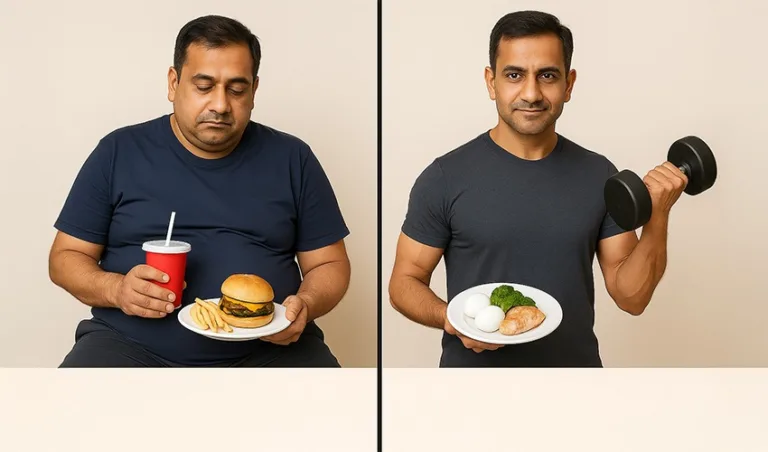
- It changes the assessment. Two patients at the same weight can have very different metabolic pictures — one with preserved muscle and modest visceral fat, another with low muscle mass and significant central adiposity. Those patients need different treatment plans, not the same calorie target.
- It changes the goal. Losing 10 kg of mostly muscle mass looks good on the scale and is bad for your health. Losing 5 kg of mostly visceral fat while preserving muscle looks modest on the scale and is transformative metabolically.
- It changes what success means. Sustainable body composition change, improvement in metabolic markers, and the ability to maintain new patterns over time is the real win. A three-week water-weight drop on a crash diet is not.
Why most weight loss attempts fail
Most weight loss attempts fail for three compounding reasons: the approach is too aggressive to sustain, it loses muscle along with fat (which slows metabolism and makes regain almost inevitable), and it ignores the biology of appetite regulation that makes caloric restriction progressively harder over time. Sustained weight loss requires addressing appetite, body composition, and the Indian food environment — not just calorie cutting.
The specific patterns we see repeatedly:
- Crash diets that drop 5–8 kg in a month — mostly water and muscle — followed by rapid regain as the body’s appetite and metabolic defences kick in hard
- Exercise-heavy, nutrition-light approaches — hours in the gym without addressing what’s actually being eaten — producing fitness without fat loss
- Elimination diets (keto, paleo, intermittent fasting taken to extremes) that work short-term but collapse when they collide with Indian social, family, and festival eating
- Supplements, teas, and ‘detox’ products promising metabolic boost — almost entirely placebo or marginal effect at best
- Low-protein dieting that loses muscle, drops metabolic rate, and sets up relapse
Indian diet plan for weight loss — what actually works with Indian food
A weight-loss diet for Indian patients does not require eliminating rice, roti, or dal. It requires correcting four things most Indian diets get wrong: not enough protein at any meal, too many refined carbohydrates in too large a portion, an inflammatory cooking oil in daily use, and meals spread across the whole day in a pattern that keeps insulin elevated from morning to night.
Breakfast is where most Indian weight-loss attempts collapse. Poha, upma, idli, toast — these are carbohydrate-dominant and contain almost no protein. By 10:30 AM the patient is hungry, blood sugar has spiked and dropped, and snacking begins. Three eggs and a small amount of paneer at breakfast — still fully Indian, cooked in ghee — change the metabolic trajectory of the entire day. Hunger stabilises. The 10:30 snack reflex disappears. Blood sugar stays flat through the morning.
The cooking oil issue nobody addresses. Sunflower oil — used in most Indian kitchens because it is cheap and considered “heart-healthy” — is high in omega-6 fatty acids that drive systemic inflammation at the quantities used in Indian cooking. This inflammation worsens insulin resistance and makes fat loss harder. Switching to ghee as the primary cooking fat is not a cultural indulgence; it is a metabolic intervention. The Indian kitchen already had the right answer before refined vegetable oils arrived.
Dal is not a protein source — it is a protein contribution. One katori dal at lunch gives roughly 8–9 grams of protein. A meal needs 25–30 grams to satisfy hunger and support muscle. The gap has to come from eggs, paneer, curd, chicken, or fish — eaten at the same meal, not instead of dal.
Three structured meals, no snacking. Every time you eat — even fruit, even a handful of nuts — insulin rises. Fat burning requires insulin to fall between meals. The Indian habit of small amounts throughout the day, which feels virtuous, keeps insulin elevated and actively resists fat loss. Three meals with a real protein and fat content satisfy hunger for 4–5 hours and allow insulin to fall between them.
Chai with sugar is the most common hidden saboteur. Three cups a day with two teaspoons of sugar each is 25 grams of sugar daily — added before you eat a single meal. Reducing or eliminating chai sugar is consistently one of the biggest single dietary changes for Indian weight loss patients.
What medical weight loss means — and when it applies
Medical weight loss is obesity treatment delivered under physician supervision, with proper metabolic workup, prescription medications where clinically appropriate, and ongoing medical oversight of progress and side effects. It is different from commercial weight-loss programs (calorie counting apps, generic meal plans) and different from surgical bariatric care. Medical weight loss sits in the space where lifestyle work needs clinical support to succeed.
Medical weight loss is most appropriate when:
- BMI is ≥27 (per ICMR Indian thresholds) with one or more metabolic complications — type 2 diabetes or prediabetes, hypertension, fatty liver, PCOS, dyslipidaemia
- BMI is ≥30 regardless of complications — clinically obese by Indian criteria, with substantial metabolic and cardiovascular risk
- Previous structured lifestyle attempts have not produced sustained progress, and the patient and clinician agree that additional clinical support is warranted
- Appetite, hunger regulation, or food-reward biology is clinically dominant — the patient is not failing from laziness or lack of discipline; they are fighting biology that medication can help rebalance
GLP-1 medications in the Indian context — Ozempic, Wegovy, Mounjaro, and the honest conversation
GLP-1 receptor agonist medications — including semaglutide (Ozempic, Wegovy), tirzepatide (Mounjaro, Zepbound), and liraglutide (Saxenda, Victoza) — represent the most significant pharmacological advance in obesity treatment in decades. In clinical trials, tirzepatide produced average weight loss of 15–22% over 72 weeks, and semaglutide produced average weight loss of 15–17%. For suitable Indian patients where lifestyle treatment alone is not enough, these medications are a legitimate medical option — and they should only be used under proper medical supervision, with baseline workup, appropriate dosing, and monitoring for side effects. They are not a shortcut and they are not magic.
What these medications actually do
GLP-1 receptor agonists mimic a naturally occurring gut hormone that regulates appetite and blood sugar. They reduce hunger, slow gastric emptying, and improve insulin sensitivity. The result, for many patients, is a significantly reduced appetite that makes sustainable caloric reduction feel achievable for the first time. They work through appetite regulation, not through magical fat-burning — patients who don’t also change their eating patterns may lose some weight, but far less than those who combine medication with structured nutrition and movement work.
Availability and access in India
Mounjaro (tirzepatide) is approved and marketed in India by Eli Lilly. Wegovy (semaglutide for weight loss) has a more limited distribution footprint. Ozempic (semaglutide for diabetes) is available through specific channels but is technically indicated for diabetes, not weight loss alone. We help patients understand what is actually available, what is legitimate through supervised medical use, and what is being sourced through grey-market channels that we do not recommend.
Who is a reasonable candidate
GLP-1 medications are reasonable to consider for patients with BMI ≥27 (ICMR threshold) with metabolic complications, or BMI ≥30 regardless of complications, who have not succeeded with structured lifestyle treatment alone. They are not appropriate as a first-line option for mildly overweight patients, for patients without medical supervision, or for patients who are unwilling to also address nutrition, movement, and behavioural patterns alongside medication.
Side effects and honest trade-offs
Common side effects include nausea, mild to moderate gastrointestinal discomfort, and occasional constipation — most of which subside over weeks as the dose is titrated. Rare but more serious side effects include gallbladder issues, pancreatitis, and (for tirzepatide in particular) a need to monitor for specific concerns. Muscle loss is a real concern with rapid weight loss on these medications — which is why structured strength training alongside medication is not optional. Weight regain after discontinuation is also documented — which is why these medications are best understood as long-term metabolic tools, not short-term courses.
Our position — non-ideological
We do not push GLP-1 medications on patients who do not need them, and we do not refuse to discuss them honestly with patients for whom they could genuinely help. When they are clinically appropriate and the patient is prepared to use them properly, they are part of modern obesity treatment. When they are not appropriate, the answer is honest lifestyle work and structured supervision — not pressure toward a prescription.
What we actually assess — beyond the scale
A proper obesity assessment goes far beyond weight and BMI. We evaluate body composition (fat vs. muscle, visceral fat distribution), metabolic markers (insulin resistance, fasting insulin, HOMA-IR, fatty liver markers, lipid subfractions), current dietary patterns with honest quantification, sleep and stress drivers, medication review for drugs that may be promoting weight gain, and — where clinically relevant — hormonal workup (thyroid, cortisol, sex hormones) and screening for obstructive sleep apnoea.
How the program works — four clinically validated levers
The program works through four parallel levers: nutrition correction built around Indian food, progressive strength and movement to preserve and build muscle, appetite and behavioural support that addresses eating patterns rather than willpower, and — where appropriate — medical options including GLP-1 medications under supervision. These work together because obesity has multiple drivers; no single lever is sufficient for most patients with meaningful obesity.
Nutrition — Indian food, not imported diets
Ghee replaces seed oils. A real protein source at every meal — eggs, paneer, curd, fish — not dal alone. Carbohydrate portions controlled, not eliminated. Three structured meals with no snacking between them. Chai sugar and packaged snacks identified and removed. Built entirely around Indian food: nothing imported, nothing your kitchen does not already have.
Strength and movement — muscle preservation is non-negotiable
Rapid weight loss without strength work loses muscle, slows metabolism, and sets up regain. Structured strength training, calibrated to your current fitness level and any complications, is a core part of the program — not an optional add-on. For patients who cannot do resistance training initially, progressive walking plus bodyweight work gets the muscle-preservation conversation started.
Appetite and behaviour
We work on the actual eating patterns that drive overconsumption — evening snacking, stress eating, sleep-driven cravings, restaurant and travel patterns, social eating — not generic willpower advice. For patients where appetite regulation is genuinely broken, medical support can help rebalance the biology that makes willpower alone insufficient.
Medical options where appropriate
Some patients respond well to structured lifestyle treatment alone. Others benefit from additional medical support, including GLP-1 receptor agonist medications. We discuss medication options openly and honestly when they are clinically appropriate — we are not ideological about them. Where indicated, prescription and supervision are part of doctor-led care, not a replacement for the foundation work.
Can obesity be reversed?
Yes, for many patients, meaningful and sustainable body composition change is achievable — including substantial reduction in visceral fat, measurable metabolic improvement, and durable weight loss. “Reversal” here does not mean permanent freedom from metabolic risk (the underlying susceptibility remains), but it does mean genuine long-term change in body composition, metabolic markers, and medication burden. Sustained remission of obesity is possible; it requires continued attention to the conditions that caused the problem.
What it takes, realistically:
- A long-enough timeline — meaningful obesity reversal typically takes 6–18 months of consistent work, not 30-day challenges
- A plan that survives contact with real life — festivals, travel, family meals, work stress
- Muscle preservation alongside fat loss, so that the body you build is metabolically better, not just smaller
- Clinical support that persists through the inevitable plateau phases, because motivation alone does not
What progress looks like
With consistent treatment, early improvements in energy, hunger patterns, and confidence around food typically appear within 2–6 weeks. Measurable fat loss, waist-circumference reduction, and improved fitness usually emerge by month 2–4. Significant body-composition change, metabolic marker improvement, and durable behavioural shift typically build through months 3–6. Sustained weight maintenance and long-term risk reduction establish over 12–18 months and beyond.
Typical progression in committed patients:
- Weeks 2–6: Less hunger, fewer cravings, improved eating confidence, early energy improvement
- Months 2–4: Measurable fat loss, waist-circumference reduction, improved fitness and strength, early metabolic marker improvement
- Months 3–6: Significant body-composition change in suitable patients, measurable drop in visceral fat, more durable eating and movement patterns
- Months 6–18: Substantial and durable weight loss, significant metabolic improvement, established lifestyle architecture
- Beyond 18 months: Maintenance phase — consolidation, long-term risk reduction, periodic review to prevent relapse
Obesity in the Indian patient — why South Asian biology matters
Indian adults face a distinct obesity picture: the South Asian metabolic phenotype stores fat viscerally at lower total weights, produces insulin resistance earlier, and drives metabolic disease at BMI thresholds well below WHO global cutoffs. ICMR guidelines classify BMI ≥23 kg/m² as overweight and ≥25 kg/m² as obese in Indian adults — substantially below the WHO thresholds of 25 and 30. Treating an Indian patient with BMI 26 as “only slightly overweight” by Western standards regularly misses clinically significant metabolic risk.
- BMI thresholds: overweight ≥23 kg/m², obesity ≥25 kg/m² per ICMR Indian guidelines (vs WHO 25 and 30)
- Waist circumference matters more than total weight — ≥90 cm for men and ≥80 cm for women flag elevated metabolic risk in Indian adults
- Visceral fat dominates — South Asian adults can have high visceral fat at BMIs that would suggest low metabolic risk in European populations
- Nutrition corrections must fit Indian food, not replace it — plans built around oats, broccoli, and salmon fail in Indian kitchens, at Indian restaurants, and at Indian family gatherings
Who this program is for — and who it is not for
This program is designed for
- Adults with obesity or overweight with metabolic complications (diabetes, prediabetes, hypertension, fatty liver, PCOS, dyslipidaemia)
- Adults with BMI ≥23 (per ICMR) who have high waist circumference, significant visceral fat, or strong metabolic-risk family history
- Patients who have tried multiple weight-loss approaches without sustained success
- Patients interested in structured medical supervision, including honest evaluation of GLP-1 medications where appropriate
- Patients seeking an Indian-food-centric nutrition plan rather than imported diet templates
This program is not designed for
- Patients seeking rapid crash weight loss — our approach targets durable metabolic change, not 30-day results
- Patients seeking unsupervised GLP-1 access — we will not prescribe without proper workup and monitoring
- Patients whose BMI is in the severe-obesity range with major surgical considerations — bariatric surgery may be more appropriate; we can coordinate referral
- Patients not prepared to engage with nutrition, movement, or behavioural change — medication-only approaches deliver much weaker results and are not what we offer