




Written By: Dr. Gagandeep Singh, MBBS
Medically Reviewed By: Dr. Gagandeep Singh, MBBS
Last Updated: 29 September 2026 · Redial Clinic, Green Park, New Delhi.
Metformin quiets the liver’s glucose output — but reversal asks a different question than control does.
Metformin can lower your sugar number, but it does not repair the insulin resistance underneath — that gap is the whole difference between control and reversal. This article explains exactly what metformin does inside the body, what it leaves untouched, and what the evidence says about combining it with the changes that do address the root cause.
| Key Takeaways Metformin does not reverse diabetes on its own. It mainly reduces glucose output from the liver and modestly improves insulin sensitivity — it does not remove the visceral or liver fat that drives insulin resistance in the first place. Control and reversal are different outcomes. Control means your HbA1c and blood sugar numbers look better on medication. Reversal (remission) means the underlying insulin resistance has improved enough that normal blood sugar is sustained with little or no medication. Lifestyle change beat metformin in the U.S. trial, but not in the Indian one.In the Diabetes Prevention Program, intensive lifestyle change cut diabetes incidence by 58% versus placebo, compared with 31% for metformin, and both benefits persisted over 15 years of follow-up. In India’s IDPP-1 trial, the two worked about equally well. Stopping metformin is a physician decision only. Never stop or reduce metformin on your own, even if your sugars look good — this needs supervised reassessment and monitoring. Reversal is not guaranteed and not permanent by default. It occurs in selected patients under sustained lifestyle change and can relapse if the underlying drivers — visceral fat, inactivity, poor sleep — return. |
Can Metformin Reverse Diabetes?
No — not by itself. Metformin can lower blood sugar and HbA1c effectively, but it works mainly by reducing how much glucose your liver releases, not by reducing the visceral and liver fat that cause insulin resistance in the first place.
Diabetes remission has been achieved in trials, but through substantial weight loss ideally, 90 cm/80 cm waist cut off as recommended by WHO guidelines, and lifestyle change, with metformin as a supporting tool at most — not the mechanism of reversal itself.
This is the single most important distinction in this entire topic, and it is worth stating plainly: metformin is a highly effective glucose-lowering drug. It is not, by its own mechanism, a diabetes-reversing drug. Those are two different jobs, and conflating them is why so many patients feel confused when their HbA1c improves on metformin but their doctor still calls the diabetes “controlled” rather than “in remission.”
The internationally accepted definition of diabetes remission — from the 2021 consensus statement backed by the ADA, EASD, and other major bodies — requires an HbA1c below 6.5% sustained for at least three months with no glucose-lowering medication at all [4]. By that definition, being on metformin with a good HbA1c is, by design, not remission. It is well-controlled diabetes. The two can look identical on a lab report and be fundamentally different underneath.
| From the clinicA 44-year-old software engineer came to Redial Clinic on metformin 1000 mg twice daily, HbA1c steady at 6.4% for two years. He’d been told his diabetes was “under control” and stopped thinking about it further. On ultrasound, he had moderate fatty liver and a waist circumference well above the South Asian risk threshold.
His numbers looked fine. His insulin resistance had not moved an inch in two years — the medication was doing exactly what it’s designed to do, masking the problem underneath rather than solving it. * Individual results may vary. |
How Does Metformin Actually Work?
Metformin’s primary action is suppressing hepatic (liver) glucose production, mainly by reducing gluconeogenesis — the liver’s manufacture of new glucose. Metformin interrupts this by inhibiting mitochondrial respiration in liver cells, which activates AMPK (AMP-activated protein kinase), lowers cyclic AMP signalling, and switches off the genes that drive glucose manufacture.
Mechanistically, metformin’s largest and most reliable effect is on the liver. In someone with insulin resistance, the liver keeps producing glucose even when blood sugar is already high — it has essentially stopped listening to insulin’s “stop” signal.
The clinically dominant effect is less glucose pouring out of the liver between meals and overnight — which is why metformin is particularly good at improving fasting blood sugar. It also produces a modest improvement in peripheral insulin sensitivity, and some people lose a little weight on it. What it does not do is directly target the visceral or liver fat that is the upstream driver of insulin resistance in most people with type 2 diabetes.
A smaller, secondary effect improves how muscle tissue takes up glucose, via increased translocation of GLUT4 glucose transporters — genuinely useful, but modest compared to what resistance training does to the same pathway. DeFronzo and Tripathy’s review argues that insulin resistance in skeletal muscle, the main site of insulin-stimulated glucose disposal, is the primary defect in type 2 diabetes [7]. A drug that acts mainly on the liver therefore leaves a large part of the problem untouched.
What metformin does not directly touch is the fat itself — the visceral fat around the organs and the fat infiltrating the liver and pancreas that Taylor’s twin-cycle hypothesis identifies as the actual engine of type 2 diabetes. Taylor’s model, now well supported, describes how excess fat in the liver drives fasting glucose up, and fat accumulating in the pancreas impairs the beta cells that produce insulin — two linked “cycles” that together produce the disease [3]. Metformin can quiet the liver’s output. It does not empty the liver’s fat.
| Mechanism | Metformin’s effect | What repairs it directly |
| Liver glucose output | Reduced — metformin’s strongest, most reliable action | Also reduced by calorie deficit / weight loss |
| Muscle insulin sensitivity | Modest improvement via GLUT4 | Resistance training — larger, more durable effect |
| Visceral fat mass | Not directly reduced | Sustained calorie deficit |
| Liver fat / hepatic steatosis | Not directly reduced | Substantial weight loss (in DiRECT, remission rose steeply with 10–15 kg or more lost) |
| Beta-cell function | Not restored | May partially recover once pancreatic fat clears |
Table 1: What metformin’s core mechanism actually reaches — and what it leaves for diet and muscle to do.
Does Metformin Treat the Cause of Diabetes?
It helps to think of insulin resistance as a bathtub with the tap running (glucose supply from food and the liver) and a small drain (glucose demand from muscle). Metformin partially turns down the tap by quieting hepatic glucose output. It does very little to widen the drain — building the muscle mass that soaks up glucose from the bloodstream requires resistance training, since skeletal muscle is the body’s largest peripheral glucose sink. Diet reduces glucose supply; muscle increases glucose demand.
Metformin nudges the supply side only, and only partially. Metformin’s actions — reducing liver glucose output and mildly improving insulin sensitivity treat downstream consequences of that fat burden, not the fat burden itself. Removing it requires a sustained calorie deficit and, ideally, resistance training to build the muscle that absorbs glucose.
This is why a patient can be fully adherent to metformin, have an excellent HbA1c, and still have worsening visceral fat, a fatty liver, and rising insulin levels underneath — because nothing in the drug’s mechanism reaches those tissues. Read more: What Causes Insulin Resistance?
Metformin vs. Lifestyle Change: What the Trials Show
In a large U.S. study of people with prediabetes, modest weight loss and regular brisk walking prevented diabetes better than Metformin. Both approaches kept some benefit for years afterwards, though the gap between them narrowed over time.
The Diabetes Prevention Program (DPP) randomised 3,234 adults with prediabetes to placebo, metformin, or intensive lifestyle change (a 7% weight-loss target plus 150 minutes of activity a week). Over an average of 2.8 years, diabetes developed at a rate of 11.0 cases per 100 person-years on placebo, 7.8 on metformin and 4.8 with lifestyle change [5]. At 15 years of follow-up, both groups still had fewer cases than placebo, 27% fewer with lifestyle and 18% fewer with metformin, though the difference between them narrowed over time [10].
This pattern is echoed in remission-specific data. The DiRECT trial in the UK put people with type 2 diabetes on a structured low-calorie total diet replacement programme (not metformin) and achieved diabetes remission in 46% of participants at 12 months, rising with the amount of weight lost — nearly 9 in 10 people who lost 15 kg or more achieved remission [1].
At two years, 36% of DiRECT participants were still in remission, and those who kept the weight off were the ones who stayed in remission [2]. That reinforces the point: reversal tracks fat loss, not medication dose.
India’s own IDPP-1 trial adds an important nuance. In Asian Indian adults with impaired glucose tolerance, who were younger, leaner and more insulin-resistant than Western trial participants, lifestyle change and metformin each reduced progression to diabetes by roughly a quarter (28.5% and 26.4%), and combining them added no further benefit [6]. For Indian readers, that means metformin is a genuinely useful preventive tool. The stronger case for lifestyle change lies in remission, where DiRECT shows what fat loss can achieve.
None of this makes metformin unnecessary. For many patients, especially soon after diagnosis, it is an appropriate, evidence-based first step, and IDPP-1 shows it can match lifestyle advice for prevention in Indian adults. Where the evidence clearly favours lifestyle change is remission: reducing the fat that drives insulin resistance can bring blood sugar back to normal without medication, which metformin alone has not been shown to do.
| Trial | Intervention | Key outcome |
| DPP (2002) | Metformin vs. intensive lifestyle vs. placebo | Lifestyle cut diabetes incidence 58% vs. 31% for metformin |
| DiRECT (2018) | Low-calorie diet replacement, no metformin required | 46% remission at 12 months; up to ~86% with ≥15 kg loss |
| DiRECT 2-yr (2019) | Same cohort, extended follow-up | 36% still in remission at 24 months; remission tracked with sustained weight loss |
| IDPP-1 (2006) | Lifestyle modification, metformin, or both, in Asian Indian adults with impaired glucose tolerance | Lifestyle and metformin each cut progression by about a quarter (28.5% vs. 26.4%); no added benefit from combining |
Table 2: What the major trials show. For prevention, metformin helps, and lifestyle change helps as much or more. For remission, the evidence points to fat loss.
| From the clinicA 51-year-old homemaker from South Delhi came to us two years post-diagnosis, on metformin 2000 mg/day, HbA1c 7.1%. Her fasting insulin was elevated and her waist-hip ratio flagged significant visceral adiposity. Over five months of a structured calorie deficit and twice-weekly resistance training, alongside her existing metformin, her HbA1c came down to 5.8% and her physician began a supervised, gradual dose reduction.
She has not reached medication-free remission, but her trajectory — visceral fat down, insulin sensitivity measurably better — is the pattern DiRECT describes, not something metformin alone produced. * Individual results may vary. |
Can You Stop Metformin After Reversing Diabetes?
Sometimes, yes — but only under direct physician supervision, never on your own.
| MEDICATION SAFETY — READ BEFORE MAKING ANY CHANGE Deprescribing metformin, or any diabetes or blood pressure medication, is a physician decision only. This is true even if your blood sugar numbers look excellent. Never stop, skip, or reduce metformin on your own based on how you feel or a single good reading. Diabetes remission is confirmed by sustained lab evidence over months, not a good week or a low fasting sugar reading at home. If you are on additional medications — insulin, sulfonylureas, SGLT2 inhibitors, or blood pressure medication — the risks of unsupervised changes are higher still, including hypoglycaemia and rebound hyperglycaemia. Any deprescribing plan should include a monitoring schedule (HbA1c, fasting glucose, and clinical review) agreed with your treating doctor. |
If sustained lifestyle change has genuinely reduced insulin resistance (reflected in stable normal blood sugar, improved fasting insulin, and reduced visceral fat), a doctor may consider a gradual, monitored dose reduction. Stopping abruptly, or without medical guidance, risks unrecognised blood sugar deterioration. ICMR guidelines for diabetes management provide an evidence first, tailored framework for diagnosis and treatment of diabetes.
The 2021 remission consensus statement is explicit that remission is confirmed retrospectively, after medication has already been stopped and sugar has stayed normal for at least three months [4] — which is the opposite order of what patients often assume. You do not stop the medicine because you feel reversed; a doctor confirms reversal partly by observing that blood sugar stays normal after medication is carefully withdrawn under supervision. This sequence exists specifically to prevent the false confidence of stopping too early.
Read more: Is Diabetes Reversal Permanent? The Truth About Long-Term Control
Is Metformin Alone Enough to Control Diabetes?
For some patients early in the disease, metformin alone can achieve reasonable glycaemic control for a period. But because it does not address visceral fat, liver fat, or muscle glucose demand, its effect often plateaus or requires escalating doses or additional drugs over time as insulin resistance continues to progress in the background, unless diet and activity also change.
This shows up in long-term trial data. In the ADOPT trial, 21% of people with recently diagnosed type 2 diabetes who started on metformin alone had lost adequate glucose control within five years [9].
Ferrannini’s foundational work linking insulin resistance to metabolic and cardiovascular risk underscores why this matters beyond blood sugar alone: unaddressed insulin resistance also drives blood pressure and lipid abnormalities, not just glucose [8].
This is why Redial Clinic’s approach treats metformin as one tool alongside — not instead of — the two levers that reach the root cause: reducing glucose supply through a structured, realistic Indian diet, and increasing glucose demand through resistance training that builds skeletal muscle, the body’s largest glucose sink. Medication buys time and safety; the lifestyle changes are what move the underlying biology.
Read more: How to Reverse Insulin Resistance Naturally
What Actually Reverses Diabetes, If Metformin Alone Doesn’t?
Diabetes remission has been demonstrated most consistently through substantial, sustained weight loss (typically 10–15%+ of body weight) that reduces liver and pancreatic fat, combined with resistance training to build muscle glucose demand. Metformin can support this process but is not, by itself, the reversal mechanism seen in trials like DiRECT.
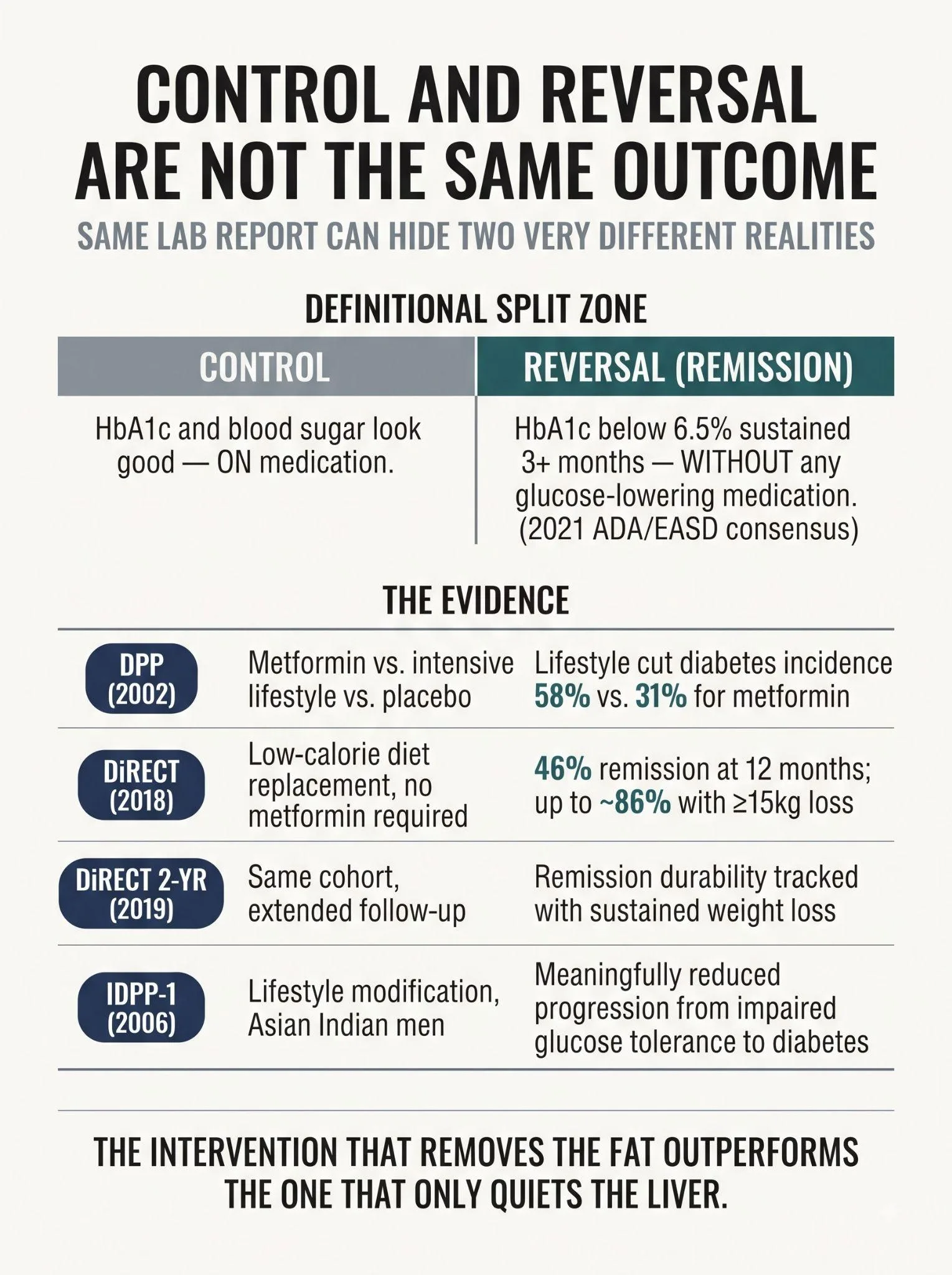
Figure 1: Control keeps the dashboard numbers steady. Reversal changes what’s happening in the liver, pancreas, and muscle underneath.
The mechanism behind reversal follows directly from Taylor’s twin-cycle model: pull enough fat out of the liver and pancreas, and fasting glucose control and, in many people, beta-cell function measurably improve [3]. DiRECT operationalised this with a structured low-calorie diet and achieved remission in nearly half of participants at one year, with rates climbing sharply among those who lost the most weight [1].
Resistance training adds the second lever — skeletal muscle is the single largest site of glucose disposal in the body, so building and using it increases how much glucose gets cleared from the blood independent of the liver.
None of this happens instantly, and none of it is guaranteed in every patient — reversal has been demonstrated in selected patients under sustained, supervised conditions, particularly earlier in the disease course before extensive beta-cell loss.
For someone years into type 2 diabetes with significant beta-cell decline, the realistic goal may be substantially better control and reduced medication rather than full medication-free remission — and that is still a meaningful, evidence-backed outcome worth pursuing under medical guidance.
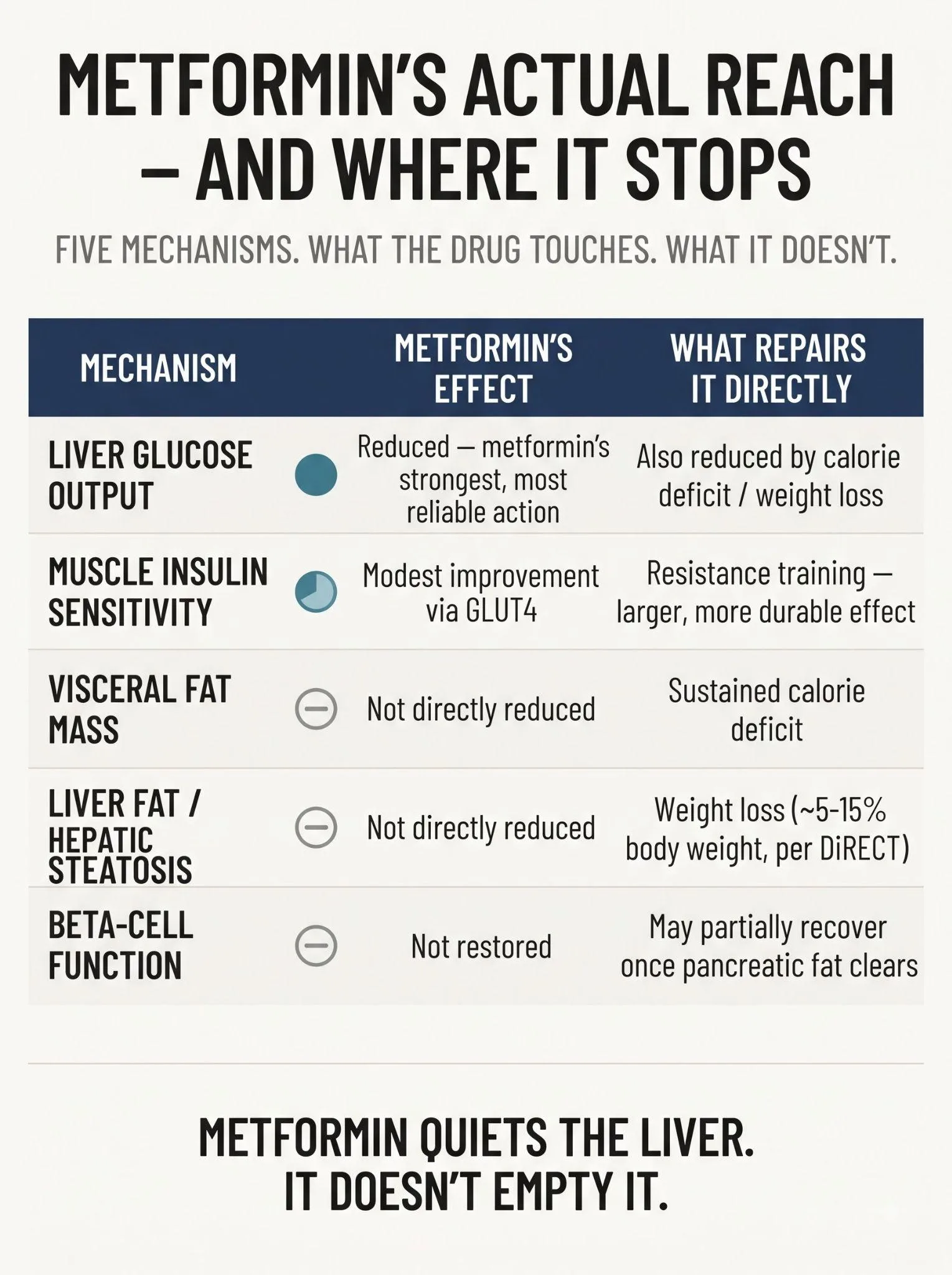
Figure 2: A plain-language summary of metformin’s actual reach, mapped against what root-cause repair requires.
Read more: Best Indian Diet for Diabetes Reversal
Read more: Exercise Plan for Diabetes Reversal
Next Step
| Want to know if reversal is realistic for you — not just better control? We review your current prescriptions, insulin resistance markers, and build a supervised plan for what’s medically appropriate — including whether and how deprescribing could ever fit your case.
Book a Metabolic Assessment at Redial Clinic, Green Park, New Delhi. |
Frequently Asked Questions
Can metformin reverse diabetes?
Not by itself. Metformin mainly reduces the liver’s glucose output and modestly improves insulin sensitivity, but it does not remove the visceral or liver fat that drives insulin resistance. Diabetes remission, as defined by the 2021 consensus statement, means normal blood sugar sustained without any glucose-lowering medication — an outcome achieved in trials through substantial, sustained weight loss, not through metformin’s own mechanism.
Does metformin treat the cause of diabetes?
Metformin treats a downstream consequence of insulin resistance — excess liver glucose output — rather than its root cause, which is typically excess fat in the liver, pancreas, and around the abdominal organs. Reducing that fat requires a sustained calorie deficit and resistance training; metformin does not directly reduce visceral or liver fat.
Can you stop metformin after reversing diabetes?
Only under direct physician supervision, and only after sustained lab evidence — not a single good reading — confirms your blood sugar stays normal. Deprescribing is always a doctor’s decision, made with a monitoring plan in place. Never stop or reduce metformin on your own.
Is metformin alone enough to control diabetes?
For some patients early in the disease, metformin alone can provide reasonable control for a period. But because it does not address the underlying insulin resistance, its effect often plateaus over time unless combined with dietary change and resistance training that reach the root cause.
Can I eventually get off my Metformin?
Whether you can come off Metformin is your doctor’s decision, made case by case. If your metabolic markers improve, a gradual taper is sometimes possible, especially when the root cause is being treated under medical supervision, as at a diabetes reversal clinic like Redial Clinic. Never stop Metformin without consulting your doctor first.
Medical Disclaimer
This article is for educational purposes only and does not constitute individual medical advice. Metformin and all other prescription medications should only be started, adjusted, or stopped under the guidance of a qualified physician. Diabetes remission has been demonstrated in selected patients under supervised clinical conditions and is not achieved or guaranteed for everyone.
If you have type 2 diabetes and are considering changes to your diet, exercise routine, or medication, consult your treating doctor before making changes. In a medical emergency, contact your local emergency services immediately.
References
- Lean MEJ, et al. “Primary care-led weight management for remission of type 2 diabetes (DiRECT): an open-label, cluster-randomised trial.” Lancet, 2018. https://doi.org/10.1016/S0140-6736(17)33102-1
- Lean MEJ, et al. “Durability of a primary care-led weight-management intervention for remission of type 2 diabetes: 2-year results of the DiRECT open-label, cluster-randomised trial.” Lancet Diabetes & Endocrinology, 2019. https://doi.org/10.1016/S2213-8587(19)30068-3
- Taylor R. “Type 2 diabetes: etiology and reversibility.” Diabetes Care, 2013. https://doi.org/10.2337/dc12-1805
- Riddle MC, et al. “Consensus Report: Definition and Interpretation of Remission in Type 2 Diabetes.” Diabetes Care, 2021. https://doi.org/10.2337/dci21-0034
- Knowler WC, et al. “Reduction in the incidence of type 2 diabetes with lifestyle intervention or metformin.” New England Journal of Medicine, 2002. https://doi.org/10.1056/NEJMoa012512
- Ramachandran A, et al. “The Indian Diabetes Prevention Programme shows that lifestyle modification and metformin prevent type 2 diabetes in Asian Indian subjects with impaired glucose tolerance (IDPP-1).” Diabetologia, 2006. https://doi.org/10.1007/s00125-005-0097-z
- DeFronzo RA, Tripathy D. “Skeletal muscle insulin resistance is the primary defect in type 2 diabetes.” Diabetes Care, 2009. https://doi.org/10.2337/dc09-S302
- Ferrannini E, et al. “Insulin resistance in essential hypertension.” New England Journal of Medicine, 1987. https://doi.org/10.1056/NEJM198708063170605
- Kahn SE, et al. “Glycemic durability of rosiglitazone, metformin, or glyburide monotherapy.” New England Journal of Medicine, 2006. https://doi.org/10.1056/NEJMoa066224
- Diabetes Prevention Program Research Group. “Long-term effects of lifestyle intervention or metformin on diabetes development and microvascular complications over 15-year follow-up: the Diabetes Prevention Program Outcomes Study.” Lancet Diabetes & Endocrinology, 2015. https://doi.org/10.1016/S2213-8587(15)00291-0

 Facebook
 Instagram
 LinkedIn