




Written by: Dr. Gagandeep Singh, MBBS
Medically reviewed by: Dr. Gagandeep Singh, MBBS
Last updated: 16 Oct 2026 · Redial Clinic, Green Park, New Delhi
Key Takeaways
- PCOD (Polycystic Ovarian Disease) and PCOS (Polycystic Ovary Syndrome) are related but not medically identical — PCOD is a broader, India-common clinical label; PCOS is the internationally standardised diagnosis.
- PCOS is diagnosed using the Rotterdam criteria (2 of 3: irregular ovulation, excess androgens, polycystic ovaries on scan) and is more strongly linked to insulin resistance.
- PCOD is generally described as milder, more responsive to diet and lifestyle change, and less consistently defined across clinics.
- In real-world Indian practice, the two terms are frequently used interchangeably — this is a genuine terminology inconsistency in the literature, not just patient confusion.
- The metabolic risk (insulin resistance, future diabetes/heart risk) tracks more closely with a PCOS-pattern presentation, which is why it deserves closer follow-up regardless of which label is used.
- Whichever term is on your report, what matters clinically is the underlying pattern — ovulation, androgens, and insulin resistance — not the label itself.
If your ultrasound report says “polycystic ovaries” and one doctor called it PCOD while another called it PCOS, you are not imagining the inconsistency. Both terms get used for overlapping — but not identical — pictures of ovarian and hormonal health, and which one lands on your report often depends on the clinician, the lab, and the region as much as on your actual findings.
At Redial Clinic in Green Park, New Delhi, we see this confusion daily — patients arrive with a PCOD diagnosis from one clinic and a PCOS label from another, sometimes for the same set of symptoms. This guide separates what the terms are meant to mean, why India uses PCOD so much more loosely than the international literature uses PCOS, and — more importantly — why the label matters far less than the underlying metabolic pattern driving it.
What is the difference between pcod and pcos?
PCOD (Polycystic Ovarian Disease) is a broader, less standardised term — mostly used in Indian clinical practice — for ovaries releasing immature or partially mature eggs, generally considered milder and more responsive to diet and lifestyle change. PCOS (Polycystic Ovary Syndrome) is the internationally recognised endocrine disorder, diagnosed using the Rotterdam criteria, and is more consistently linked to insulin resistance and metabolic risk.
The distinction sounds tidy in a textbook, but it gets blurry fast in real practice. PCOD does not have a single internationally agreed diagnostic threshold the way PCOS does. It is typically used when a scan shows multiple small follicles and periods are somewhat irregular, without necessarily meeting the fuller Rotterdam picture. PCOS, by contrast, requires at least two of three specific features (see the criteria table below) and comes with a much larger body of research linking it to insulin resistance, higher androgen levels, and long-term cardiometabolic risk.
A 2004 clinical commentary bluntly called “PCOD” a misnomer, arguing the name itself creates confusion because it implies a simple ovarian disease rather than the broader hormonal and metabolic picture involved [1]. Two decades later, that confusion is still exactly what plays out in Indian clinics — one doctor’s “mild PCOD” can look identical to another doctor’s “early PCOS.”
Side-by-side comparison
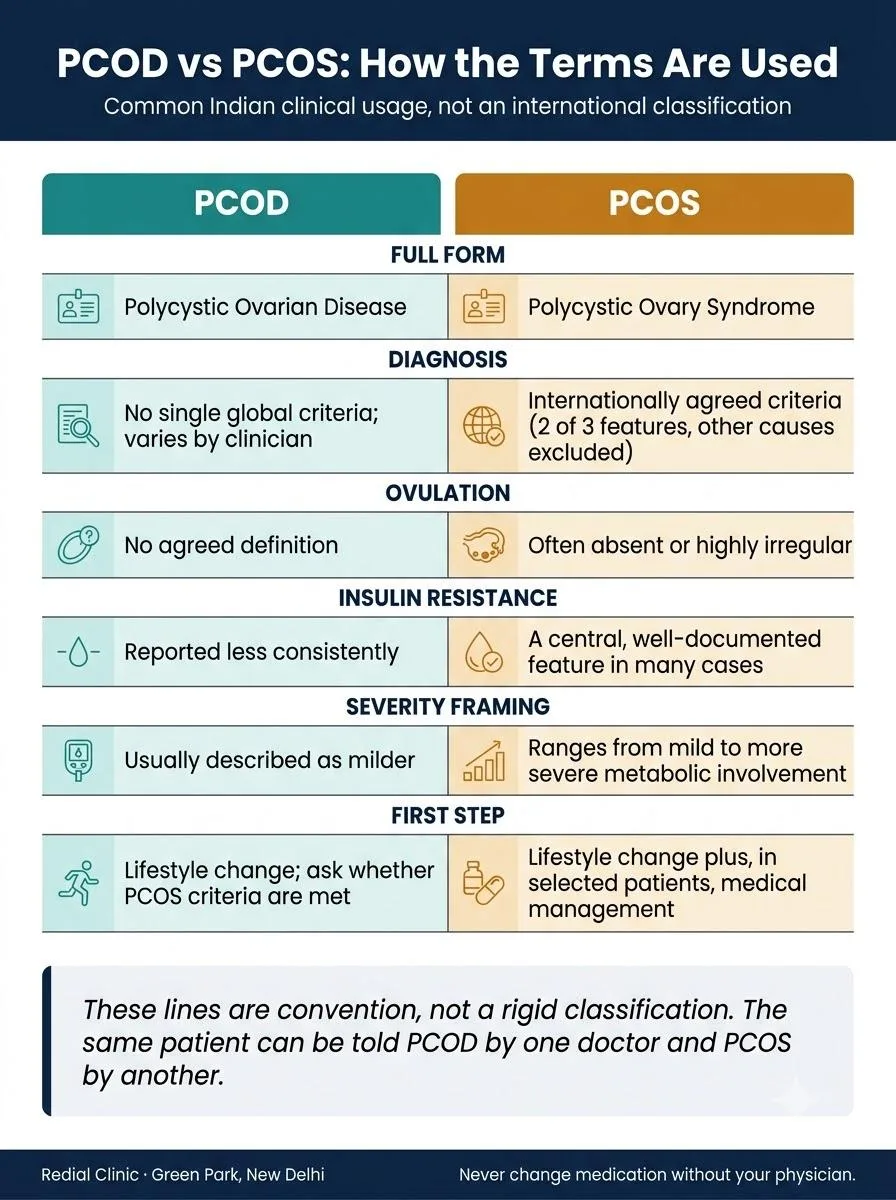
| Feature | PCOD | PCOS |
| Full form | Polycystic Ovarian Disease | Polycystic Ovary Syndrome |
| Diagnostic standard | No single global criteria; varies by clinician | Rotterdam criteria (2 of 3 features), 2023 international guideline |
| Egg release | Immature or partially mature eggs often released | Ovulation is frequently absent or highly irregular |
| Insulin resistance | Reported less consistently | A central, well-documented feature in a large share of cases [2] |
| Typical severity framing | Usually described as milder | Can range from mild to more severe metabolic involvement |
| Fertility impact | Often less disrupted | More frequently associated with ovulatory infertility |
| First-line management | Diet, weight management, exercise often sufficient | Lifestyle change plus, in selected patients, medical management |
Table 1 — General distinctions between PCOD and PCOS as used in Indian clinical practice. Note: these lines are convention, not a rigid international classification — see the terminology section below.
Is PCOD and PCOS the same thing?
No — but in everyday Indian clinical use, they are treated as close enough that many doctors, labs, and patients use the terms interchangeably. Strictly, PCOS is the internationally defined syndrome with formal diagnostic criteria; PCOD is a broader, India-common label without a single agreed definition, which is why the same patient can be told she has “PCOD” by one doctor and “PCOS” by another.
This is not a case where one clinic is right and the other is wrong. The honest picture is that the literature itself is inconsistent here — PCOD largely exists as an Indian clinical-practice convention rather than a formally distinct diagnosis recognised by international bodies like the Rotterdam consortium or the 2023 international PCOS guideline [2]. Globally, “PCOS” is the only term with a standardised diagnostic pathway; “PCOD” does not appear as a separate entity in that framework.
What this means practically: if your report says PCOD, ask your doctor whether you also meet the Rotterdam criteria for PCOS (see the table above). That answer — not which word is on the paper — tells you how closely your case needs to be watched for insulin resistance and long-term metabolic risk.
We regularly see patients who were told at one clinic that they have “mild PCOD, nothing to worry about,” and at another that they have “PCOS with insulin resistance” — based on very similar ultrasound and symptom pictures. The difference usually comes down to which criteria the second clinic actually checked (fasting insulin, androgen levels), not a change in the underlying condition.
Which is more serious, PCOD or PCOS?
On average, PCOS is considered the more clinically significant label because it is more consistently associated with insulin resistance, higher androgen levels, and long-term metabolic and fertility risk. PCOD, as generally used, describes a milder ovarian picture that more often responds well to diet and lifestyle change alone — but severity still varies a great deal within each label, so the name alone should not decide how worried to be.
Insulin resistance is the reason this distinction matters beyond semantics. Women with a PCOS-pattern presentation show measurable insulin resistance independent of body weight in a large share of cases, along with post-receptor signalling defects that specifically affect metabolic pathways [2]. That mechanism is what links PCOS to higher future risk of type 2 diabetes, dyslipidaemia, and cardiovascular disease if left unaddressed — not the ovarian appearance on the scan itself.
This is also why we say the engine matters more than the dashboard: a normal-looking ultrasound with confirmed insulin resistance is a more serious metabolic finding than a “polycystic” scan with normal insulin and androgen levels. Whichever word is written on your file, ask your clinician about fasting insulin, HOMA-IR, or an oral glucose tolerance test — see our guide on how to check insulin resistance for what a proper work-up includes.
Can PCOD turn into PCOS?
PCOD does not “turn into” PCOS in a strict biological sense the way early diabetes progresses to full diabetes — because PCOD is not a formally staged precursor condition. What actually happens is that unmanaged weight gain, worsening insulin resistance, and rising androgen levels over time can shift someone from a milder PCOD-labelled presentation into one that meets full Rotterdam PCOS criteria.
So the practical answer is: the label can change as the picture worsens, even though there is no confirmed medical staging system from one to the other. This is one more reason clinicians increasingly think of PCOD and PCOS less as two separate diseases and more as points on the same underlying spectrum of ovarian and metabolic dysfunction — with insulin resistance often the variable that pushes someone further along it.
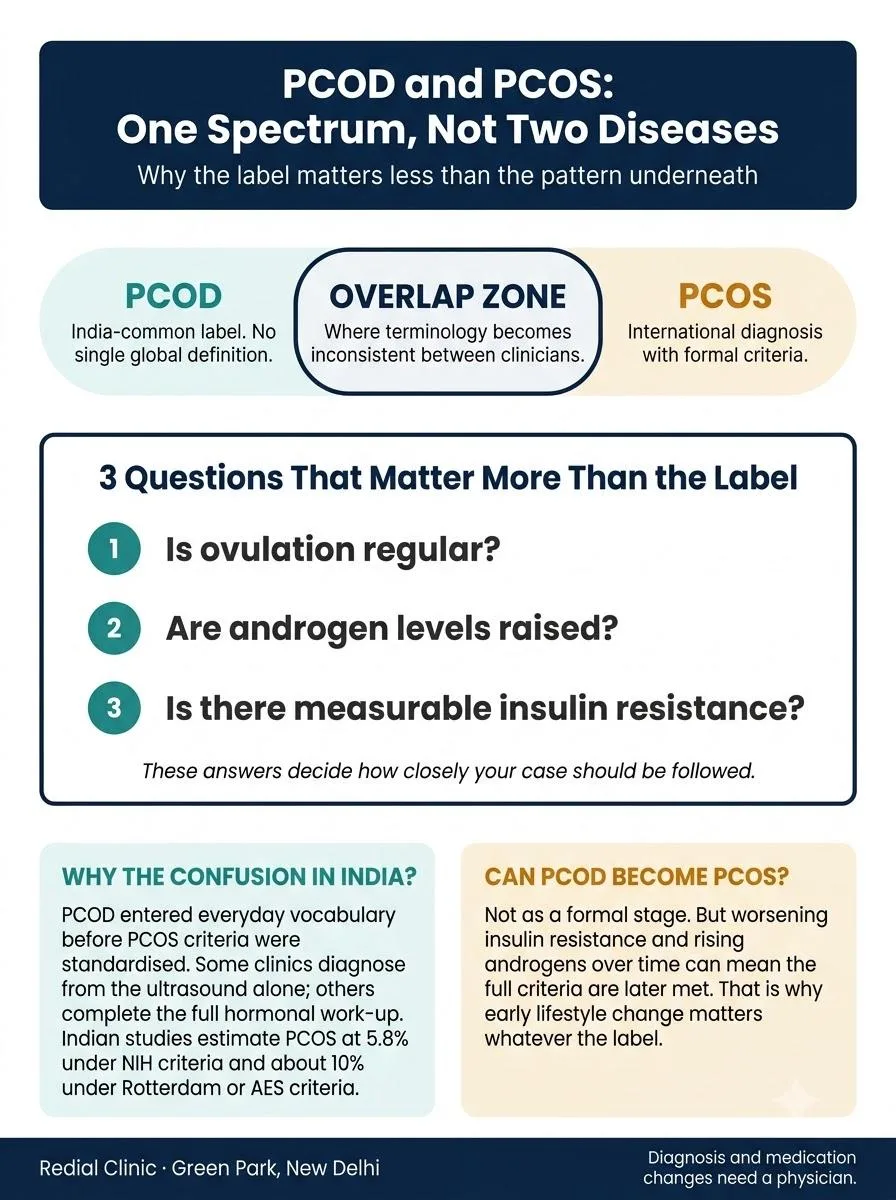
Infographic 2 — PCOD and PCOS are best understood as points on a shared spectrum rather than two unrelated diagnoses; the overlap zone is where terminology becomes genuinely inconsistent between clinicians.
This is also where lifestyle intervention earns its place as first-line care. Structured diet and exercise programmes have been shown to improve weight, insulin sensitivity, and reproductive outcomes in women with PCOS, particularly when started early [3]. In our clinic, this means we treat a PCOD label as an opportunity to intervene before the pattern progresses — not as a reason to dismiss it as “nothing serious.”
A patient came to us with a PCOD diagnosis from three years earlier, told to “just lose some weight.” By the time she was evaluated with us, her fasting insulin and androgen levels met full PCOS criteria. Nothing about her ovaries had dramatically changed — what had progressed was the untreated insulin resistance underneath.
Why does the terminology confusion exist in India?
The PCOD-versus-PCOS confusion in India stems from PCOD entering common clinical vocabulary well before the Rotterdam criteria standardised PCOS diagnosis internationally, plus inconsistent diagnostic practices — some clinics diagnose from ultrasound appearance alone, while others complete the fuller hormonal and metabolic work-up the international guideline recommends.
A systematic review and meta-analysis of Indian studies found the pooled prevalence of PCOS ranged from roughly 5.8% to 11.3% depending entirely on which diagnostic criteria were applied — NIH, Rotterdam, or Androgen Excess Society [4]. That is not a small rounding difference; it shows that even within India’s own PCOS research, the numbers move substantially based on how rigorously the condition is defined. If prevalence estimates shift this much under formal research criteria, it is unsurprising that day-to-day clinical labelling between “PCOD” and “PCOS” is even less consistent.
We want to be precise rather than tidy here: this is not a case of one term being outdated slang and the other being the “correct” modern name. PCOD persists in Indian practice partly because it is a familiar, less alarming word for patients, and partly because full Rotterdam-criteria testing (androgen levels, detailed ultrasound, ruling out thyroid and other mimics) is not always done at the first visit. The honest takeaway is that terminology varies by clinician and by region — what should not vary is whether insulin resistance and metabolic risk get properly assessed, regardless of which label ends up on the file.
What this means for your treatment
Regardless of whether your report says PCOD or PCOS, the treatment approach that actually changes outcomes is the same two-lever model: reduce glucose supply through diet, and increase glucose demand through resistance training, since skeletal muscle is the body’s largest site for clearing glucose from the blood. The label affects how closely we monitor metabolic markers — it should not change whether the root cause gets addressed.
At Redial Clinic, every PCOD or PCOS assessment includes fasting insulin and androgen testing alongside the ultrasound, because the ovarian appearance alone cannot tell us how much insulin resistance is driving the picture. In selected patients, medical management may be added alongside lifestyle change — that decision is always made by a physician, and any adjustment to existing medication is a supervised process, never something to change on your own.
If you already have a working diagnosis and want to understand PCOS itself in more depth — symptoms, the Rotterdam criteria, and why insulin resistance sits at the centre of it — read our companion guide, What Is PCOS?. If you are unsure whether your symptoms meet the threshold for a PCOS diagnosis at all, see How Do I Know If I Have PCOS? for the exact tests that confirm it.
For the metabolic side specifically — why insulin resistance is the mechanism connecting PCOD/PCOS to long-term weight and blood sugar risk — our guide on weight loss for insulin resistance explains the two-lever approach in more detail, and PCOS and weight gain looks specifically at breaking that cycle.
If irregular periods are your main concern rather than fertility, managing irregular periods during PCOS reversal covers a non-hormonal approach, and our full PCOS management programme page outlines what a structured, physician-led plan looks like at Redial Clinic in Green Park, New Delhi.
Medication safety note: if you are currently on metformin, an oral contraceptive, or any other medication for PCOD/PCOS, do not stop or change the dose based on this article. Any deprescription or adjustment is a decision made together with your treating physician, based on your individual labs and response to lifestyle change.
Frequently asked questions
What is the difference between PCOD and PCOS?
PCOD (Polycystic Ovarian Disease) is a broader term commonly used in Indian clinical practice for ovaries releasing immature eggs with a milder hormonal picture, usually manageable through lifestyle change. PCOS (Polycystic Ovary Syndrome) is the internationally standardised endocrine disorder diagnosed using the Rotterdam criteria, more strongly linked to insulin resistance and metabolic risk. In practice, the two terms overlap considerably and are often used inconsistently between clinicians.
Which is more serious, PCOD or PCOS?
PCOS is generally considered more clinically significant because it is more consistently associated with insulin resistance, higher androgen levels, and long-term metabolic and cardiovascular risk. PCOD, as typically used, describes a milder presentation — but severity varies within each label, so the specific findings (insulin, androgens, ovulation pattern) matter more than which word is on the report.
Are PCOD and PCOS the same thing?
Not strictly — PCOS has a formal, internationally agreed diagnostic pathway (the Rotterdam criteria), while PCOD does not have a single global definition and is used more loosely, particularly in Indian practice. However, the two conditions sit on an overlapping spectrum, and many patients labelled with one would meet criteria for the other if fully evaluated.
Can PCOD turn into PCOS?
PCOD is not a formally staged precursor to PCOS, so it does not “turn into” PCOS in a strict medical sense. But because both conditions can worsen with unmanaged weight gain and rising insulin resistance, a milder PCOD-labelled presentation can progress over time into one that meets full PCOS diagnostic criteria — which is why early lifestyle intervention matters regardless of the initial label.
The bottom line
PCOD and PCOS describe overlapping points on the same hormonal and metabolic spectrum rather than two cleanly separate diseases. The label on your report is less important than three specific questions: is ovulation regular, are androgen levels raised, and is there measurable insulin resistance. Those three answers — not the word PCOD or PCOS — determine how seriously your case should be followed and treated.
This article is for educational purposes and does not replace individualised medical advice. PCOD and PCOS diagnosis and management should always involve a qualified physician who can review your full history, examination, and laboratory results.
Not sure if it’s PCOD or PCOS — or what to do next?
A label from an old ultrasound report does not tell you your current insulin resistance or metabolic risk. Book a PCOS/PCOD assessment at Redial Clinic, Green Park, New Delhi — we test the markers that actually decide your treatment, not just the wording on your file.
Book a PCOS/PCOD assessment at Redial Clinic →
References
- Karoshi M, Okolo SO (2004) — Polycystic Ovarian Disease (PCOD): A Misnomer, Looking for a New Name
https://pubmed.ncbi.nlm.nih.gov/15481485/ - Diamanti-Kandarakis E, Dunaif A (2012) — Insulin Resistance and the Polycystic Ovary Syndrome Revisited
https://doi.org/10.1210/er.2011-1034 - Lim SS et al. (2019) — Lifestyle Changes in Women With Polycystic Ovary Syndrome
https://doi.org/10.1002/14651858.CD007506.pub4 - Bharali MD et al. (2022) — Prevalence of Polycystic Ovarian Syndrome in India: A Systematic Review and Meta-Analysis
https://doi.org/10.7759/cureus.32351 - Teede HJ et al. (2023) — International Evidence-Based Guideline for the Assessment and Management of PCOS
https://doi.org/10.1210/clinem/dgad463

 Facebook
 Instagram
 LinkedIn