



Medically reviewed by Dr. Gagandeep Singh, MBBS · Last updated 17 Oct 2026 · Green Park, New Delhi
Medically reviewed by Dr. Gagandeep Singh, MBBS · Last updated 17 Oct 2026 · Green Park, New Delhi
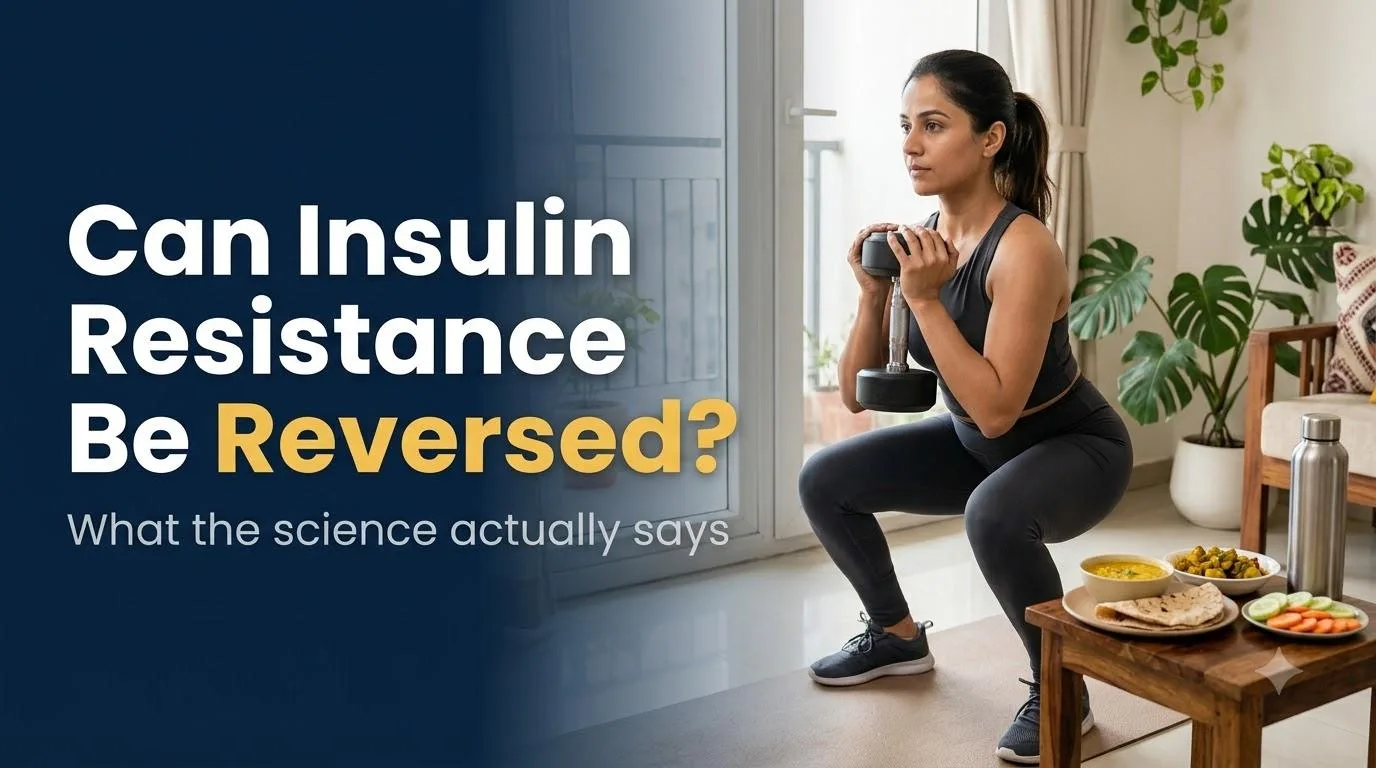
Insulin resistance is not a fixed diagnosis — it sits on a spectrum, and for most people caught early, it can move in the other direction.
KEY TAKEAWAYS
- Yes — insulin resistance can be reversed in many people, especially when it’s caught at the prediabetes or early stage, through sustained reduction in glucose supply (diet) and increase in glucose demand (muscle activity).
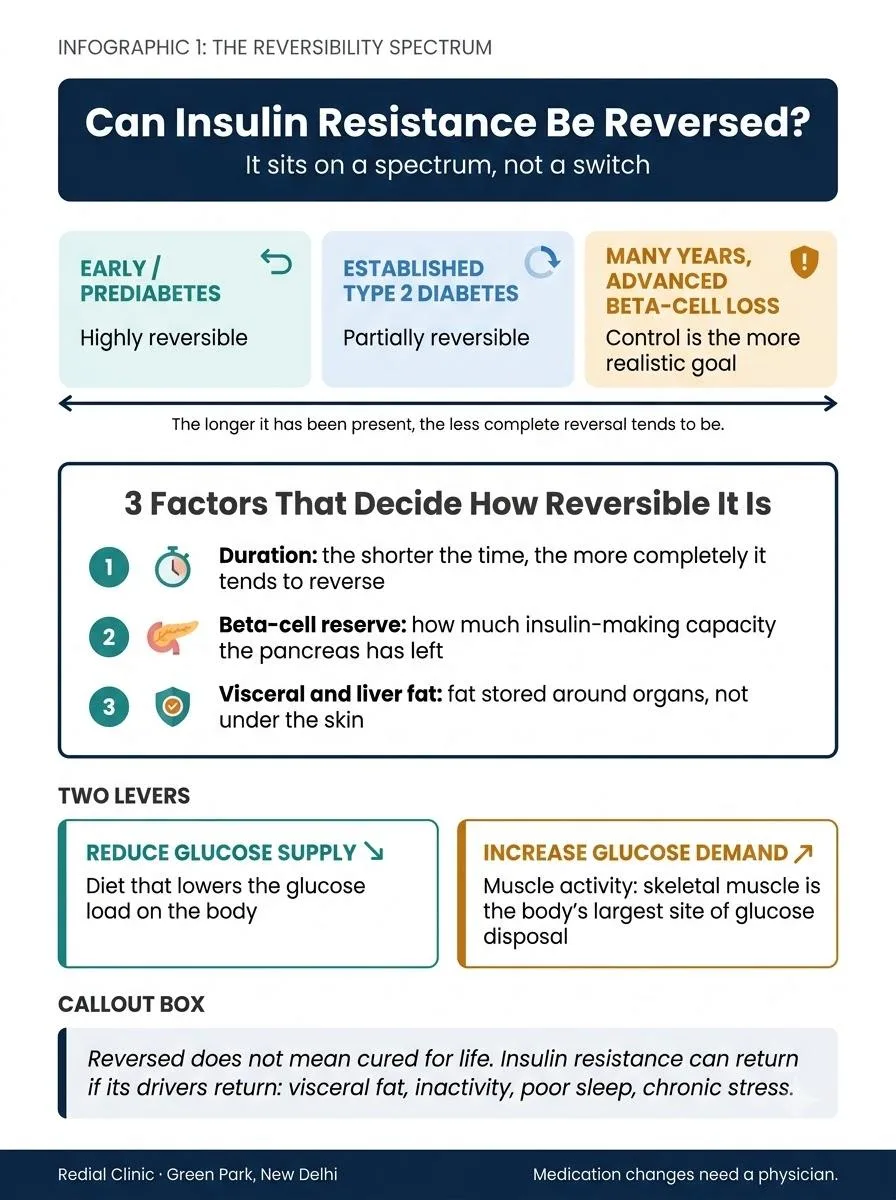
- Reversibility is not all-or-nothing. It sits on a spectrum: highly reversible early on, partially reversible once type 2 diabetes is established, and mostly about control (not reversal) after many years of advanced beta-cell loss.
- Early, measurable changes can begin within 1–2 weeks of a real intervention; meaningful insulin-sensitivity improvement typically takes 3–8 weeks, and deeper changes continue for 6–12+ months.
- “Reversed” does not mean “cured for life.” Insulin resistance can return if the underlying drivers — visceral fat, inactivity, poor sleep, chronic stress — return. It is a state to be maintained, not a one-time fix.
- Left unaddressed, insulin resistance does not always progress to type 2 diabetes — but it is the single strongest predictor of it, and it also drives risk for hypertension, PCOS, and fatty liver independently of blood sugar.
Table of Contents
- Can insulin resistance be reversed?
- Is insulin resistance reversible for everyone?
- How long does it take to reverse insulin resistance?
- Can insulin resistance be reversed permanently?
- Does insulin resistance always lead to diabetes?
- Reversal vs control: what’s the real difference?
- Frequently Asked Questions
- What to do next
- References
Can insulin resistance be reversed?
Yes. Insulin resistance can be reversed in many people, particularly when it is caught early — at the prediabetes stage or in the first few years of type 2 diabetes. Reversal happens by reducing the glucose load on the body (diet) and increasing the body’s capacity to absorb glucose (skeletal muscle activity), which together restore the cell’s sensitivity to insulin.
This is one of the more genuinely hopeful facts in metabolic medicine, and it’s worth sitting with: insulin resistance is not a life sentence. It’s a physiological state — cells that have stopped responding normally to insulin because they are overloaded with fat, particularly in the liver and pancreas. Roy Taylor’s twin-cycle hypothesis, developed from detailed metabolic imaging studies, showed that when that fat load is removed through sustained calorie and carbohydrate reduction, liver insulin sensitivity can begin to normalise within about a week, and pancreatic insulin secretion can recover over roughly eight weeks as pancreatic fat clears.
What makes insulin resistance different from many chronic conditions is that its two biggest drivers — how much glucose you’re asking your body to process, and how much capacity your body has to process it — are both modifiable. That’s the entire logic behind reversal: you’re not fighting the condition directly, you’re removing the two things that are causing it.
This is also why our companion article, how to reverse insulin resistance naturally, exists as a separate piece — this article answers whether and how reliably reversal happens; that one walks through exactly how to do it, meal by meal and workout by workout.
A patient in her early 30s came to us with a fasting insulin of 22 microIU/mL and a HOMA-IR consistent with significant insulin resistance, but a completely normal HbA1c. She was convinced she “already had diabetes” and had resigned herself to medication for life. Eight months of a structured low-glycaemic-load diet and twice-weekly resistance training later, her fasting insulin was back in the normal range. She never had diabetes to begin with — she had reversible insulin resistance, and reversing it kept it that way.
Is insulin resistance reversible for everyone, or does it depend on the person?
It depends on how long the insulin resistance has been present and how much pancreatic beta-cell function remains. Someone with prediabetes or newly diagnosed type 2 diabetes has a high chance of near-complete reversal; someone with 10+ years of diabetes and significant beta-cell loss is more likely to achieve better control rather than full reversal.
This is the single most important nuance missing from most “can insulin resistance be reversed” content online, and it’s the reason we don’t give blanket promises. Reversibility sits on a spectrum, not a switch. The DiRECT trial in the UK — one of the most rigorous studies on this question — found that almost 9 in 10 people who lost 15kg or more within 2 years of a type 2 diabetes diagnosis achieved remission. But the same intervention, started later in the disease course, produces smaller and less durable results, because by then some beta cells have already been permanently lost.
Three factors matter most for how reversible your insulin resistance is:
- Duration — the shorter the time insulin resistance has been present, the more completely it tends to reverse.
- Beta-cell reserve — the pancreas’s remaining capacity to produce insulin, which declines gradually the longer resistance and compensatory high insulin output persist.
- Visceral and liver fat — the amount of fat stored around organs (not under the skin), which drives the “twin-cycle” mechanism directly.
Where you sit on this spectrum — not just your current blood sugar number — determines how realistic full reversal is.
This is also why the two most useful numbers to know are not just your HbA1c, but how long you’ve likely had insulin resistance and what your fasting insulin or HOMA-IR shows. You can read about how these are measured in our guide.
how to check insulin resistance, and about the condition itself in what is insulin resistance.
How long does it take to reverse insulin resistance?
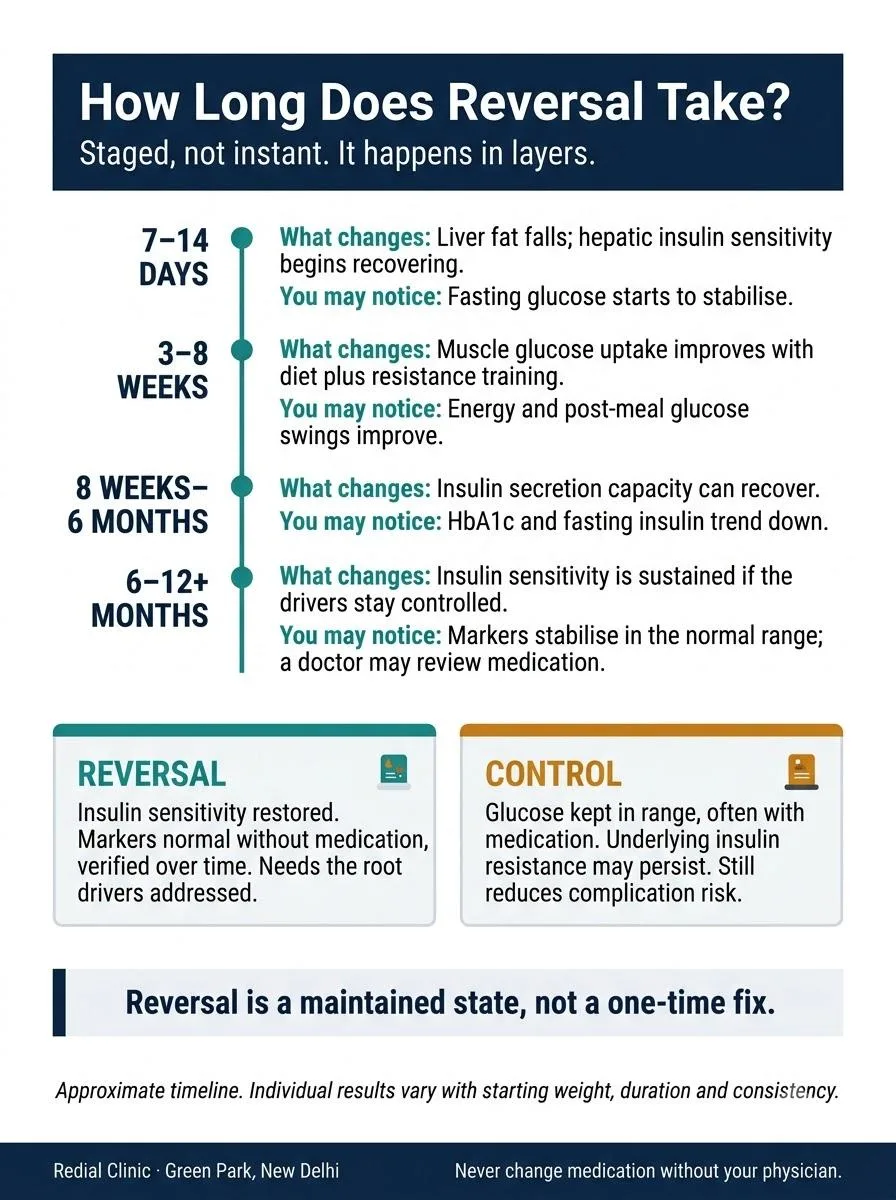
Early markers can begin improving within 1–2 weeks of a genuine intervention; meaningful gains in insulin sensitivity typically take 3–8 weeks; and the deeper structural changes — pancreatic fat clearance, sustained beta-cell recovery — continue over 6–12+ months. Reversal timelines are staged, not instant, and vary by individual.
This staged pattern comes directly from metabolic imaging research. In Taylor’s twin-cycle studies, within about 7 days of a substantial calorie deficit, liver fat content dropped and fasting glucose began to normalise as hepatic insulin sensitivity returned. Over the following 8 weeks, pancreatic fat cleared progressively and insulin secretion capacity recovered in step with it. Beyond that window, continued weight loss and consistent resistance training keep improving skeletal muscle insulin sensitivity — muscle is the single largest site of glucose disposal in the body, which is why building and using it matters as much as what’s on the plate.
Reversal happens in layers — the liver responds first, the pancreas next, and skeletal muscle sensitivity keeps improving over many months.
A few things shift how long this takes for a given person: how much visceral fat needs to clear, how consistent the diet and training changes are, sleep quality, and stress levels (chronic cortisol elevation itself worsens insulin resistance, independent of diet). A detailed timeline, week by week, is covered in our step-by-step guide.
how to reverse insulin resistance naturally.
| Time since starting | What’s changing physiologically | What you may notice |
| 7–14 days | Liver fat falls; hepatic insulin sensitivity begins recovering | Fasting glucose starts to stabilise |
| 3–8 weeks | Muscle glucose uptake improves with diet + resistance training | Energy and post-meal glucose swings improve |
| 8 weeks–6 months | Pancreatic fat clears; insulin secretion capacity recovers | HbA1c and fasting insulin trend down |
| 6–12+ months | Sustained insulin sensitivity if drivers stay controlled | Markers stabilise in normal range; medication review possible |
Approximate staged timeline based on Taylor R, Diabetes Care 2013. Individual results vary with starting weight, duration of insulin resistance, and consistency.
Can insulin resistance be reversed permanently?
Insulin resistance can stay reversed for years, but “permanently” is the wrong frame — it’s better understood as a maintained state, not a cure. If the drivers that caused it (visceral fat, inactivity, poor sleep, chronic stress) return, insulin resistance can return with them, even after a genuine reversal.
This is not a reason for pessimism — it’s the same logic that applies to any physiological state that depends on ongoing inputs, like fitness or bone density. The evidence backs this up directly. In the DiRECT trial, at 2 years, sustained weight loss of 10kg or more predicted a much higher chance of remaining in remission, while people who regained weight saw their glucose control worsen again. This is not a flaw of the reversal — it’s confirmation that the mechanism (fat load driving insulin resistance) works in both directions.
This is not a reason for pessimism — it’s the same logic that applies to any physiological state that depends on ongoing inputs, like fitness or bone density. The evidence backs this up directly. In the DiRECT trial, at 2 years, sustained weight loss of 10kg or more predicted a much higher chance of remaining in remission, while people who regained weight saw their glucose control worsen again. This is not a flaw of the reversal — it’s confirmation that the mechanism (fat load driving insulin resistance) works in both directions.
This distinction — control versus true reversal, and what “permanent” realistically means — is explored in more depth in our companion piece.whether diabetes reversal is permanent, which walks through the same durability question for full type 2 diabetes.
What this means practically: reversal is a milestone worth chasing, and it’s real. But it needs the same maintenance that got you there — periodic re-checks, staying active, and treating weight regain as an early signal rather than a failure. This is also precisely why deprescribing insulin, sulfonylureas, or other glucose-lowering medication is never a self-directed decision — it must be done gradually and only under your physician’s supervision, based on your actual lab trends, not how you feel.
Does insulin resistance always lead to diabetes?
No — insulin resistance does not always progress to type 2 diabetes, but it is the strongest known predictor of it, and left unaddressed, most people with significant insulin resistance will progress toward prediabetes and then diabetes over years as beta-cell compensation gradually fails.
Here’s the mechanism: in early insulin resistance, the pancreas compensates by producing more insulin to keep blood glucose normal — which is exactly why fasting glucose and even HbA1c can look completely normal for years while insulin resistance is already well established underneath. Diabetes is only diagnosed once the pancreas can no longer keep up with that compensatory demand. That’s the entire premise of “treating the engine, not the dashboard”: if you wait for your glucose number to move, you are watching the endpoint of a process that started years earlier.
The good news is that this same window is the highest-leverage moment to intervene. The Indian Diabetes Prevention Programme (IDPP-1), a landmark Indian trial, showed that lifestyle intervention in people with impaired glucose tolerance reduced progression to diabetes significantly compared to no intervention — evidence generated specifically in an Indian population, which matters given that South Asians tend to develop insulin resistance and diabetes at lower BMI thresholds than Western populations.
Insulin resistance is also not only a pre-diabetes story. It independently drives risk for hypertension (via sodium retention and sympathetic nervous system activation), PCOS (via ovarian androgen production), and non-alcoholic fatty liver disease — which is why treating it early has benefits well beyond glucose control.
A 41-year-old man came in after a routine check-up flagged mildly elevated blood pressure. His fasting glucose was completely normal, and his previous doctor had reassured him nothing metabolic was going on. A fasting insulin test told a different story — significantly elevated, with a HOMA-IR in the insulin-resistant range. His blood pressure was a downstream marker, not a separate problem. Addressing the insulin resistance directly, his BP normalised without needing to add a second antihypertensive.
For more on this specific pathway, see our articles on the link between hypertension and diabetes and how obesity connects to type 2 diabetes.
Reversal vs control: what’s the real difference?
Reversal means insulin sensitivity and glucose regulation return to a normal range without ongoing medication, verified by lab markers over time. Control means blood glucose is kept in a safe range, often with medication, while the underlying insulin resistance persists. Both are legitimate goals — but they are not the same outcome, and the difference matters for what you should expect.
Reversal means insulin sensitivity and glucose regulation return to a normal range without ongoing medication, verified by lab markers over time. Control means blood glucose is kept in a safe range, often with medication, while the underlying insulin resistance persists. Both are legitimate goals — but they are not the same outcome, and the difference matters for what you should expect.
Consensus clinical guidance defines diabetes remission specifically as an HbA1c below the diabetic threshold, sustained for at least three months, without glucose-lowering medication. That’s a meaningfully higher bar than “my numbers look fine on metformin.” Both outcomes are worth pursuing, and control is always better than uncontrolled disease — but conflating the two is where a lot of the confusion around “can insulin resistance be reversed” comes from.
Someone whose blood sugar is well controlled on medication has not necessarily reversed the underlying insulin resistance; they have neutralised its downstream effect.
- Reversal: insulin sensitivity restored; markers normal without medication; requires addressing root drivers (visceral fat, inactivity, diet quality).
- Control: glucose kept in range, often via medication; underlying insulin resistance may persist; still meaningfully reduces complication risk.
Neither path is a moral failure — where you land depends on how early insulin resistance was caught and how much beta-cell reserve remains. Our broader philosophy on this, and on when medication reduction is appropriate, is covered here.
diabetes reversal without medication.
Frequently Asked Questions
Can insulin resistance be reversed?
Yes, in many people — especially when caught at the prediabetes or early stage. Reversal works by reducing glucose supply through diet and increasing glucose demand through muscle activity, which restores cellular insulin sensitivity. The earlier it’s addressed, the more complete the reversal tends to be.
How long does it take to reverse insulin resistance?
Early changes can begin within 1–2 weeks; meaningful improvement in insulin sensitivity typically takes 3–8 weeks; and fuller recovery, including pancreatic function, continues over 6–12+ months. Timelines vary based on how long insulin resistance has been present and how consistent the intervention is.
Can insulin resistance be reversed permanently?
It can stay reversed for years if the underlying drivers — visceral fat, inactivity, poor sleep, chronic stress — are kept in check. It is better understood as a maintained state than a permanent cure: insulin resistance can return if those drivers return, which is why ongoing monitoring matters even after reversal.
Does insulin resistance always lead to diabetes?
No. Insulin resistance does not automatically progress to type 2 diabetes, but it is the strongest known predictor of it. Left unaddressed, most people with significant insulin resistance will progress toward prediabetes and diabetes over years, as the pancreas’s ability to compensate gradually declines.
What to do next
Curious where you actually stand on the reversibility spectrum?
Fasting glucose and even HbA1c can stay normal for years while insulin resistance is already established — which is why a number on a routine panel isn’t enough to answer “can I still reverse this?” A metabolic assessment at Redial Clinic looks at fasting insulin, HOMA-IR, visceral fat indicators, and your personal history to give you an honest, individualised answer: how reversible your insulin resistance is, realistically, and what a structured plan looks like from here.
Book a metabolic assessment with Dr. Gagandeep Singh at Redial Clinic, Green Park, New Delhi — in person or via teleconsultation.
This article is for educational purposes and does not replace individual medical advice. If you are on insulin, sulfonylureas, SGLT2 inhibitors, or blood pressure medication, do not stop or adjust your dose based on this article — all medication changes, including deprescribing, must be made by your treating physician based on your lab trends.
References
- Taylor R (2013) — Type 2 Diabetes: Etiology and Reversibility
https://doi.org/10.2337/dc12-1805 - DeFronzo RA, Tripathy D (2009) — Skeletal Muscle Insulin Resistance Is the Primary Defect in Type 2 Diabetes
https://doi.org/10.2337/dc09-S302 - Lean MEJ et al. (2018) — DiRECT Trial: Weight Management for Type 2 Diabetes Remission
https://doi.org/10.1016/S0140-6736(17)33102-1 - Lean MEJ et al. (2019) — DiRECT Trial: Two-Year Results of Type 2 Diabetes Remission
https://doi.org/10.1016/S2213-8587(19)30068-3 - Riddle MC et al. (2021) — Definition and Interpretation of Remission in Type 2 Diabetes
https://doi.org/10.2337/dci21-0034 - Ramachandran A et al. (2006) — Indian Diabetes Prevention Programme (IDPP-1)
https://doi.org/10.1007/s00125-005-0097-z - Anjana RM et al. (2023) — ICMR-INDIAB National Cross-Sectional Study
https://doi.org/10.1016/S2213-8587(23)00119-5 - Ferrannini E et al. (1987) — Insulin Resistance in Essential Hypertension
https://doi.org/10.1056/NEJM198708063170605

 Facebook
 Instagram
 LinkedIn