




Written by: Dr. Gagandeep Singh, MBBS
Medically reviewed by: Dr. Gagandeep Singh, MBBS
Last updated: 20 June 2026 · Redial Clinic, Green Park, New Delhi
| Key Takeaways PCOS (polycystic ovary syndrome) is a common hormonal and metabolic condition in women of reproductive age. It is diagnosed from a combination of irregular or absent ovulation, signs of excess androgens (acne, unwanted hair), and the appearance of the ovaries on ultrasound — not from one test alone. For many women the underlying driver is insulin resistance, which links PCOS to long-term metabolic health. Common signs include irregular periods, acne, excess facial or body hair, scalp hair thinning, and difficulty losing weight. PCOS is highly manageable: treating the metabolic root improves symptoms and lowers future health risks. Having “polycystic-looking” ovaries on a scan alone does not mean you have PCOS — diagnosis needs the full picture. |
If a doctor has mentioned PCOS, or you have seen the term after months of irregular periods and stubborn weight, you are not alone — and the condition is more understandable than it first appears. What is PCOS, in plain terms? It is polycystic ovary syndrome, one of the most common hormonal conditions in women of reproductive age, and for many it is as much a metabolic condition as a reproductive one.
This guide explains what PCOS actually is, how it is diagnosed, the symptoms to recognise, and why insulin resistance sits at the centre of the story for so many women.
What is PCOS in simple terms?
PCOS, or polycystic ovary syndrome, is a hormonal and metabolic condition in which ovulation becomes irregular and the body often shows signs of excess androgens, such as acne or unwanted hair. Despite the name, it is not mainly about cysts — it is about disrupted hormone signalling, frequently driven by insulin resistance.
The full form of PCOS is polycystic ovary syndrome. The “polycystic” part refers to the appearance of many small follicles on the ovaries on ultrasound, but that single feature is neither necessary nor sufficient for the diagnosis.
It is better understood as a syndrome — a cluster of features that tend to occur together — affecting the menstrual cycle, the skin and hair, fertility, and metabolic health. Seeing it this way explains why PCOS looks so different from one woman to the next.
How is PCOS diagnosed?
PCOS is diagnosed when at least two of three features are present: irregular or absent ovulation; clinical or blood-test signs of excess androgens; and polycystic ovaries on ultrasound. Other conditions that mimic PCOS, such as thyroid disorders, must be ruled out first.
These are known as the Rotterdam criteria, endorsed by the 2023 international PCOS guideline. The “two of three” rule is why two women with PCOS can present so differently — one with irregular cycles and acne, another with regular-looking ovaries on scan but clear hormonal signs.
Crucially, polycystic-looking ovaries on a scan alone do not equal PCOS; many women without the condition have them. A proper diagnosis also screens for insulin resistance and metabolic markers, which is why our assessment includes them — see how to check insulin resistance.
| Diagnostic feature | What it means | How it is assessed |
| Irregular ovulation | Infrequent, absent or unpredictable periods | Cycle history |
| Excess androgens | Acne, excess facial/body hair, scalp thinning | Examination and/or blood tests |
| Polycystic ovaries | Many small follicles on the ovary | Pelvic ultrasound |
PCOS requires at least two of these three features, with mimicking conditions excluded (Rotterdam criteria).
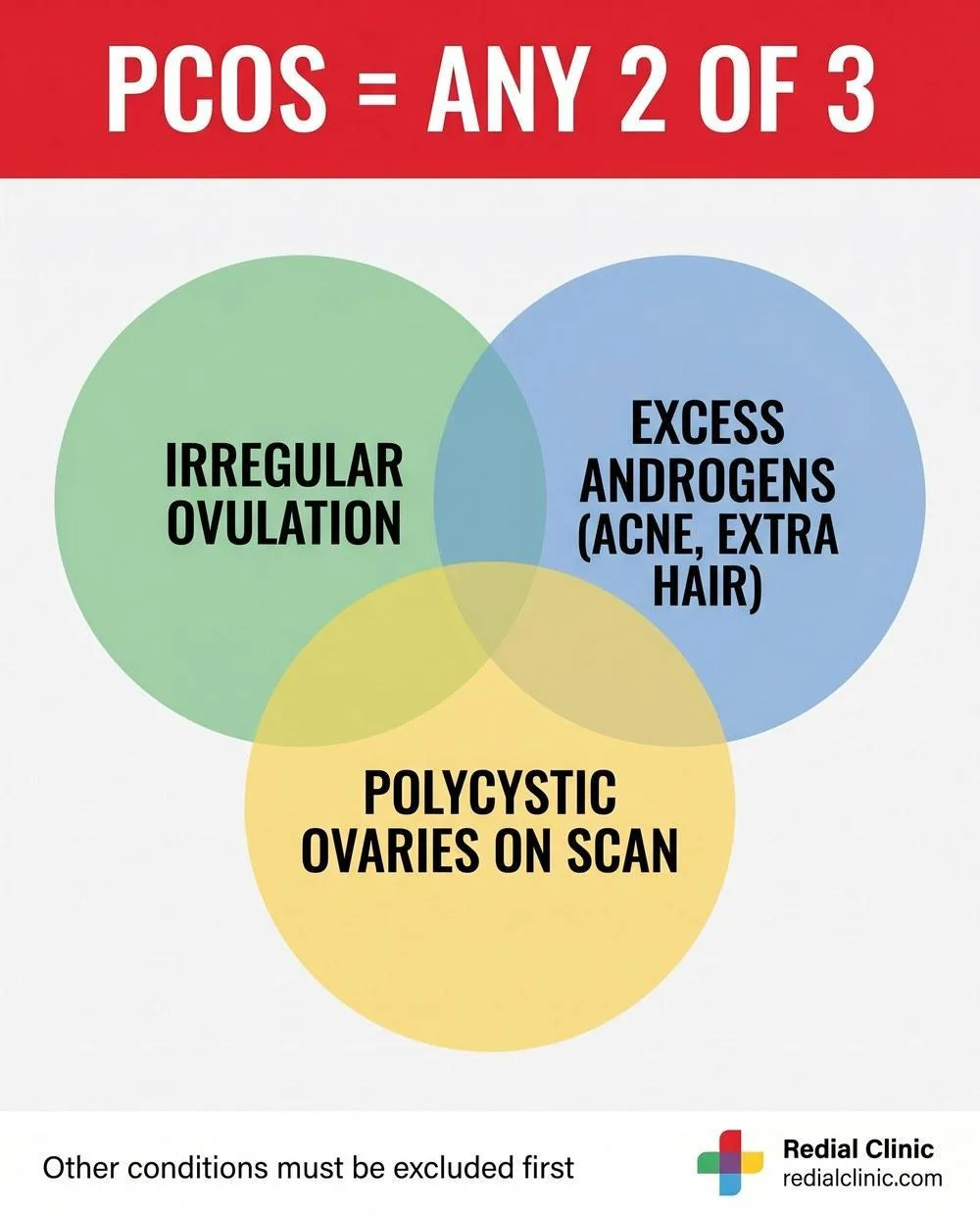
Infographic of the Rotterdam two-of-three criteria for diagnosing PCOS
What are the symptoms of PCOS?
Common PCOS symptoms include irregular or missed periods, acne, excess facial or body hair (hirsutism), thinning scalp hair, difficulty losing weight, and sometimes difficulty conceiving. Many women also have fatigue and sugar cravings linked to the underlying insulin resistance.
Symptoms vary widely in type and severity. The skin and hair changes — acne and hirsutism — are among the most distressing, and we cover them in detail in PCOS acne and hair loss solutions. Weight gain, especially around the abdomen, is also common and often the hardest to shift.
It is worth naming what is not your fault here: the weight and cravings are frequently downstream of insulin resistance, not a lack of willpower. That reframing is often the first relief patients feel.
| A pattern we see often in clinic: a young woman is told her periods are irregular and is offered a pill to regulate them, but no one explains the acne, the weight that will not move, and the fatigue as parts of the same metabolic picture. Connecting them is usually the moment the condition finally makes sense to her. |
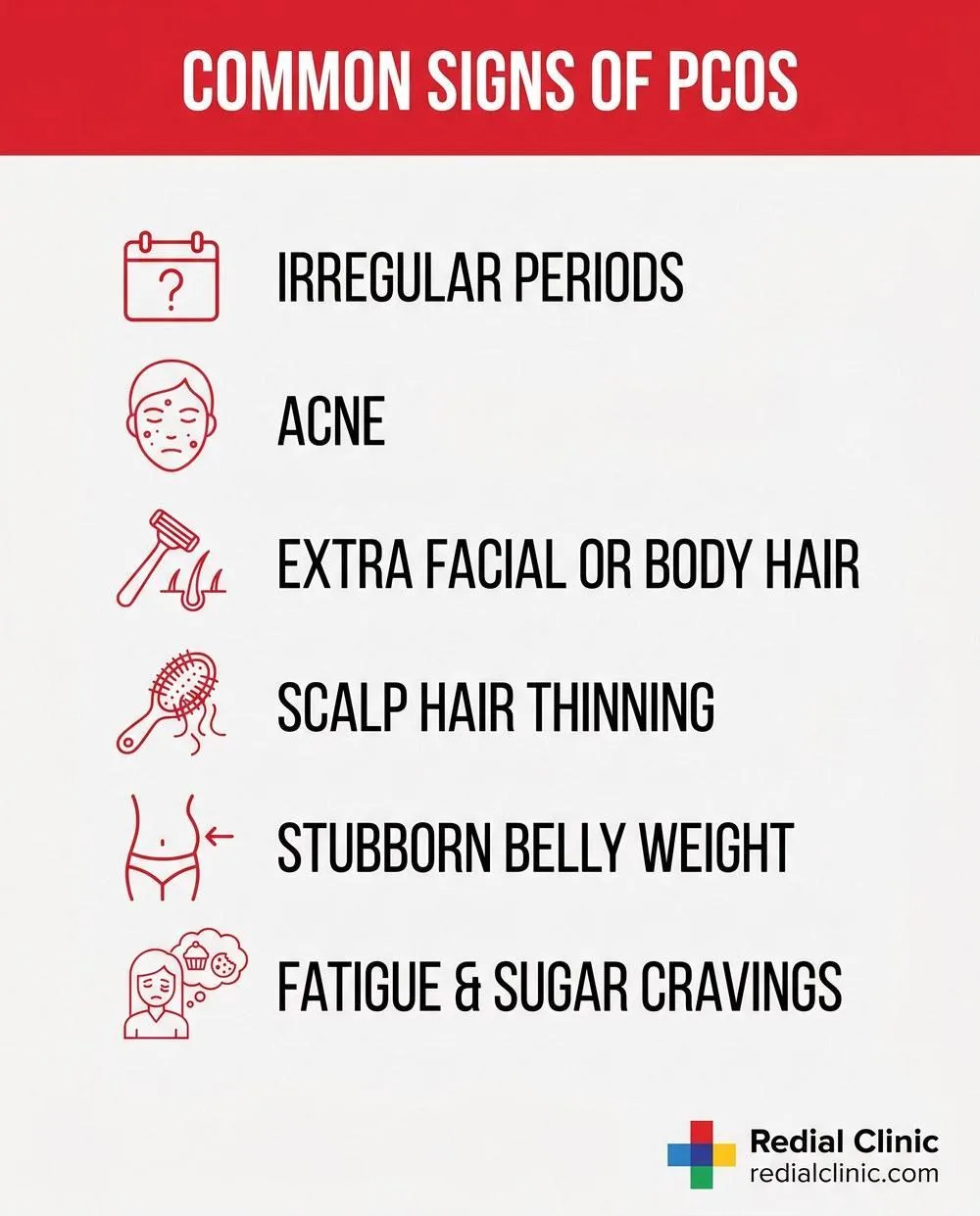
Infographic checklist of common PCOS symptoms
Why is insulin resistance central to PCOS?
Because in most women high insulin is what pushes the ovaries to overproduce androgens, driving the irregular cycles and skin changes. Insulin resistance also links PCOS to a higher long-term risk of type 2 diabetes and fatty liver, which is why addressing it improves both symptoms and future health.
This metabolic core is what makes PCOS treatable at the root rather than only symptom by symptom. Lower the insulin, and the downstream hormonal disruption often eases.
It also explains why lifestyle change is first-line treatment, and why PCOS deserves the same metabolic attention we give to diabetes and obesity. For the practical path from here, see our guide on how to put PCOS into lasting remission.
Frequently Asked Questions
What is PCOS in simple terms?
PCOS, or polycystic ovary syndrome, is a common hormonal and metabolic condition where ovulation becomes irregular and the body often shows signs of excess male-type hormones, such as acne or unwanted hair. It is frequently driven by insulin resistance. It is a syndrome — a cluster of features — rather than a single disease.
What are the first signs of PCOS?
The earliest signs are usually irregular, infrequent or missed periods, often alongside acne, excess facial or body hair, and difficulty losing weight. Some women first notice it when trying to conceive. Because signs vary, two women with PCOS can look quite different.
Is PCOS a serious problem?
PCOS is very manageable, but it is more than a cosmetic or period issue — it is a long-term metabolic condition that raises the risk of type 2 diabetes and fatty liver if left unaddressed. Treating the underlying insulin resistance improves symptoms and protects future health. With the right approach, most women do well.
What causes PCOS?
For most women the central driver is insulin resistance, which raises insulin and prompts the ovaries to make excess androgens. Genetics and other hormonal factors also contribute. The insulin pathway is the most treatable, which is why lifestyle change is the first-line approach.
Next step
| If you have irregular periods, acne, or weight that will not move and suspect PCOS, a metabolic assessment can tell you what is really driving it. Book a Metabolic Assessment at Redial Clinic, Green Park, New Delhi. |
Medical disclaimer: This article is for informational purposes only and does not constitute medical advice. Always consult a qualified healthcare professional before making changes to your diet, exercise, medication, or treatment plan.
References
1. Teede HJ, Tay CT, Laven JJE, et al., “Recommendations From the 2023 International Evidence-based Guideline for the Assessment and Management of Polycystic Ovary Syndrome,” The Journal of Clinical Endocrinology & Metabolism, 2023. https://doi.org/10.1210/clinem/dgad463
2. Diamanti-Kandarakis E, Dunaif A, “Insulin Resistance and the Polycystic Ovary Syndrome Revisited: An Update on Mechanisms and Implications,” Endocrine Reviews, 2012. https://doi.org/10.1210/er.2011-1034
3. Lim SS, Hutchison SK, Van Ryswyk E, Norman RJ, Teede HJ, Moran LJ, “Lifestyle changes in women with polycystic ovary syndrome,” Cochrane Database of Systematic Reviews, 2019. https://doi.org/10.1002/14651858.CD007506.pub4
4. Anjana RM, Unnikrishnan R, Deepa M, et al., “Metabolic non-communicable disease health report of India: the ICMR-INDIAB national cross-sectional study (ICMR-INDIAB-17),” The Lancet Diabetes & Endocrinology, 2023. https://doi.org/10.1016/S2213-8587(23)00119-5

 Facebook
 Instagram
 LinkedIn