



Written By: Dr. Gagandeep Singh, MBBS
Medically Reviewed By: Dr. Gagandeep Singh, MBBS
Last Updated: 3 July 2026
| Key Takeaways High blood pressure and belly fat are not two separate problems — in many patients they are two expressions of one underlying condition: metabolic syndrome, driven primarily by insulin resistance. Visceral (belly) fat behaves as an active endocrine organ, secreting leptin, reducing protective adiponectin, and driving inflammatory signals that directly raise blood pressure. Perivascular fat and activation of the RAAS/aldosterone pathway are key — and often overlooked — mechanisms linking central obesity to hypertension. Excess weight, particularly visceral adiposity, has been estimated to account for 65–75% of the risk for primary (essential) hypertension in adults. Treating blood pressure and weight as two unrelated numbers on two different charts misses the shared upstream driver — metabolic syndrome needs to be assessed and managed as one cluster, not two coincidences. |
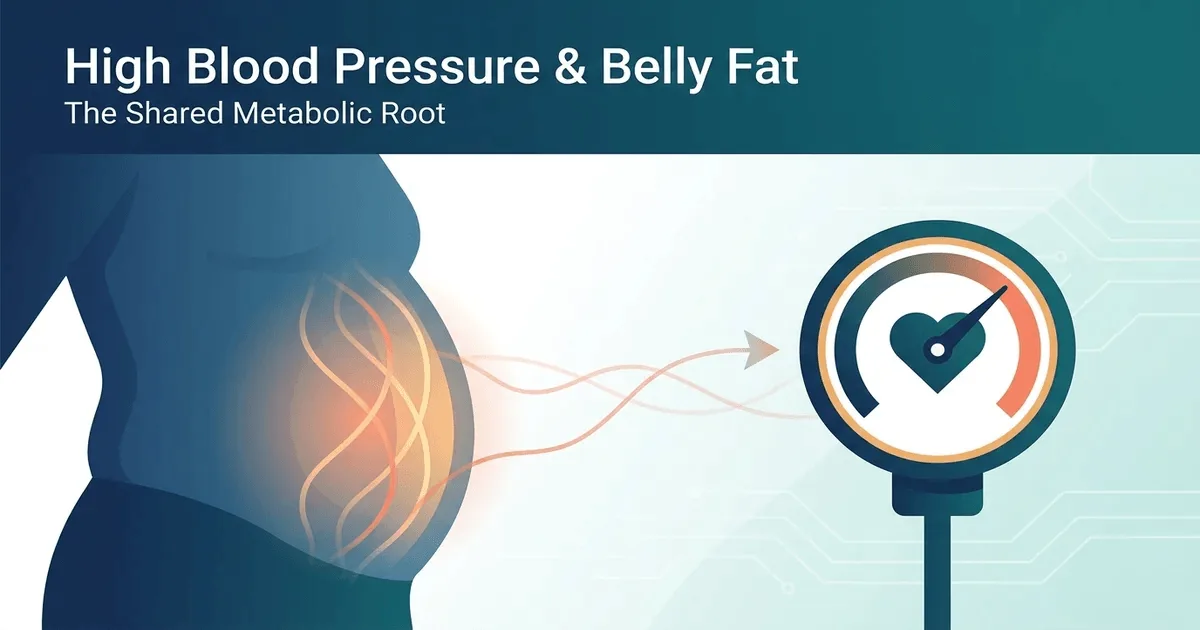
If your blood pressure and your waistline are climbing together, they are not separate problems — they share one metabolic root.
Most patients arrive at our Green Park clinic with two separate concerns written on two separate pieces of paper: a blood pressure reading that has been “borderline” for a year or two, and a waistline that has quietly expanded despite no major change in diet. These are usually managed as two independent issues — one by a cardiologist adjusting a tablet, one by the patient themselves, feeling vaguely guilty about the mirror.
In a large proportion of these patients, both numbers are being driven upward by the same underlying process. That process has a name: metabolic syndrome. Understanding it changes how you think about your own numbers — and, more importantly, what actually needs to be treated.
What Is Metabolic Syndrome?
Metabolic syndrome is a cluster of five interrelated risk markers — central obesity, high blood pressure, high triglycerides, low HDL cholesterol, and impaired fasting glucose — that occur together far more often than chance would predict, because they share a common upstream driver: insulin resistance. Meeting three or more of these markers earns the diagnosis.
This is not a disease in the way a chest infection is a disease. It is a pattern-recognition framework — a way of naming a cluster clinicians have observed for decades: patients gaining weight around the middle, whose blood pressure is edging up, whose lipid panel is drifting the wrong way, and whose fasting glucose is creeping toward the diabetic range, usually all at once, usually in the same person, and usually years before any single marker crosses into a “disease” threshold on its own.
International criteria — most commonly the ATP III (Adult Treatment Panel III) and IDF (International Diabetes Federation) definitions — formalise this cluster using threshold values for waist circumference, blood pressure, triglycerides, HDL cholesterol, and fasting glucose (see the table below). Exact cutoffs vary slightly by criteria set and by population, so please consult your physician for the thresholds applicable to you rather than self-diagnosing from a table.
What matters clinically is not memorising the numbers — it is recognising that if your belly fat and your blood pressure are both rising, checking only one of them is checking half the picture. A 2024 review in Nature Reviews Disease Primers frames metabolic syndrome precisely this way: as a clustering phenomenon rooted in shared pathophysiology, not a coincidence of unrelated conditions occurring in the same body.
| From the clinicA patient in his early 40s came in for a blood pressure prescription refill. His BP was 142/92. His waist circumference, taken as part of our standard intake, was well above the commonly cited threshold. His fasting glucose was 108 mg/dL — not diabetic, but impaired. His triglycerides were high, his HDL low. On paper, he had four separate “mild” problems. In reality, he had one diagnosis: metabolic syndrome, with insulin resistance as the shared root. |
Why Do High Blood Pressure and Belly Fat Rise Together?
Belly fat and blood pressure rise together because visceral fat is not passive storage tissue — it is a hormonally active organ that directly drives blood pressure up, primarily through insulin resistance, altered adipokine signalling, low-grade inflammation, and local effects on the blood vessels running through and around it.
This is the mechanism most general explanations of “what causes high blood pressure” skip over, because it is not primarily about salt, and it is not primarily about the nervous system. It is about fat tissue behaving like a gland.
Insulin Resistance Is the Shared Root
When visceral fat accumulates — particularly around the abdominal organs rather than under the skin — the body’s cells, especially muscle and liver cells, become progressively less responsive to insulin. The pancreas compensates by producing more insulin (hyperinsulinemia) to keep blood glucose in range. This compensatory state is now recognised as a primary driver of the entire metabolic syndrome cluster, not just of blood glucose.
Research by DeFronzo and Tripathy has shown that skeletal muscle insulin resistance is the primary defect underlying this cascade, with downstream effects reaching well beyond glucose control, including blood pressure (DeFronzo & Tripathy, 2009). Ferrannini and colleagues demonstrated the direct link between insulin resistance and hypertension as far back as 1987 (Ferrannini et al., 1987), and it remains one of the most replicated findings in metabolic medicine.
Fat as an Endocrine Organ: Adipokines and Inflammation
Visceral adipose tissue secretes a range of signalling molecules called adipokines. As visceral fat expands, this secretion pattern shifts in a way that actively promotes hypertension:
- Leptin rises with increasing fat mass. Beyond its role in appetite regulation, elevated leptin has direct effects on the sympathetic nervous system and on sodium handling in the kidney, contributing to higher blood pressure.
- Adiponectin, a protective hormone that normally improves insulin sensitivity and supports healthy blood vessel function, falls as visceral fat increases — removing a natural buffer against vascular stiffening.
- Inflammatory cytokines (such as TNF-alpha and IL-6) increase, contributing to a state of chronic low-grade inflammation that damages the inner lining of blood vessels (the endothelium) and impairs their ability to relax and dilate normally.
This adipokine and inflammatory shift is a distinct pathway from — and works alongside — the well-documented effects of sodium retention and sympathetic nervous system activation.
RAAS, Aldosterone, and Perivascular Fat
One of the more specific mechanisms linking visceral fat to hypertension involves the renin-angiotensin-aldosterone system (RAAS). Visceral and perivascular fat — the fat that sits directly around blood vessels — can locally produce factors that stimulate aldosterone release, independent of the kidney’s usual regulatory signals. Elevated aldosterone promotes sodium and fluid retention and contributes to vascular stiffening.
Perivascular fat itself is increasingly understood as a local contributor: fat tissue wrapped directly around arteries can secrete inflammatory and vasoconstrictive signals into the adjacent vessel wall, affecting blood pressure regulation at the site of the vessel itself, rather than through a distant hormonal signal.
A landmark 2015 review by Hall and colleagues in Circulation Research put a number on the scale of this problem: excess weight gain, especially when associated with increased visceral adiposity, is estimated to account for 65% to 75% of the risk for human primary (essential) hypertension (Hall et al., 2015). That statistic alone should reframe how belly fat and blood pressure are discussed in a clinic — not as two findings, but as one finding with two measurements.
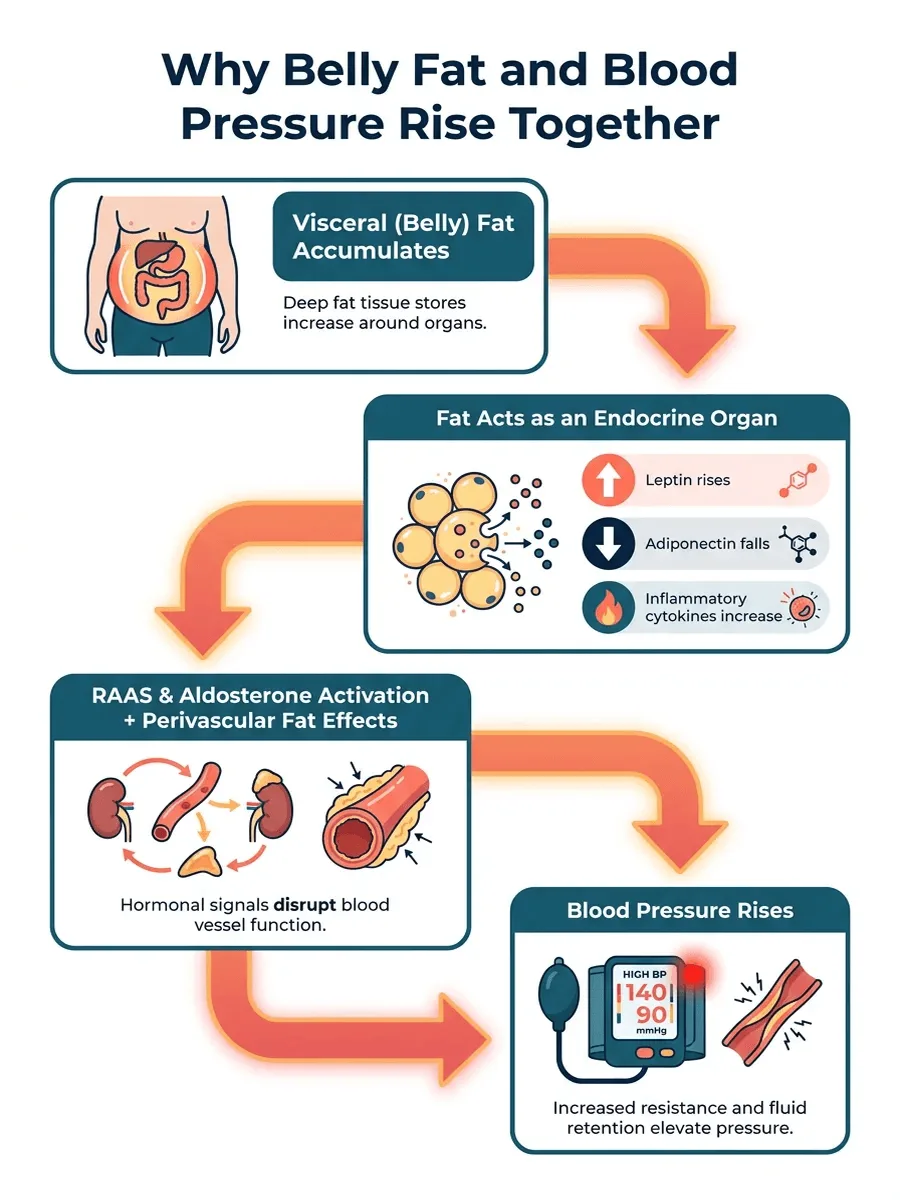
The adipokine, inflammatory, and RAAS/perivascular fat pathway connecting belly fat to rising blood pressure.
It is worth briefly acknowledging that sodium retention by the kidneys and sympathetic (“fight-or-flight”) nervous system activation also contribute to obesity-related hypertension. These pathways are real and clinically important — we cover them, along with the fuller causation picture, in our guide on what causes high blood pressure. Here, our focus is the adipokine, inflammatory, and RAAS/perivascular fat pathway — the piece of the puzzle that explains why belly fat and blood pressure move together as a syndrome, not just as coincidental findings.
| From the clinicA patient in her late 30s had been on two blood pressure medications for three years with only partial control. Her treating physicians had never ordered a fasting insulin level. When we tested it, it was significantly elevated despite a “normal” fasting glucose — a sign of compensatory hyperinsulinemia. Her waist circumference had grown steadily over the same three years. Once insulin resistance was identified as the likely upstream driver, her management shifted from “add a third BP drug” to addressing the metabolic root alongside her existing medication. |
Does Belly Fat Cause High Blood Pressure, or Do They Just Happen Together?
Belly fat and high blood pressure are best understood as sharing a common cause rather than following a simple one-way causal line — insulin resistance and the endocrine activity of visceral fat drive both conditions simultaneously, though visceral fat also independently worsens blood pressure through the mechanisms above, making the relationship genuinely bidirectional in many patients.
This nuance matters. It is tempting to simplify the relationship into “fat causes high BP,” but the evidence points to something more layered. Insulin resistance can develop before significant weight gain is visible, and it independently raises blood pressure risk. At the same time, once visceral fat accumulates, it further worsens insulin resistance — creating what researcher Roy Taylor has described, in the context of the liver and pancreas, as a self-reinforcing “twin cycle,” where excess fat in metabolically active organs drives dysfunction that, in turn, promotes further fat accumulation.
Roy Taylor’s twin-cycle hypothesis (Taylor, 2013) was developed to explain type 2 diabetes reversal, but the underlying principle — that excess fat in metabolically active tissue drives dysfunction which then promotes further fat accumulation — helps explain why belly fat and blood pressure so often move in the same direction rather than independently.
In practice, this means two people with an identical blood pressure reading and an identical waist circumference may have arrived there via slightly different weightings of the same underlying mechanisms — some more insulin-driven, some with a larger sodium-retention or sympathetic-activation component. This is precisely why metabolic syndrome is diagnosed as a cluster rather than inferred from a single number: it captures shared risk regardless of which specific pathway dominates in a given patient. For the fuller causation picture, including the sodium-retention and nervous-system pathways in detail, see our guide on what causes high blood pressure.
Metabolic Syndrome Diagnostic Criteria
The table below summarises the markers commonly used in ATP III/IDF-style metabolic syndrome criteria. A diagnosis is generally considered when three or more markers are present. Exact numeric thresholds vary by criteria set and by population — please consult your physician for values applicable to you.
| Marker | Commonly Cited Threshold Range | Notes |
| Waist circumference (central obesity) | Ethnicity- and sex-specific; commonly cited IDF South-Asian cutoffs are approximately ≥90 cm (men) / ≥80 cm (women) | Flagged for clinical verification — population-specific; consult your physician |
| Blood pressure | Commonly cited as ≥130/85 mmHg, or on treatment for hypertension | International criteria vary slightly; consult your physician |
| Triglycerides | Commonly cited as ≥150 mg/dL, or on lipid-lowering treatment | Part of the atherogenic dyslipidaemia pattern |
| HDL cholesterol | Commonly cited as <40 mg/dL (men) / <50 mg/dL (women) | Low HDL, not high LDL, is the syndrome-specific marker |
| Fasting glucose | Commonly cited as ≥100 mg/dL, or on treatment for elevated glucose | Reflects early insulin resistance, often before diabetes develops |
This table is an educational overview of internationally used criteria (ATP III/IDF), not a diagnostic tool. Please consult your physician for population-specific thresholds and formal diagnosis. Note: the infographic below uses commonly cited general-population waist circumference figures; Indian/South-Asian patients should ask their physician about ethnicity-specific IDF cutoffs, which are typically lower.
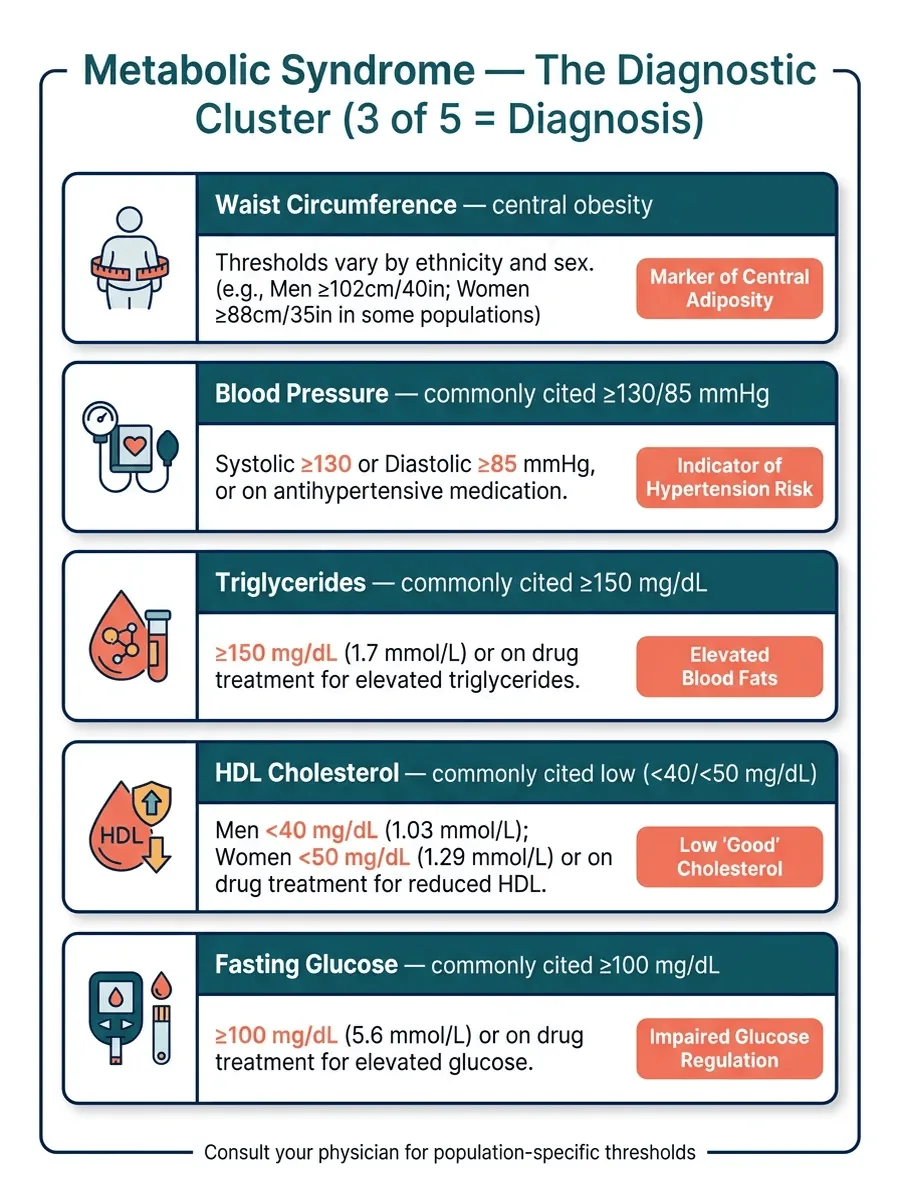
Metabolic syndrome is diagnosed when three or more of these five markers are present.
What Does This Mean for Treatment?
If belly fat and high blood pressure share a metabolic root, they should be evaluated and managed as one connected condition — with insulin resistance as a central target — rather than as two separate numbers monitored on two different dashboards by two different specialists.
In practice, this shifts the clinical conversation. Instead of asking only “how do we get this BP number down,” the more useful question becomes: “what is driving both the waist circumference and the blood pressure at the same time?” Addressing insulin resistance — through nutrition, activity, sleep, and stress management — may improve multiple markers in the metabolic syndrome cluster simultaneously, in selected patients, rather than requiring a separate intervention for each one.
This does not mean lifestyle change is a substitute for medication.
Any adjustment to blood pressure medication — reducing dose, changing drug class, or stopping altogether — is a physician decision only. Weight loss and metabolic improvement may, in selected patients, allow a physician to safely adjust antihypertensive treatment over time, but patients should never self-discontinue or self-adjust BP medication based on how their weight or symptoms feel.
For the detailed, step-by-step lifestyle protocol — including the dietary pattern, sodium and potassium targets, and exercise recommendations that support healthy blood pressure — see our full guide on natural ways to lower blood pressure. This article’s purpose is different: to help you understand why your belly fat and blood pressure are connected in the first place, so the “how” makes more sense when you get there.
| From the clinicA patient who had been told for years to “just watch her diet a bit” for her creeping BP and waistline was, on closer assessment, found to meet full metabolic syndrome criteria — elevated waist circumference, BP, triglycerides, and fasting glucose. Reframing her care around the shared insulin-resistance driver, in coordination with her physician for medication oversight, changed both what she focused on and how her follow-up numbers were tracked — as one interconnected picture rather than four separate line items. |
At Redial Clinic in Green Park, New Delhi, this cluster-based approach is the starting point for every metabolic assessment we run — because treating the numbers separately, in our experience, usually means addressing the same root cause four times over instead of once.
Frequently Asked Questions
Does belly fat cause high blood pressure?
Belly fat contributes directly to high blood pressure, primarily through visceral fat’s activity as an endocrine organ — releasing adipokines like leptin, reducing protective adiponectin, driving inflammation, and activating the RAAS/aldosterone pathway. It is not the sole cause, but in most patients with both findings, it is a major, measurable contributor rather than a coincidence.
The relationship works alongside shared drivers like insulin resistance, meaning belly fat and blood pressure often rise together because one underlying process is pushing both upward, not because one simply causes the other in isolation.
Can losing belly fat lower blood pressure?
Reducing visceral fat has been shown to help lower blood pressure in many patients, by improving insulin sensitivity and reducing the adipokine and inflammatory signals that drive vascular dysfunction. It may improve blood pressure meaningfully in selected patients, though results vary by individual and by underlying cause.
Importantly, any change to blood pressure medication based on improved weight or metabolic markers must be made by a physician — never stop or adjust antihypertensive medication on your own, even if your waistline and readings are improving.
Why do BP and weight rise together?
BP and weight tend to rise together because both are frequently driven by the same underlying process: insulin resistance and the hormonal activity of expanding visceral fat. This shared root, rather than two unrelated coincidences, is why doctors increasingly look at them as one clustering condition — metabolic syndrome — instead of two separate problems.
This is distinct from simply gaining weight from overeating; it reflects a metabolic state where fat tissue itself begins actively signalling in ways that raise blood pressure.
What is metabolic syndrome?
Metabolic syndrome is a cluster of at least three of five interconnected risk markers — central obesity, high blood pressure, high triglycerides, low HDL cholesterol, and impaired fasting glucose — that commonly occur together because they share insulin resistance as an upstream driver. It is a pattern-recognition diagnosis, not a single disease with one test.
Meeting the criteria significantly raises long-term risk for type 2 diabetes and cardiovascular disease, which is why clinicians increasingly screen for the full cluster rather than treating each marker in isolation.
Medical Disclaimer
This article is intended for general educational purposes only and does not constitute medical advice, diagnosis, or treatment. Metabolic syndrome, hypertension, and related conditions require individualised clinical assessment. Always consult a qualified physician before making changes to your diet, exercise routine, or medication — and never stop or adjust blood pressure medication without direct medical guidance. Individual results and outcomes vary.
Next Step
| If your blood pressure and your waistline have been climbing together, it may be time to look at the shared root cause rather than treating each number separately. Redial Clinic, located in Green Park, New Delhi, offers comprehensive metabolic syndrome assessments that evaluate insulin resistance, blood pressure, waist circumference, and lipid and glucose markers as one connected picture — under Dr. Gagandeep Singh’s clinical oversight, always working alongside your existing physician’s care where medication is involved.
Book a Metabolic Assessment at Redial Clinic to understand what is actually driving your numbers. |
Related Reading
- What Causes High Blood Pressure in Young Adults — the full causation picture, including sodium retention and sympathetic nervous system pathways
- Natural Ways to Lower Blood Pressure — the full lifestyle protocol
- The Link Between Hypertension and Diabetes
- What Is Insulin Resistance?
- Lifestyle Modifications for Blood Pressure Control
- Hypertension Reversal Treatment at Redial Clinic
References
- DeFronzo RA, Tripathy D, “Skeletal Muscle Insulin Resistance Is the Primary Defect in Type 2 Diabetes,” Diabetes Care, 2009. https://doi.org/10.2337/dc09-S302
- Taylor R, “Banting Memorial Lecture 2012: Reversing the Twin Cycles of Type 2 Diabetes,” Diabetes Care, 2013. https://doi.org/10.2337/dc12-1805
- Hall JE, do Carmo JM, da Silva AA, Wang Z, Hall ME, “Obesity-Induced Hypertension: Interaction of Neurohumoral and Renal Mechanisms,” Circulation Research, 2015. https://doi.org/10.1161/CIRCRESAHA.116.305697
- Ferrannini E, Buzzigoli G, Bonadonna R, et al., “Insulin Resistance and Hypertension,” New England Journal of Medicine, 1987. https://doi.org/10.1056/NEJM198708063170605
- Neeland IJ, Lim S, Tchernof A, Gastaldelli A, Rangaswami J, Ndumele CE, Powell-Wiley TM, Després JP, “Metabolic Syndrome,” Nature Reviews Disease Primers, 2024. https://doi.org/10.1038/s41572-024-00563-5
- Anjana RM, et al., “Metabolic Non-Communicable Disease Health Report of India: The ICMR-INDIAB National Cross-Sectional Study (ICMR-INDIAB-17),” Lancet Diabetes & Endocrinology, 2023. https://doi.org/10.1016/S2213-8587(23)00119-5

 Facebook
 Instagram
 LinkedIn