



Written By: Dr. Gagandeep Singh
Medically Reviewed By: Dr. Gagandeep Singh, MBBS
Last Updated: 30 Sept 2026
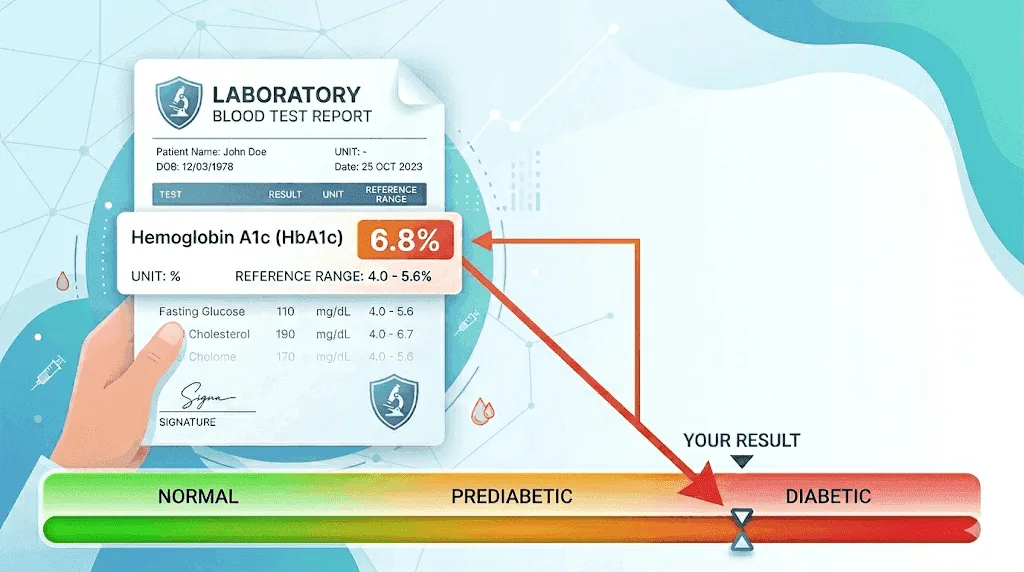
Patients often hear “your HbA1c is okay” without anyone explaining whether “okay” means healthy, acceptable, or merely less alarming than last time. HbA1c is one of the most important blood tests in diabetes care, yet it is also one of the least well-explained. If you have recently received your lab report and are wondering what is the normal HbA1c level, this article will help you understand what your number really means and why the answer is not as simple as a single cut-off.
In this guide, we break down the standard HbA1c ranges for normal, prediabetic, and diabetic levels, explain how age and other factors can influence your reading, and share what doctors actually look for when they review your result. We also cover situations where HbA1c can be misleading something especially relevant for Indian patients.
📋 Key Takeaways
- An HbA1c below 5.7% is considered normal. Between 5.7% and 6.4% falls in the prediabetic range, and 6.5% or above indicates diabetes.
- HbA1c reflects your average blood sugar over the past 2–3 months, not a single-day snapshot.
- For most adults with diabetes, the ADA recommends a target HbA1c below 7%, but individual goals may vary based on age, health status, and risk of hypoglycaemia.
- “Normal” on a lab report does not always mean optimal, an HbA1c of 5.9% is technically within range but already signals elevated metabolic risk.
- HbA1c can be unreliable in people with iron deficiency anaemia, thalassaemia trait, or certain haemoglobin variants — conditions that are common in India.
What HbA1c Actually Measures
HbA1c (glycated haemoglobin) measures the percentage of haemoglobin in your red blood cells that has glucose attached to it, reflecting your average blood sugar over the preceding two to three months. Unlike a fasting blood sugar test, which captures a single moment, HbA1c provides a longer-term picture of glycaemic control.
Here is how it works in simple terms. Glucose in your bloodstream naturally attaches to haemoglobin — the oxygen-carrying protein inside red blood cells. The higher your blood sugar has been over the past few months, the more glucose becomes attached, and the higher your HbA1c percentage. Since red blood cells typically live for about 90–120 days, the test essentially averages your sugar exposure across that window.
This is why HbA1c is considered the gold standard for monitoring diabetes management and is also used as a diagnostic tool by both the ADA and WHO.
Normal, Prediabetic, and Diabetic HbA1c Ranges
According to the ADA’s 2025 Standards of Care, an HbA1c below 5.7% is classified as normal, 5.7–6.4% indicates prediabetes, and 6.5% or higher on two separate tests confirms a diabetes diagnosis. These thresholds are used worldwide, including in Indian clinical practice.
| Category | HbA1c (%) | HbA1c (mmol/mol) | What It Means |
| Normal | Below 5.7% | Below 39 | Blood sugar well controlled; low diabetes risk |
| Prediabetes | 5.7% – 6.4% | 39 – 47 | Elevated risk; action needed to prevent progression |
| Diabetes | 6.5% or above | 48 or above | Diagnostic threshold; confirms diabetes on repeat testing |
| Target for most adults with diabetes | Below 7% | Below 53 | ADA-recommended goal; may be individualised |
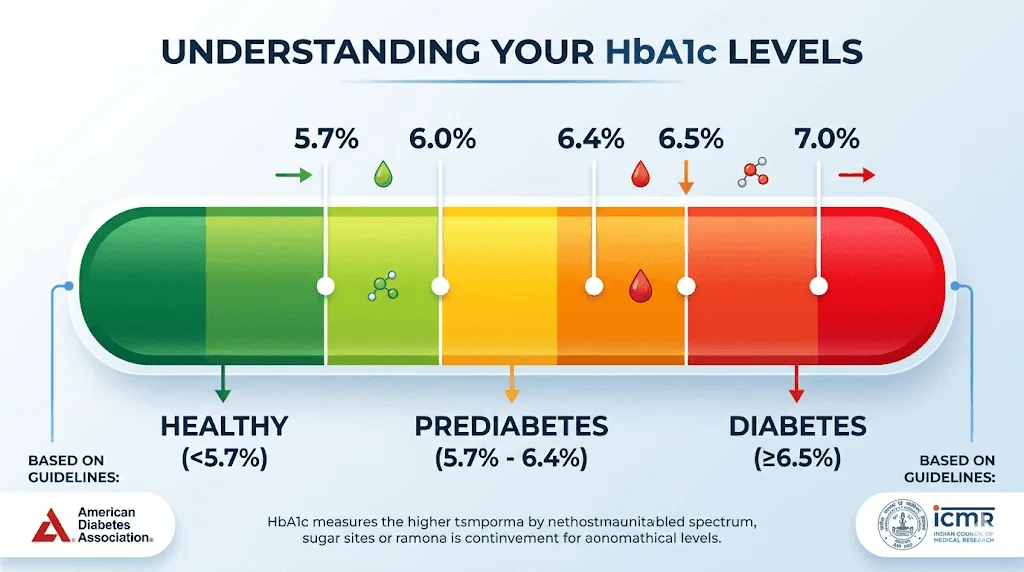
We frequently see patients at Redial Clinic whose HbA1c sits at 5.8% or 5.9% — technically within the “normal” range on many lab printouts. But when we pair that with a fasting insulin level that is already creeping up, the picture looks quite different. A number that is “in range” is not necessarily the same as a number that is optimal. For most healthy adults, an HbA1c closer to 5.0–5.4% is what we would consider truly healthy.
Does HbA1c Vary by Age?
The diagnostic thresholds for HbA1c (5.7% for prediabetes and 6.5% for diabetes) do not change with age, but the treatment targets for people already living with diabetes may be relaxed in older adults to reduce the risk of hypoglycaemia.
In younger and otherwise healthy adults with type 2 diabetes, most guidelines recommend an HbA1c target below 7% (and sometimes below 6.5% if it can be achieved safely). For older adults — especially those over 65 with multiple health conditions — the ADA’s 2025 guidelines suggest that a target of 7.5–8% may be more appropriate, because aggressively lowering blood sugar in this group can increase the risk of dangerous hypoglycaemic episodes, falls, and related complications.
In children, the normal range remains the same (below 5.7%), while the treatment target for children with type 1 diabetes is typically below 7–7.5%. During pregnancy, tighter control is expected, with recommended values generally below 6% and ideally below 5.7% to reduce the risk of foetal complications.
The key takeaway is that while the definition of “normal” HbA1c does not shift with age, the target your doctor sets for you should be personalised based on your age, overall health, risk of low blood sugar, and how long you have had diabetes.
Why HbA1c Is Useful — But Not Perfect
HbA1c is one of the most reliable markers for long-term blood sugar control because it averages glucose exposure over months rather than hours, making it far less affected by day-to-day variation in meals, stress, or timing of the blood draw. This is why it does not require fasting and can be taken at any time of day.
However, HbA1c has important limitations that patients and even some doctors overlook.
It can miss glucose variability. Two patients can have the same HbA1c of 7%, but one may have steady blood sugar throughout the day while the other swings between sharp spikes after meals and low dips at night. HbA1c cannot distinguish between these patterns. This is why, at Redial Clinic in Green Park, New Delhi, we often combine HbA1c with post-meal glucose checks or continuous glucose monitoring (CGM) data to get a complete picture.
It reflects the past, not the present. Because HbA1c averages the previous 2–3 months, it takes time to reflect recent lifestyle changes. A patient who has significantly improved their diet and exercise routine may not see the HbA1c improvement for 8–12 weeks. This is normal — do not be discouraged if the number has not budged yet at your first follow-up.
It does not replace fasting or post-meal glucose testing. If your doctor suspects diabetes or prediabetes, they may use fasting glucose, an oral glucose tolerance test (OGTT), or post-meal readings alongside HbA1c to confirm the diagnosis or assess your day-to-day patterns.
When HbA1c Can Mislead
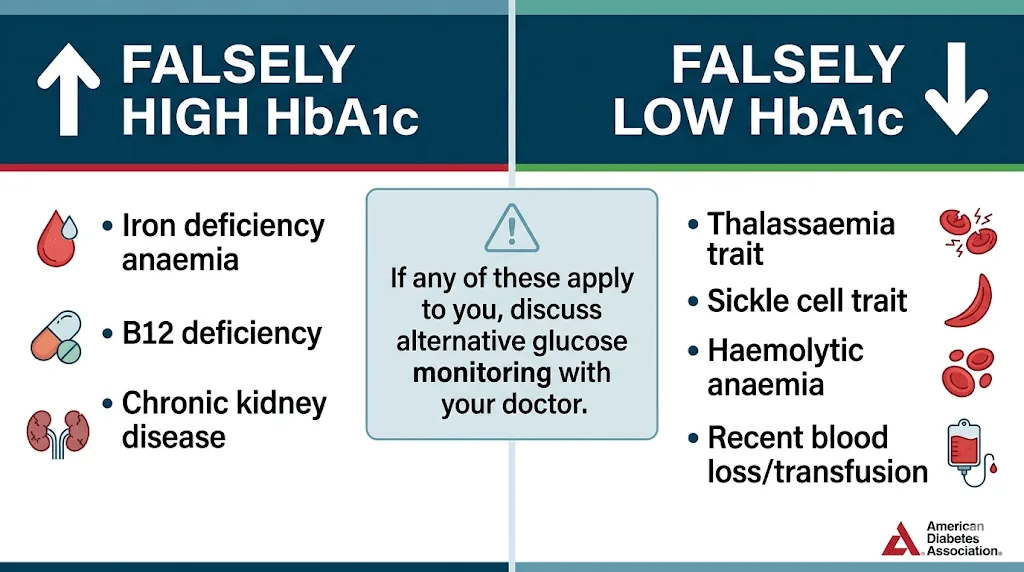
HbA1c results can be falsely elevated or falsely low in certain medical conditions that alter haemoglobin or red blood cell lifespan, which means the number on your report may not accurately reflect your true average blood sugar. This is particularly relevant in India, where several of these conditions are common.
Conditions that can falsely raise HbA1c
- Iron deficiency anaemia — one of the most common nutritional deficiencies in India, especially among women. Lower haemoglobin turnover means glucose stays attached for longer, artificially inflating the HbA1c reading.
- Vitamin B12 deficiency — common among vegetarians, which represents a large proportion of the Indian population.
- Chronic kidney disease — altered red blood cell metabolism affects glycation.
Conditions that can falsely lower HbA1c
- Thalassaemia trait or sickle cell trait — haemoglobin variants shorten red blood cell lifespan, meaning less time for glucose to attach. Thalassaemia trait is prevalent in several Indian communities, particularly in Gujarat, Punjab, Sindh, and parts of southern India.
- Haemolytic anaemia — rapid red blood cell destruction reduces glycation time.
- Recent significant blood loss or blood transfusion — dilutes or replaces the existing red blood cell pool.
In our clinic, we routinely check a complete blood count and iron studies alongside HbA1c — not as an afterthought, but because so many of our patients in Delhi have underlying iron deficiency or thalassaemia trait that can distort the reading. If your HbA1c seems inconsistent with your home glucose readings or your CGM data, ask your doctor whether a haemoglobin variant or anaemia could be affecting the accuracy.
Redial Case Study: A man in his seventies illustrates why the trend matters more than any single reading. Over about five months, his HbA1c fell steadily from above 10% to 6.9%. Part of that improvement was already underway before he joined our programme. Over the same period, one fasting glucose reading actually rose, from around 115 to around 135 mg/dL. Judged on that single morning’s number, he appeared to be getting worse; the HbA1c, averaging months of exposure, showed the real direction.
The ICMR guidelines also recommend that HbA1c testing in India be done through NGSP-certified laboratories to ensure standardised and reliable results.
What to Do if Your HbA1c Is Elevated
If your HbA1c is elevated — whether into the prediabetic or diabetic range — the most important first step is to get a comprehensive metabolic evaluation rather than reacting to a single number in isolation.
Here is what a thorough evaluation typically includes.
- Repeat confirmation: A single elevated HbA1c should be confirmed with a repeat test or a fasting glucose test unless symptoms of diabetes are already present.
- Look at the full metabolic picture: Fasting insulin, lipid profile (especially triglycerides and HDL ratio), liver enzymes, waist circumference, and blood pressure all contribute to the assessment. At Redial Clinic, our metabolic workup includes all of these because HbA1c alone only tells part of the story.
- Address root causes: For many patients, insulin resistance is the underlying driver. Lifestyle changes — particularly reducing refined carbohydrate intake, adding structured physical activity, improving sleep quality, and managing stress — form the foundation of any improvement strategy.
- Consider Indian dietary realities: The typical Indian diet is carbohydrate-heavy — roti, rice, and dal at every meal, sweetened chai multiple times a day, and festival or social sweets. Small, sustainable modifications to meal structure and carbohydrate quality can meaningfully shift HbA1c over 3–6 months.
- Monitor your progress: Recheck HbA1c every 3 months while making changes. This timeframe aligns with the red blood cell lifespan that the test measures.
Redial Case Study: A woman who came to us with an HbA1c of 6.5% saw it fall to 6.0% within about two months on a structured, lower-carbohydrate eating plan. Her post-meal glucose improved sharply, from around 165 to around 115 mg/dL. Yet her fasting insulin barely moved. Her HbA1c said she was improving; her insulin level said the underlying resistance had not shifted yet. This is why we never judge progress on HbA1c alone, and why her plan stayed focused on her metabolic markers rather than stopping at a better number.
If lifestyle changes alone are not sufficient, medication may be needed — and that is not a failure. It is a practical decision made in partnership with your doctor based on your individual metabolic profile.
Frequently Asked Questions
Is HbA1c affected by fasting?
No, HbA1c is not affected by fasting. Unlike fasting blood sugar, the HbA1c test can be done at any time of day regardless of when you last ate. It measures glucose that has accumulated on red blood cells over weeks and months, so a single meal has no impact on the result. This convenience is one reason HbA1c is widely preferred for both diagnosis and long-term monitoring.
Can HbA1c be normal but sugar still spike after meals?
Yes, this is entirely possible and more common than many people realise. HbA1c is an average. A patient who experiences significant post-meal blood sugar spikes but has normal fasting sugar may still produce an HbA1c that looks acceptable overall. This is why post-meal glucose testing or CGM can be valuable for people whose HbA1c appears “normal” but who still have symptoms like fatigue, brain fog, or energy crashes after meals.
What is the best HbA1c target for most adults?
For most non-pregnant adults with diabetes, the ADA recommends a target HbA1c below 7%. However, a more aggressive target of below 6.5% may be appropriate for younger patients, those early in their diagnosis, or those at low risk of hypoglycaemia. Conversely, for older adults or those with significant comorbidities, a target of 7.5–8% may be safer. The best target is one set collaboratively between you and your doctor, taking your full health picture into account.
How often should HbA1c be checked?
For people with diabetes, HbA1c should be tested every 3 months if blood sugar is not at target, or at least twice a year if control is stable. For people with prediabetes, annual testing is recommended. If you are making active lifestyle changes, checking every 3 months gives you timely feedback on whether those changes are translating into measurable improvement. Your doctor may adjust this frequency based on your individual situation.
Not sure what your HbA1c really means for your health?
If your HbA1c is borderline or elevated and you want to understand the full metabolic picture — not just one number — consider getting your reports reviewed by a team that looks at the complete story. At Redial Clinic in Green Park, New Delhi, we assess HbA1c alongside fasting insulin, lipid markers, and other metabolic indicators so that you get clarity on what is actually happening and a practical plan to improve it.
| Book a Metabolic Assessment at Redial Clinic, Green Park, New Delhi. |
Disclaimer: This article is for informational purposes only and does not constitute medical advice. Always consult a qualified healthcare professional before making changes to your diet, exercise, medication, or treatment plan.
References
1. American Diabetes Association Professional Practice Committee, “2. Diagnosis and Classification of Diabetes: Standards of Care in Diabetes—2025,” Diabetes Care, 2025.
https://doi.org/10.2337/dc25-S002
2. World Health Organization, “Use of Glycated Haemoglobin (HbA1c) in the Diagnosis of Diabetes Mellitus,” WHO, 2011.
3. Indian Council of Medical Research, “ICMR Guidelines for Management of Type 2 Diabetes,” ICMR, 2018.
4. Anjana RM et al., “Achievement of guideline recommended diabetes treatment targets in people with self-reported diabetes in India (ICMR-INDIAB-13),” Lancet Diabetes Endocrinol, 2022.
https://doi.org/10.1016/S2213-8587(22)00072-9
5. American Diabetes Association Professional Practice Committee, “6. Glycemic Goals and Hypoglycemia: Standards of Care in Diabetes—2025,” Diabetes Care, 2025.
https://doi.org/10.2337/dc25-S006
 Facebook
 Instagram
 LinkedIn