





Written by: Dr. Gagandeep Singh, MBBS
Medically reviewed by: Dr. Gagandeep Singh, MBBS
Last updated: 24 Oct 2026 · Redial Clinic, Green Park, New Delhi
Semaglutide can genuinely reduce appetite and weight but it works best as one tool inside a plan that also protects muscle and builds lasting habits.
| Key Takeaways Semaglutide is a GLP-1 receptor agonist that reduces appetite, slows gastric emptying, and increases satiety — originally developed for type 2 diabetes (Ozempic), now also approved specifically for weight management at a higher dose (Wegovy). In the STEP 1 trial, adults with obesity or overweight and without diabetes lost an average of 14.9% of body weight on semaglutide 2.4mg over 68 weeks, versus 2.4% on placebo — a substantial, clinically meaningful effect, though results vary between individuals. Semaglutide is not a standalone fix. A meaningful share of weight lost on GLP-1 medication can come from lean muscle rather than fat alone, which is why resistance training and adequate protein intake matter more, not less, while on it. The most common side effects are gastrointestinal — nausea, diarrhoea, constipation, and reflux — usually manageable with slow dose titration, but not trivial for everyone. Weight tends to return after stopping semaglutide unless the underlying habits, muscle mass, and metabolic drivers have also been addressed — which is why Redial Clinic frames it as one tool inside a root-cause programme, not a replacement for one. Cost in India has fallen since generic semaglutide launched in 2026 but still varies widely by brand and dose. Discuss it openly with your doctor before starting. |
Semaglutide has become one of the most talked-about medications in weight management — sold as Ozempic (for type 2 diabetes) and Wegovy (for weight management), and increasingly asked about by patients who have heard dramatic before-and-after stories. Some of that reputation is earned: the clinical trial data on weight loss is genuinely strong. Some of it is oversold, particularly around what happens to muscle mass during rapid weight loss, and what happens after the medication stops.
This guide covers what semaglutide actually is, how it works in the body, what the real trial data shows, its safety profile, the muscle-loss question that gets underdiscussed, and how we think about it at Redial Clinic — as a genuinely useful tool that works best alongside a root-cause metabolic approach, not as a replacement for one.
| Patient example (de-identified) A patient in their fifties arrived with type 2 diabetes, high blood pressure, high cholesterol and obesity. The first visit set out a plan built on diet and exercise, and baseline testing covered HbA1c, fasting insulin, lipids, liver function and a liver stiffness scan, so the plan started from measurements, not from the scale alone. |
What is semaglutide and how does it work?
Semaglutide is a GLP-1 (glucagon-like peptide-1) receptor agonist — a lab-made version of a natural gut hormone that your intestine releases after eating. It works by acting on GLP-1 receptors in the brain to reduce appetite, slowing gastric emptying so meals feel more filling for longer, and increasing insulin release in response to food, which together lead to eating less and losing weight over time.
GLP-1 is a hormone your gut already produces normally after meals — its natural job is to help regulate blood sugar and signal fullness. Semaglutide mimics this hormone but stays active in the body for about a week (hence once-weekly dosing), giving it a much longer and more sustained effect than the natural hormone, which is broken down within minutes.
The effect works through three connected mechanisms:
- Brain (hypothalamus): semaglutide acts on appetite-control centres in the brain, directly reducing hunger signals and food cravings — many patients describe simply thinking about food less.
- Stomach (gastric emptying): it slows the rate at which food leaves the stomach, so a normal-sized meal produces a stronger and longer-lasting feeling of fullness.
- Pancreas (glucose-dependent insulin release): it increases insulin secretion specifically when blood glucose is elevated, and suppresses glucagon, which is why it was originally developed and remains approved for type 2 diabetes.
These actions are described in detail in reviews of GLP-1 biology and pharmacology (Drucker, Cell Metabolism, 2018) [1].
Semaglutide’s weight-loss effect comes from three connected mechanisms: reduced appetite signalling in the brain, slower gastric emptying, and increased satiety after meals.
Does semaglutide work for weight loss? The STEP 1 trial data
Yes, for most people it produces substantial, clinically meaningful weight loss — but results vary and it is not effective for everyone. In the landmark STEP 1 trial, adults with obesity or overweight (with at least one weight-related condition) lost an average of 14.9% of their body weight over 68 weeks on semaglutide 2.4mg plus lifestyle support, compared with 2.4% on placebo plus the same lifestyle support (Wilding JPH et al., NEJM, 2021).
The STEP 1 trial randomised 1,961 adults without diabetes (BMI of 30 or more, or 27 or more with a weight-related condition) 2:1 to semaglutide 2.4mg weekly or placebo, both alongside diet and exercise counselling, over 68 weeks. The results were among the strongest ever recorded for a weight-loss medication at the time of publication:
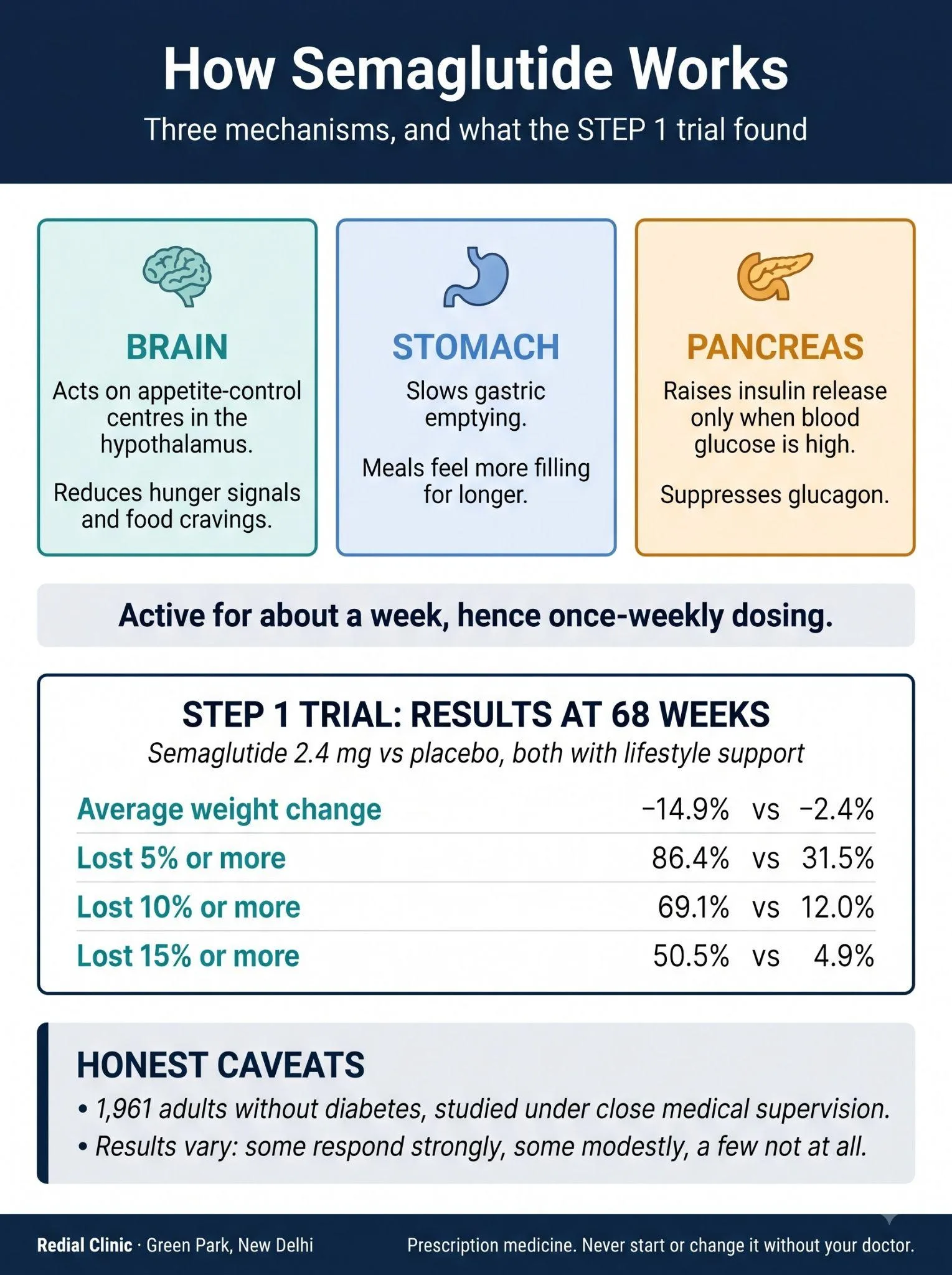
Wilding JPH, Batterham RL, Calanna S, et al., “Once-Weekly Semaglutide in Adults with Overweight or Obesity,” New England Journal of Medicine, 2021. [2]
A few honest caveats worth stating plainly: this was a trial population studied under close medical supervision with structured lifestyle counselling included for both arms — real-world results in routine clinical use tend to be somewhat more variable. Weight loss is also not uniform across individuals; some patients respond dramatically, others more modestly, and a small proportion do not respond meaningfully at all. “Does semaglutide work” is best answered as “it works well for most people, substantially, but it is not universal or automatic” — not as a guarantee.
| From the clinicA pattern we see in consultations at Redial Clinic — patients arrive having read about the STEP 1 results and expect the number on the scale to be the whole story. What often gets missed in the conversation before starting is what the medication does not do on its own: it does not build muscle, it does not fix the habits that drove weight gain in the first place, and it does not guarantee the weight stays off once stopped. The patients who do best combine it with a structured plan rather than treating it as a stand-alone solution. |
Ozempic vs Wegovy — what’s the difference for weight loss?
Ozempic and Wegovy contain the exact same active ingredient, semaglutide, made by the same manufacturer — the difference is regulatory indication and dose. Ozempic is approved and dosed for type 2 diabetes (typically up to 1–2mg weekly); Wegovy is approved specifically for chronic weight management at a higher maximum dose (2.4mg weekly), which is the dose studied in the STEP 1 trial.
In practice, both are prescribed off-label or on-label for weight loss depending on the country, the patient’s diabetes status, and availability — which is why “Ozempic for weight loss” and “Wegovy weight loss” are often searched as if they were different drugs, when they are the same molecule at different doses and approval pathways. Your doctor’s choice between them depends on whether you also have type 2 diabetes, dose availability, and cost. Wegovy has been available in India since June 2025.
Is semaglutide safe? Side effects and who should be cautious
Semaglutide has a well-studied safety profile from large randomised trials, and is considered safe for most appropriately screened adults under medical supervision — but it is not free of side effects, and it is not appropriate for everyone. The most common issues are gastrointestinal (nausea, vomiting, diarrhoea, constipation, reflux), and a small number of more serious risks require screening before starting.
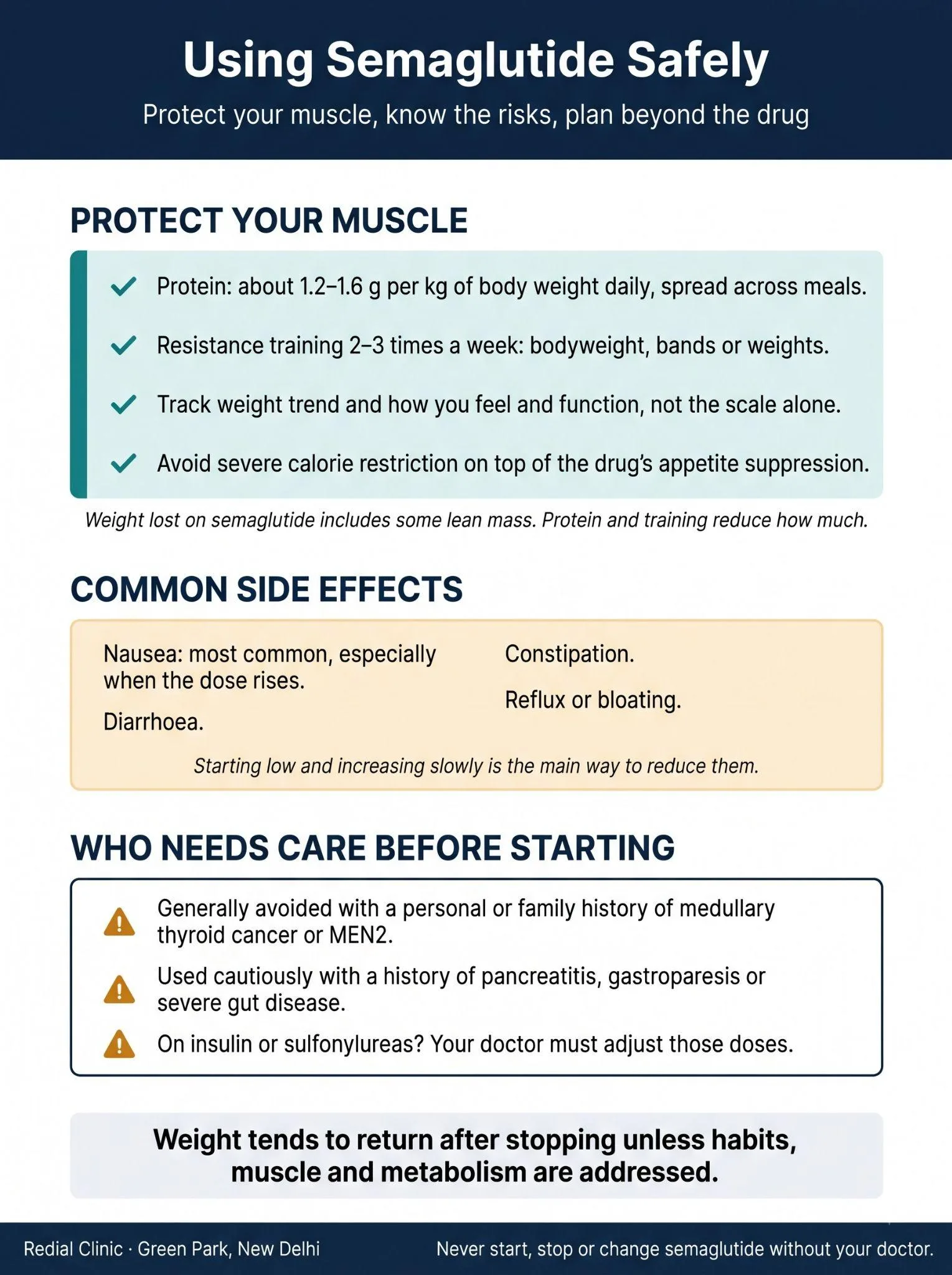
Nausea and diarrhoea were the most common adverse events with semaglutide in STEP 1, and 4.5% of people taking it stopped treatment because of gastrointestinal side effects, compared with 0.8% on placebo [2].
Gallstones were reported more often than with placebo in STEP 1. Pancreatitis is uncommon. Thyroid C-cell tumours occurred in rodent studies; the human risk is not established, and the medicine is avoided with a personal or family history of medullary thyroid cancer or MEN2.
Medication safety note: semaglutide is not appropriate for everyone. It is generally avoided in people with a personal or family history of medullary thyroid carcinoma or Multiple Endocrine Neoplasia syndrome type 2, and used cautiously in those with a history of pancreatitis, significant gastroparesis, or severe gastrointestinal disease. If you are on insulin, sulfonylureas, or other glucose-lowering medication, starting semaglutide can meaningfully change your blood sugar control and medication needs — any dose adjustment to existing diabetes or blood pressure medication must be made by your physician, with monitoring, never self-directed. It is also not suitable during pregnancy or breastfeeding, and your doctor will advise when to stop before planned pregnancy. It is not a replacement for insulin in type 1 diabetes. Tell your doctor about any history of eating disorders or diabetic eye disease, and tell your anaesthetist before any procedure.
Dose titration — starting low and increasing gradually over weeks — is the main lever used to reduce side effects, which is why self-adjusting or skipping the titration schedule is not advisable.
Does semaglutide cause muscle loss, not just fat loss?
Weight lost on semaglutide is not purely fat — a portion is lean mass, including skeletal muscle, and this proportion can be meaningful during rapid weight loss. How much varies between studies, and adequate protein intake and resistance training are widely recommended to help preserve muscle, but it is a genuine risk that deserves more attention than it typically gets.
The evidence on muscle is mixed. One small retrospective study of 88 adults with type 2 diabetes, using bioimpedance, found weight loss of about 9.5% over 24 weeks came mainly from fat, without substantial lean-mass loss, and visceral fat area fell while phase angle (a body-composition marker) stayed stable [3]. That method is less precise than DXA, the study pooled oral and injectable semaglutide, and it was not a trial of the 2.4 mg dose, so it cannot be assumed to apply to everyone. A 2024 review found that lean mass made up 40–60% of the weight lost in some GLP-1 studies and about 15% or less in others, with differences linked to population, drug and coexisting conditions, and it noted that lean mass is not the same as muscle [4].
The mechanism risk is straightforward: rapid weight loss from any cause — calorie restriction, surgery, or medication — pulls from both fat and lean tissue unless the body is given a specific reason (resistance training) and specific fuel (adequate protein) to preserve muscle. Skeletal muscle is also your body’s largest site of insulin-driven glucose disposal [5] — the same two-lever model of reducing glucose supply and increasing glucose demand that underlies our approach to insulin resistance applies directly here. Losing weight while also losing muscle undermines the very metabolic engine you are trying to improve.
Two practical levers — adequate protein intake and regular resistance training — meaningfully change how much of the weight lost on semaglutide comes from muscle versus fat.
Practical steps we recommend to any patient starting semaglutide:
- Aim for roughly 1.2–1.6g of protein per kg of body weight daily, spread across meals (individualised by your care team; check with your doctor first if you have kidney disease), from foods such as dal, paneer, eggs, curd and sprouts — appetite suppression makes this harder than it sounds, so it often needs active planning.
- Do resistance training 2–3 times a week — bodyweight, resistance bands, or weights are all reasonable starting points; this is the single strongest lever for preserving lean mass during rapid weight loss.
- Track weight trend alongside how you feel and function, not the scale number alone — unusual weakness or fatigue beyond typical GI side effects is worth flagging to your doctor.
- Avoid combining semaglutide with severe calorie restriction on top of its appetite-suppressing effect — under-eating protein and calories together increases muscle-loss risk.
| From the clinicA pattern we see in our clinic — patients who start semaglutide expecting the medication alone to do the work often eat very little without realising it, simply because appetite drops sharply. Several months in, the weight loss on the scale looks like a win, but strength and stamina have quietly dropped too. Once we add a structured protein target and twice-weekly resistance sessions to the same medication, the composition of the weight lost — not just the total — genuinely changes for the better. |
How much does semaglutide cost in India?
Semaglutide became much cheaper in India after its patent expired in March 2026. Reported prices in late 2026 run from roughly Rs 1,300–4,200 a month for generic semaglutide to about Rs 5,660–16,400 a month for branded Ozempic and Wegovy, depending on dose, after Novo Nordisk’s price cuts. Prices change often and vary by pharmacy, so confirm the current price with your pharmacist. Semaglutide is a prescription-only medicine: use only a licensed brand dispensed against a prescription.
Because semaglutide is typically needed for months to years to sustain results, the cumulative cost over a treatment course is significant for most Indian households. We recommend discussing cost transparently as part of the suitability conversation — including how long a realistic course might run, and what the plan is if cost becomes a barrier to continuing — rather than starting and discovering affordability is unsustainable partway through.
Do you have to stay on semaglutide for life?
Not necessarily, but weight regain after stopping is common unless the underlying drivers — habits, muscle mass, and metabolic health — have also been addressed during treatment. Semaglutide suppresses appetite while you take it; when it is stopped, appetite tends to return towards baseline, and without a structured maintenance plan, a meaningful share of the lost weight is often regained.
In the STEP 1 extension, participants regained about two-thirds of their prior weight loss within a year of stopping (11.6 of 17.3 percentage points) [6].
This is not a flaw unique to semaglutide — it is true of essentially any intervention that treats a symptom (appetite, hunger signalling) without also addressing what drove the weight gain in the first place (insulin resistance, muscle mass, food environment, activity levels). Obesity is now widely described as a chronic, relapsing condition (World Obesity Federation, 2017) [7], which is why maintenance matters. The decision to continue, reduce, or stop semaglutide is a physician-guided one, made by weighing your metabolic markers, weight trajectory, side effects, and how much of the underlying picture has genuinely changed — not a fixed rule that applies the same way to everyone.
This is exactly why we do not treat semaglutide as a substitute for addressing the root cause. Used well, it can create a window of reduced appetite in which building better habits, muscle mass, and metabolic health becomes considerably easier — the medication buys time and comfort; the underlying work still has to happen inside that window.
How Redial Clinic approaches GLP-1 medication
At Redial Clinic, we view semaglutide and other GLP-1 medications as one legitimate tool within a broader metabolic-reversal approach — never as a stand-alone prescription handed over without addressing the two-lever model of reducing glucose supply and increasing glucose demand through diet and resistance training.
Our starting point is always a proper metabolic suitability assessment: is a GLP-1 medication appropriate for you, given your health history, current medications, and goals? If it is, we build a plan around it — protein targets, a resistance-training programme, monitoring for side effects, and a clear conversation about the cost and duration of treatment — rather than prescribing it in isolation. This mirrors our broader philosophy across obesity reversal and insulin resistance: treat the engine, not just the number on the scale.
| Patient example (de-identified) A patient in their sixties with diabetes and fatty liver started a structured nutrition and exercise plan with us. Three months later, liver stiffness had fallen from 9.7 to 5.1 kPa and the liver fat score from 331 to 257. Individual results vary. |
If you are already on semaglutide elsewhere and want a second opinion on your plan — particularly around protecting muscle mass or thinking through a maintenance strategy — that conversation is also part of what a weight-loss consultation grounded in insulin resistance covers.
Frequently Asked Questions
What is semaglutide and how does it work?
Semaglutide is a GLP-1 receptor agonist — a lab-made version of a natural gut hormone. It reduces appetite by acting on the brain, slows gastric emptying so meals feel more filling for longer, and increases insulin release in response to food. It is sold as Ozempic (diabetes) and Wegovy (weight management), both containing the same active ingredient at different doses.
Does semaglutide work for weight loss?
Yes, for most people. In the STEP 1 trial, adults with obesity or overweight, without diabetes, lost an average of 14.9% of body weight over 68 weeks on semaglutide 2.4mg, versus 2.4% on placebo, with 86% of participants losing at least 5% of their body weight. Results vary between individuals, and it works best combined with adequate protein intake and resistance training rather than as a stand-alone treatment.
Is semaglutide safe?
Semaglutide has a well-studied safety profile from large randomised trials and is considered safe for most appropriately screened adults under medical supervision. The most common side effects are gastrointestinal — nausea, diarrhoea, constipation, and reflux — usually manageable with gradual dose titration. It is generally avoided in people with a personal or family history of medullary thyroid carcinoma, and used cautiously in those with a history of pancreatitis or severe gastrointestinal disease. Always start under physician supervision.
Dr. Singh has written in The Week about why doctors urge caution against self-use of GLP-1 drugs and about the risks and benefits of semaglutide for people without diabetes.
Do you have to stay on semaglutide for life?
Not necessarily, but weight regain after stopping is common unless the underlying drivers of weight gain — habits, muscle mass, and metabolic health — have also been addressed during treatment. The decision to continue, reduce, or stop is physician-guided, based on your individual metabolic picture, not a fixed rule that applies the same way to everyone.
| Considering semaglutide for weight loss?
At Redial Clinic (Green Park, New Delhi), a GLP-1 and metabolic suitability consult is where we assess whether semaglutide is right for you and build a plan around it that protects muscle and addresses the root cause, not just the scale. Book a Metabolic Assessment at Redial Clinic, Green Park, New Delhi. |
Medical Disclaimer
This article is for educational purposes and does not replace individualised medical advice. Semaglutide is a prescription medication that requires medical evaluation, screening, and supervision before and during use. Do not start, stop, or change the dose of semaglutide or any other medication based on this article — consult your physician.
References
- Drucker DJ, “Mechanisms of Action and Therapeutic Application of Glucagon-like Peptide-1,” Cell Metabolism, 2018;27:740-756. https://doi.org/10.1016/j.cmet.2018.03.001
- Wilding JPH, Batterham RL, Calanna S, Davies M, Van Gaal LF, Lingvay I, et al., “Once-Weekly Semaglutide in Adults with Overweight or Obesity,” New England Journal of Medicine, 2021. https://doi.org/10.1056/NEJMoa2032183
- Rodríguez Jiménez B, Rodríguez de Vera Gómez P, Belmonte Lomas S, Mesa Díaz ÁM, Caballero Mateos I, Galán I, Morales Portillo C, Martínez-Brocca MA, “Transforming Body Composition With Semaglutide in Adults With Obesity and Type 2 Diabetes Mellitus,” Frontiers in Endocrinology, 2024. https://doi.org/10.3389/fendo.2024.1386542
- Neeland IJ, Linge J, Birkenfeld AL, “Changes in Lean Body Mass With Glucagon-Like Peptide-1-Based Therapies and Mitigation Strategies,” Diabetes, Obesity and Metabolism, 2024;26(Suppl 4):16-27. https://doi.org/10.1111/dom.15728
- DeFronzo RA, Tripathy D, “Skeletal Muscle Insulin Resistance Is the Primary Defect in Type 2 Diabetes,” Diabetes Care, 2009. https://doi.org/10.2337/dc09-S302
- Wilding JPH, Batterham RL, Davies M, Van Gaal LF, Kandler K, Konakli K, Lingvay I, McGowan BM, Oral TK, Rosenstock J, Wadden TA, Wharton S, Yokote K, Kushner RF, “Weight Regain and Cardiometabolic Effects After Withdrawal of Semaglutide: The STEP 1 Trial Extension,” Diabetes, Obesity and Metabolism, 2022. https://doi.org/10.1111/dom.14725
- Bray GA, Kim KK, Wilding JPH, on behalf of the World Obesity Federation, “Obesity: A Chronic Relapsing Progressive Disease Process. A Position Statement of the World Obesity Federation,” Obesity Reviews, 2017. https://doi.org/10.1111/obr.12551

 Facebook
 Instagram
 LinkedIn