




Written By: Dr. Gagandeep Singh, MBBS
Medically Reviewed By: Dr. Gagandeep Singh, MBBS
Last Updated: 25 September 2026 · Redial Clinic, Green Park, New Delhi
| Key Takeaways Yes — both chronic stress and poor sleep can raise blood pressure, through overlapping but distinct mechanisms: stress drives cortisol and sympathetic (fight-or-flight) activation, while poor sleep removes the nightly “dip” blood pressure should show and adds its own sympathetic surge. Obstructive sleep apnoea (OSA) is an underdiagnosed but well-established cause of both essential and resistant hypertension — repeated night-time breathing pauses trigger oxygen drops and sympathetic surges that keep blood pressure elevated around the clock, not just at night. Blood pressure that will not settle despite three or more medications (resistant hypertension) should prompt screening for OSA — this is a recognised, treatable, and often overlooked secondary driver. Loud snoring, witnessed pauses in breathing, gasping awake at night, and excessive daytime sleepiness are the classic warning signs that warrant a sleep-study (polysomnography) referral. Sleep-hygiene and stress-reduction measures can meaningfully support blood pressure control, but they work alongside — never instead of — your prescribed antihypertensive medication and, where indicated, formal OSA treatment. Redial Clinic assesses blood pressure, sleep patterns, and metabolic risk together — but does not diagnose or treat sleep apnoea directly; confirmed or suspected OSA is referred for a sleep study and specialist management. |
If your blood pressure will not settle despite taking your medication as prescribed, the missing piece is often not another tablet — it is what happens after you go to bed. Chronic stress and poor sleep are not vague lifestyle add-ons to hypertension; they operate through specific, measurable physiological pathways, and one of them — obstructive sleep apnoea — is a recognised, treatable cause of blood pressure that resists standard treatment.
This guide walks through the mechanisms, what the evidence actually supports, and — because this is the point that gets missed most often — exactly when unexplained or resistant high blood pressure should prompt a sleep-study referral rather than simply another medication adjustment.
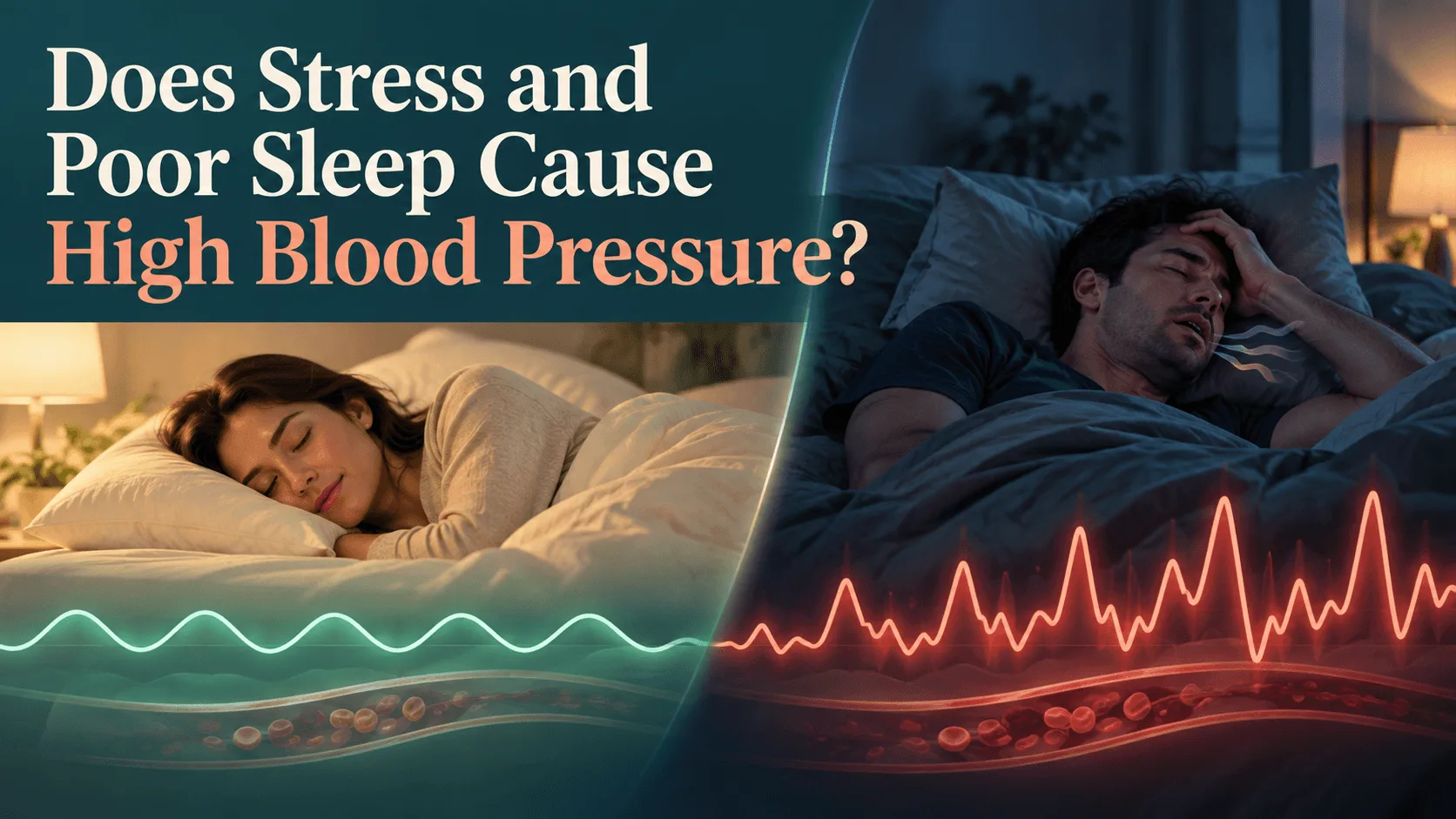
Does stress and poor sleep cause high blood pressure?
Yes. Chronic stress raises blood pressure by keeping the body’s cortisol and sympathetic (fight-or-flight) nervous system activated for far longer than is healthy, while poor sleep removes the nightly blood pressure “dip” the cardiovascular system relies on for recovery and adds its own sympathetic surge. Together, they can push blood pressure up independently of diet or weight — and when undiagnosed sleep apnoea is involved, the effect is often the dominant driver of blood pressure that will not respond to medication.
These are not separate problems that happen to occur together. Stress and poor sleep feed each other — stress hormones fragment sleep, and fragmented or shortened sleep itself raises next-day cortisol and sympathetic tone, creating a cycle that keeps blood pressure elevated round the clock rather than settling overnight the way it should in a healthy cardiovascular system.
| From the clinicWe frequently see patients whose office blood pressure looks reasonably controlled on medication, but who describe waking unrefreshed, working late into the night, or being told by a partner that they snore heavily. When we look closer — sleep history, home BP logs across the day, sometimes ambulatory monitoring — the picture that emerges is blood pressure that never truly comes down at night. Addressing the sleep and stress side alongside the medication, rather than only escalating the drug regimen, is often what finally moves the numbers. |
Can stress cause high blood pressure?
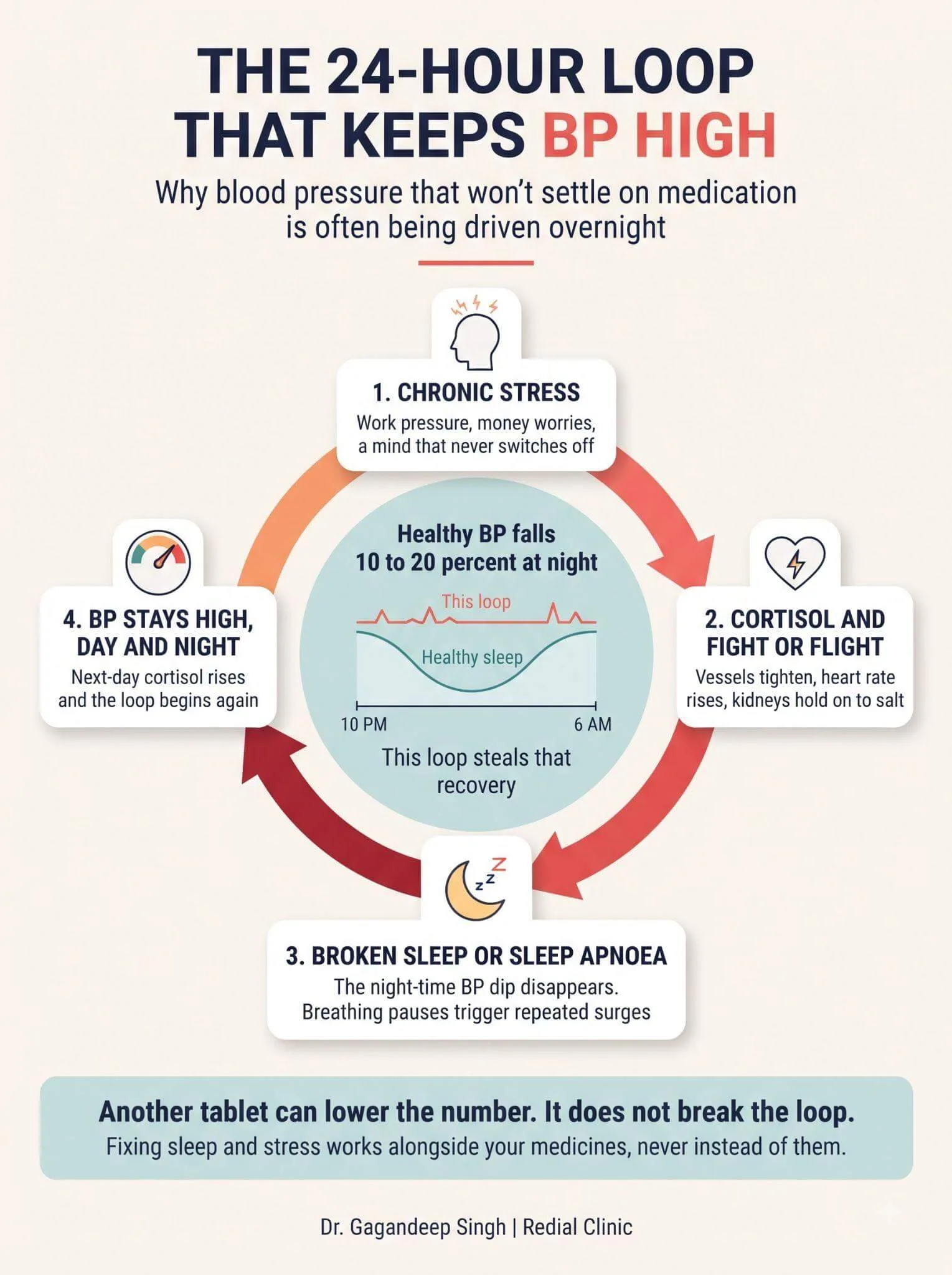
Yes — chronic psychological stress is an established contributor to the development and worsening of hypertension. It works mainly through two connected pathways: repeated activation of the hypothalamic-pituitary-adrenal (HPA) axis, which raises cortisol, and sustained activation of the sympathetic nervous system, which increases heart rate, constricts blood vessels, and prompts the kidneys to retain more sodium and fluid.
A single stressful moment causes a temporary, self-limiting blood pressure spike — that is normal physiology. The problem is chronic, unresolved stress: workplace pressure, financial strain, poor work-life boundaries, or ongoing emotional strain that never fully switches off the stress response. Reviewed evidence on the pathogenesis of essential hypertension identifies these persistent neuroendocrine and immune-system alterations — including endothelial dysfunction, where the blood vessel lining itself becomes less able to relax — as a genuine contributing pathway to sustained blood pressure elevation, not simply a correlation.
Cortisol itself has a direct blood-pressure-raising effect, independent of the sympathetic nervous system — it increases the sensitivity of blood vessels to constricting signals and promotes sodium retention by the kidneys, both of which raise blood pressure over time when cortisol stays elevated for weeks or months rather than hours.
How chronic stress raises blood pressure — the mechanism
- HPA axis activation → sustained cortisol elevation → increased vascular sensitivity to constriction and sodium retention
- Sympathetic (fight-or-flight) activation → faster heart rate, constricted blood vessels, higher cardiac output
- Endothelial dysfunction → blood vessels lose some ability to relax and widen on demand
- Reduced physical activity under chronic stress → removes one of the body’s natural counterbalances to all of the above
Does poor sleep raise blood pressure?
Yes. Blood pressure normally falls by 10 to 20 percent during deep sleep — a pattern called nocturnal “dipping” that gives the cardiovascular system nightly recovery time. Poor sleep, whether from short duration, fragmented sleep, or a circadian mismatch (working night shifts, irregular sleep timing), blunts or abolishes this dip, and the sympathetic nervous system stays more active than it should overnight, which raises average 24-hour blood pressure over time.
This is why home or ambulatory blood pressure monitoring across a full 24-hour cycle often reveals more than a single office reading — someone can look well-controlled at a daytime clinic visit while their night-time blood pressure never actually comes down. “Non-dipping” blood pressure of this kind is itself linked to a higher risk of cardiovascular complications over time, independent of the daytime number.
| Sleep pattern | What happens to blood pressure | Why |
| Consistent 7–9 hours, good quality | Normal nocturnal dip (10–20% fall overnight) | Parasympathetic (rest-and-digest) tone dominates during deep sleep stages |
| Short duration (under 6 hours), regularly | Blunted dip; higher average 24-hour BP | Sympathetic activation persists into and through the night |
| Fragmented / frequently interrupted sleep | Blunted dip; higher variability in BP | Repeated micro-arousals each trigger a small sympathetic surge |
| Obstructive sleep apnoea (untreated) | Non-dipping or reversed dipping; sustained daytime elevation | Repeated oxygen drops and arousals trigger strong, repeated sympathetic surges through the night |
This table is a simplified overview for patient education, not a diagnostic tool. Individual patterns vary, and only your physician can interpret your own ambulatory or home BP readings.
Can sleep apnoea cause hypertension?
Yes — obstructive sleep apnoea (OSA) is one of the most common identifiable causes of hypertension, and a well-documented cause of resistant hypertension specifically (blood pressure that stays above target despite three or more antihypertensive medications, including a diuretic). OSA is also widely underdiagnosed, which means it is frequently present and untreated in patients whose blood pressure control has puzzled both them and their doctors.
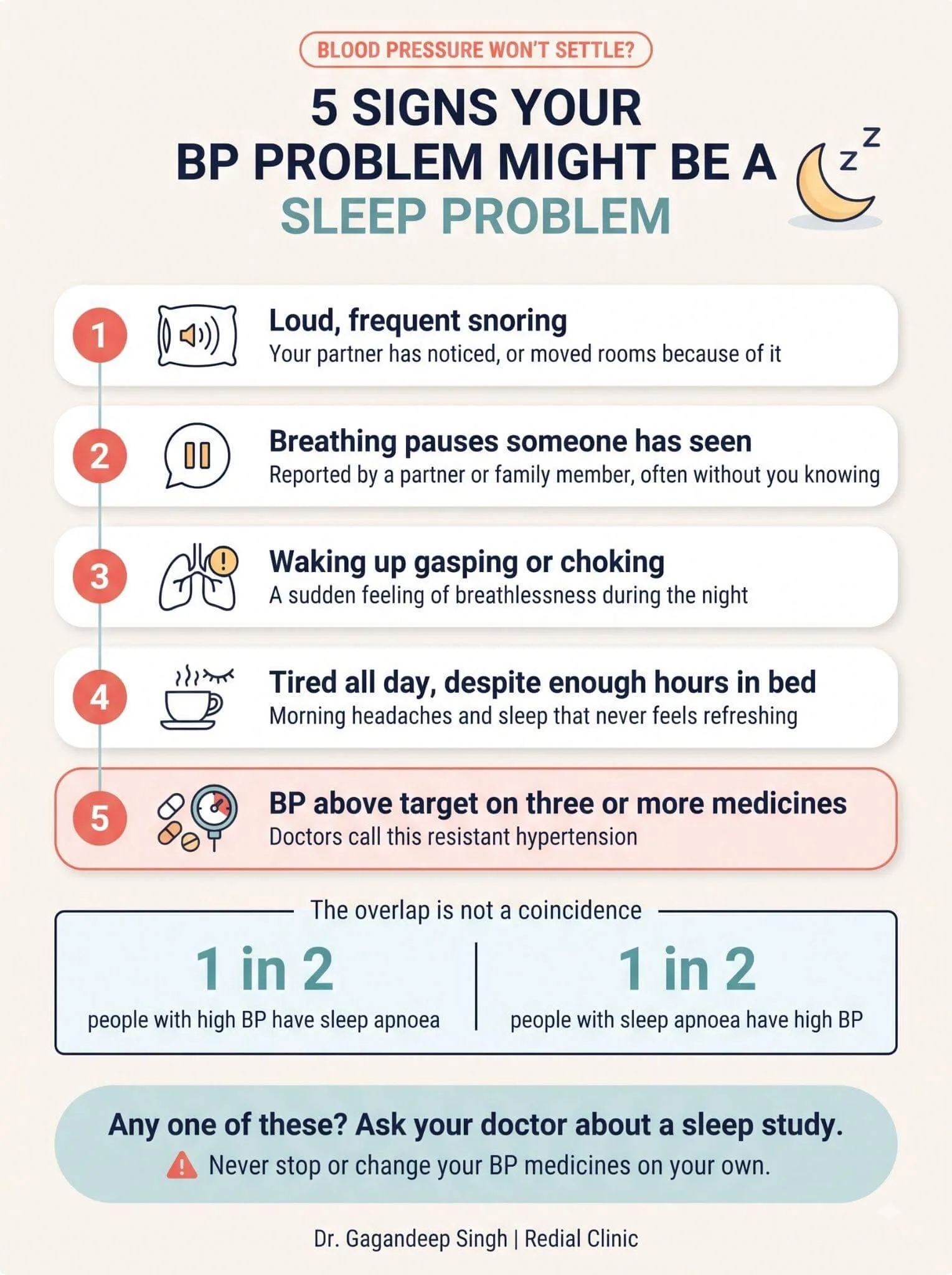
The mechanism is direct: each apnoea (breathing pause) causes oxygen levels to drop and carbon dioxide to rise, which triggers a strong sympathetic nervous system surge and a brief arousal from sleep to restart breathing. In moderate-to-severe OSA, this can happen dozens of times an hour, all night, every night. Each surge raises blood pressure acutely; repeated nightly over months and years, this remodels blood vessel function and keeps sympathetic tone chronically elevated, raising blood pressure through the day as well as at night. Roughly half of people with essential hypertension have OSA, and roughly half of people with OSA have hypertension — the overlap is substantial, not incidental.
Who should be screened for sleep apnoea
Current clinical guidance identifies obstructive sleep apnoea as one of the leading causes of secondary and resistant hypertension, and recommends specifically screening for it in patients whose blood pressure remains uncontrolled despite appropriate multi-drug therapy, alongside those with the classic symptom pattern below.
When to see a doctor about a possible sleep study
- Loud, frequent snoring — especially if a partner has noticed it or moved rooms because of it
- Witnessed pauses in breathing during sleep, reported by a partner or family member
- Waking up gasping, choking, or with a sensation of breathlessness
- Excessive daytime sleepiness despite what seems like adequate hours in bed
- Blood pressure that remains above target despite three or more antihypertensive medications (resistant hypertension)
- Morning headaches, unrefreshing sleep, or a neck circumference and body habitus associated with higher OSA risk
Any one or more of these findings warrants raising the possibility of a sleep study (polysomnography, or a validated home sleep apnoea test) with your physician. This is a diagnostic step, not a self-diagnosis checklist — the decision to refer and the interpretation of results belongs with your treating doctor.
| From the clinicMore than once, a patient referred for “resistant hypertension” has turned out, on closer questioning, to have loud snoring and a partner who describes witnessed breathing pauses that the patient himself was completely unaware of. Once appropriately worked up and treated for OSA — a decision made jointly with the treating physician and sleep specialist — the blood pressure picture often improves meaningfully, sometimes enough to reduce medication load under medical supervision. Not every case responds this clearly, but the pattern is common enough that we now ask about snoring and witnessed apnoeas as a routine part of the blood pressure history. |
Does fixing sleep lower blood pressure?
Often, yes — particularly when the underlying problem is undiagnosed OSA or a chronically shortened, disrupted sleep pattern. Treating confirmed sleep apnoea (commonly with CPAP therapy) has been shown to improve blood pressure control, and improving general sleep hygiene and duration can meaningfully support blood pressure management alongside medication. But sleep correction is a supporting lever, not a replacement for prescribed antihypertensive treatment.
This is an important distinction to hold onto: for someone with confirmed OSA-driven hypertension, treating the sleep apnoea addresses a genuine causal driver and can produce real, measurable blood pressure improvement. For someone whose hypertension is unrelated to sleep, better sleep hygiene alone will not substitute for medication — it is complementary, not curative. The honest answer depends entirely on whether sleep and stress are actually contributing to that individual’s blood pressure picture, which is why proper assessment (history, home or ambulatory BP monitoring, and sleep-study referral where indicated) matters more than a blanket lifestyle prescription.
Medication safety note: Never stop, reduce, or adjust any blood pressure medication on your own, even if your sleep and stress levels improve. Deprescription — reducing the number or dose of antihypertensive medications — must always be a supervised decision made by your treating physician, based on sustained, properly measured blood pressure readings over time.
What can you actually do about it?
The most evidence-aligned steps are: get any suspected OSA symptoms formally assessed with a sleep study, build consistent sleep timing and duration, address chronic stress with structured techniques rather than hoping it resolves on its own, keep taking your prescribed blood pressure medication exactly as directed, and track your blood pressure at home across different times of day rather than relying on a single clinic reading.
| Lever | Why it helps blood pressure | How we apply it at Redial Clinic |
| Sleep-study referral where OSA is suspected | Identifies and enables treatment of a genuine, correctable secondary cause of hypertension | We screen for snoring, witnessed apnoeas, and daytime sleepiness as part of the BP history, and refer promptly for polysomnography when indicated |
| Consistent sleep timing and duration | Supports the normal nocturnal blood pressure dip and reduces sympathetic overactivation | Practical sleep-hygiene coaching — fixed wake time, reduced late-evening screen and caffeine exposure, wind-down routine |
| Structured stress reduction | Lowers sustained cortisol and sympathetic tone, the two main stress-driven BP pathways | Practical, sustainable techniques — breathing exercises, regular physical activity, boundary-setting around work — tailored to what a patient will actually keep doing |
| Home blood pressure monitoring | Reveals non-dipping or night-time patterns a single clinic reading misses | Structured home BP logging guidance, reviewed alongside medication and sleep history |
| Medication adherence and physician-led review | Ensures any dose or drug changes are safe and evidence-based, not guesswork | Coordinated review with your prescribing physician; we never advise stopping or changing BP medication independently |
This sits within Redial Clinic’s broader metabolic model: treating the upstream drivers of blood pressure — stress physiology, sleep, insulin resistance, and weight — alongside, not instead of, appropriate medical treatment. The goal over time, always under physician supervision, is better control with the least medication necessary, not less medication as an end in itself.
What Redial Clinic does and does not do
We provide metabolic and lifestyle-medicine care — blood pressure assessment, sleep and stress history, home BP monitoring guidance, and coordination with your prescribing physician. We do not diagnose or treat sleep apnoea directly. Confirmed or suspected OSA is referred for formal sleep-study testing and, where appropriate, specialist (pulmonology or ENT) and CPAP management.
Frequently asked questions
Can stress cause high blood pressure?
Yes. Chronic psychological stress activates the HPA axis (raising cortisol) and the sympathetic nervous system, both of which increase heart rate, constrict blood vessels, and promote sodium retention — mechanisms that, sustained over time, contribute to the development and worsening of hypertension. A single stressful moment causes only a temporary spike; it is ongoing, unresolved stress that matters clinically.
Does poor sleep raise blood pressure?
Yes. Blood pressure normally dips 10 to 20 percent overnight during good-quality sleep. Short, fragmented, or disrupted sleep blunts this dip and keeps the sympathetic nervous system more active than it should be at night, raising average blood pressure over time. This effect is strongest and most clinically significant when the disruption is due to untreated obstructive sleep apnoea.
Can sleep apnoea cause hypertension?
Yes — obstructive sleep apnoea is a well-established, underdiagnosed cause of both essential and resistant hypertension. Repeated night-time breathing pauses trigger oxygen drops and strong sympathetic surges that raise blood pressure acutely each time and, over months and years, keep it elevated through the day as well. Anyone with resistant hypertension (uncontrolled on three or more medications) should be screened for OSA.
Does fixing sleep lower blood pressure?
Often, particularly when undiagnosed sleep apnoea or chronically poor sleep is a genuine contributing factor — treating confirmed OSA and improving sleep habits can meaningfully support blood pressure control. This works alongside prescribed medication, not as a replacement for it, and any change to your medication must be made by your treating physician, not independently.
Next step
| If your blood pressure is not settling despite medication — or if you or your partner have noticed loud snoring, breathing pauses, or unusual daytime sleepiness — the next step is a proper blood-pressure and sleep review, not another guess at the dose. We will assess your blood pressure pattern, sleep and stress history together, and refer you promptly for a sleep study if obstructive sleep apnoea is suspected.
Book a Metabolic Assessment at Redial Clinic, Green Park, New Delhi. |
Medical Disclaimer
This article is for informational purposes only and does not constitute medical advice. Redial Clinic provides metabolic and lifestyle-medicine care and does not diagnose or treat obstructive sleep apnoea directly. Always consult a qualified healthcare professional — and a sleep specialist where OSA is suspected or confirmed — before making changes to your diet, exercise, sleep routine, or medication.
References
- Brown J, Yazdi F, Jodari-Karimi M, Owen JG, Reisin E, “Obstructive Sleep Apnea and Hypertension: Updates to a Critical Relationship,” Current Hypertension Reports, 2022. https://doi.org/10.1007/s11906-022-01181-w
- Ushakov AV, Ivanchenko VS, Gagarina AA, “Psychological Stress in Pathogenesis of Essential Hypertension,” Current Hypertension Reviews, 2016. https://doi.org/10.2174/1573402112666161230121622
- Ferrannini E, Buzzigoli G, Bonadonna R, et al., “Insulin resistance in essential hypertension,” New England Journal of Medicine, 1987. https://doi.org/10.1056/NEJM198708063170605
- DeFronzo RA, Tripathy D, “Skeletal Muscle Insulin Resistance Is the Primary Defect in Type 2 Diabetes,” Diabetes Care, 2009. https://doi.org/10.2337/dc09-S302
- Anjana RM, Unnikrishnan R, Deepa M, et al., “Metabolic non-communicable disease health report of India: the ICMR-INDIAB national cross-sectional study (ICMR-INDIAB-17),” The Lancet Diabetes & Endocrinology, 2023. https://doi.org/10.1016/S2213-8587(23)00119-5

 Facebook
 Instagram
 LinkedIn