



Written by: Dr. Gagandeep Singh, MBBS
Medically reviewed by: Dr. Gagandeep Singh, MBBS
Last updated: 20 June 2026 · Redial Clinic, Green Park, New Delhi
| Key Takeaways Type 2 diabetes is driven by insulin resistance and excess liver and pancreas fat — for many people that underlying state can be improved, and the disease can enter remission. “Permanent reversal” is best understood as sustained remission: an HbA1c below 6.5% maintained for at least three months without glucose-lowering medication. Reversal works on two levers together — reducing the glucose your body has to handle (diet) and building the muscle that clears it (resistance training). The likelihood of lasting remission is higher when diabetes is recent and beta-cell reserve is preserved; long-standing diabetes may improve without full remission. Medication must never be reduced on your own. Deprescription is a physician decision, especially with insulin or sulfonylureas, because of hypoglycaemia risk. Remission lasts only as long as the metabolic repair holds — the habits that produced it have to continue. |
Most patients with type 2 diabetes are told the same thing: it is a chronic, progressive disease, and the job from here is to manage it with steadily increasing medication. That message is half right and half deeply discouraging. For many people, type 2 diabetes is not a permanent sentence but a reversible state of insulin resistance — and learning how to reverse type 2 diabetes permanently begins with treating that root cause rather than only chasing the numbers on a report.
This guide explains what reversal actually means, what the evidence shows is possible, and the specific, medically supervised steps that give the best chance of lasting remission. It is honest about who reverses easily and who does not — because false promises help no one.
What does it mean to reverse type 2 diabetes permanently?
Reversing type 2 diabetes permanently means achieving and holding remission — an HbA1c below 6.5% sustained for at least three months without any glucose-lowering medication. Doctors prefer the word remission over “cure,” because the tendency toward high sugar can return if the underlying metabolic problem is allowed to rebuild.
In 2021 an international expert group formally defined remission of type 2 diabetes as an HbA1c under 6.5% maintained for three months or more after stopping diabetes medication. That definition matters: it sets an honest, measurable bar instead of vague claims.
We avoid the word “cure” deliberately. The genetic and metabolic tendency that produced your diabetes does not vanish; it is brought under control. Think of it like a fire that has been put out — the conditions that allowed it can return if the room fills with fuel again. The right goal is durable remission with the least possible medication.
If you are still wondering whether reversal is realistic for you at all, our explainer on whether type 2 diabetes can be reversed covers the basics, and this guide goes deeper into making it last.
Can type 2 diabetes really be reversed, or only controlled?
Yes — for a meaningful proportion of people it can be reversed, not just controlled. In the landmark DiRECT trial, almost half of participants who followed a structured weight-management programme were in diabetes remission at one year, and over a third remained in remission at two years.
Control means the markers are suppressed by medication while the underlying dysfunction continues. Reversal means the dysfunction itself improves, and the markers normalise as a consequence. The difference is everything.
The DiRECT trial put this to the test in ordinary primary-care patients. At 12 months, 46% achieved remission; at 24 months, 36% sustained it — and remission was closely tied to how much weight, and crucially how much liver and pancreas fat, was lost and kept off. This is not fringe science; it is published, replicated clinical evidence.
The honest caveat: reversal is most achievable earlier in the disease, while the pancreas still has reserve. That is exactly why we urge people not to wait.
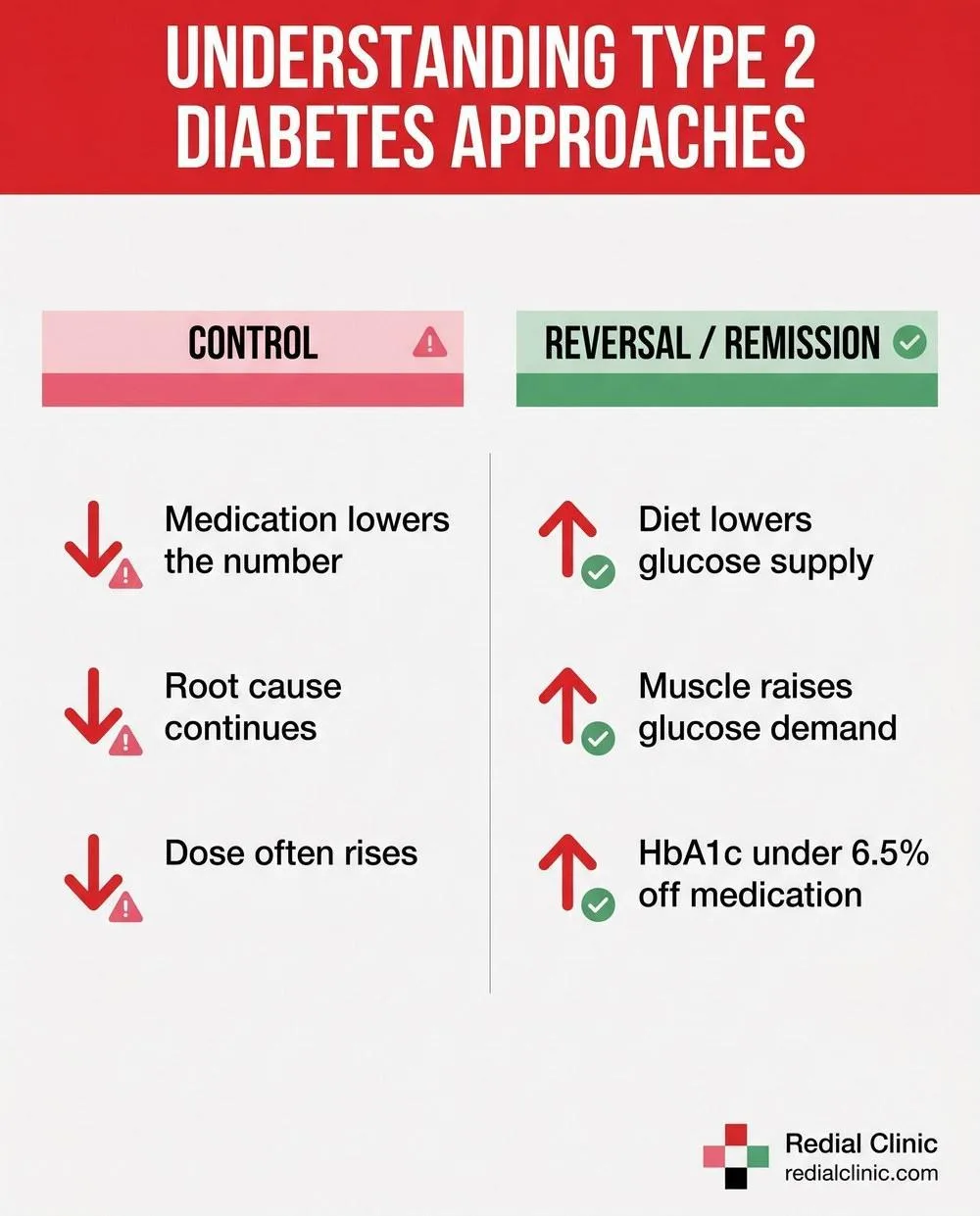
Comparison infographic showing diabetes control with medication versus reversal and remission through root-cause repair
| In our clinic in Green Park, we often see the clearest reversals in patients diagnosed within the last three to five years who still have good beta-cell reserve — many reduce or stop medication within months. Patients with fifteen years of diabetes and high insulin doses usually improve substantially, but full remission is less common, and we say so at the first consultation. |
How do you reverse the root cause instead of just the numbers?
You reverse the root cause by working two levers at once: reducing glucose supply through carbohydrate-aware eating, and increasing glucose demand by building skeletal muscle. Together these lower the insulin burden, drain fat out of the liver and pancreas, and let the body’s own glucose control recover.
High refined-carbohydrate intake drives repeated glucose and insulin spikes; over years the cells stop responding, the pancreas over-produces insulin, fat accumulates in the liver, fasting sugar climbs, and medication is added. Reversal runs that ladder backwards.
Lever one is diet: lowering the glucose load arriving from rice, roti, sugar and refined flour so insulin demand falls and liver fat clears. Lever two is resistance training — skeletal muscle is the largest site of glucose disposal in the body, and building it adds a metabolic “sink” that clears glucose even independently of insulin. If the mechanism is new to you, our guide to what insulin resistance is sets the foundation.
| Lever | What it does | How we apply it |
| Reduce glucose supply (diet) | Lowers insulin demand; clears liver fat | Carbohydrate-aware Indian meals: more protein and vegetables, controlled rice/roti, no sugary drinks or refined snacks |
| Increase glucose demand (muscle) | Adds an insulin-independent glucose sink | Progressive resistance training 2–4×/week, adapted to age and joints |
| Medical monitoring | Keeps reversal safe | Biomarker tracking and supervised medication reduction |
The two-lever model used in Redial Clinic’s RAPID protocol, with medical monitoring tying them together.
What does a permanent diabetes reversal plan actually involve?
A reversal plan starts with a full metabolic assessment, then runs an intensive, personalised phase of carbohydrate-aware nutrition and resistance training with frequent monitoring — typically over about 12 weeks — followed by a maintenance phase that protects the gains for the long term.
At Redial Clinic we structure this as the RAPID protocol: root-cause diagnosis, assessment first, a personalised protocol, intensive coordinated intervention, and supervised deprescription. You can see the full clinical approach on our diabetes reversal programme page.
Nutrition is built around Indian meals rather than against them — dal, paneer, vegetables, curd and eggs anchor the plate while refined carbohydrates are reduced; our best Indian diet for diabetes reversal guide gives practical templates. Training begins gently and progresses. Timelines vary, which we cover in how long it takes to reverse diabetes.
There is no single “reversal diet” or fixed schedule. The degree of carbohydrate restriction, the training design, and the pace of medication change are all calibrated to your metabolism, age and starting point.
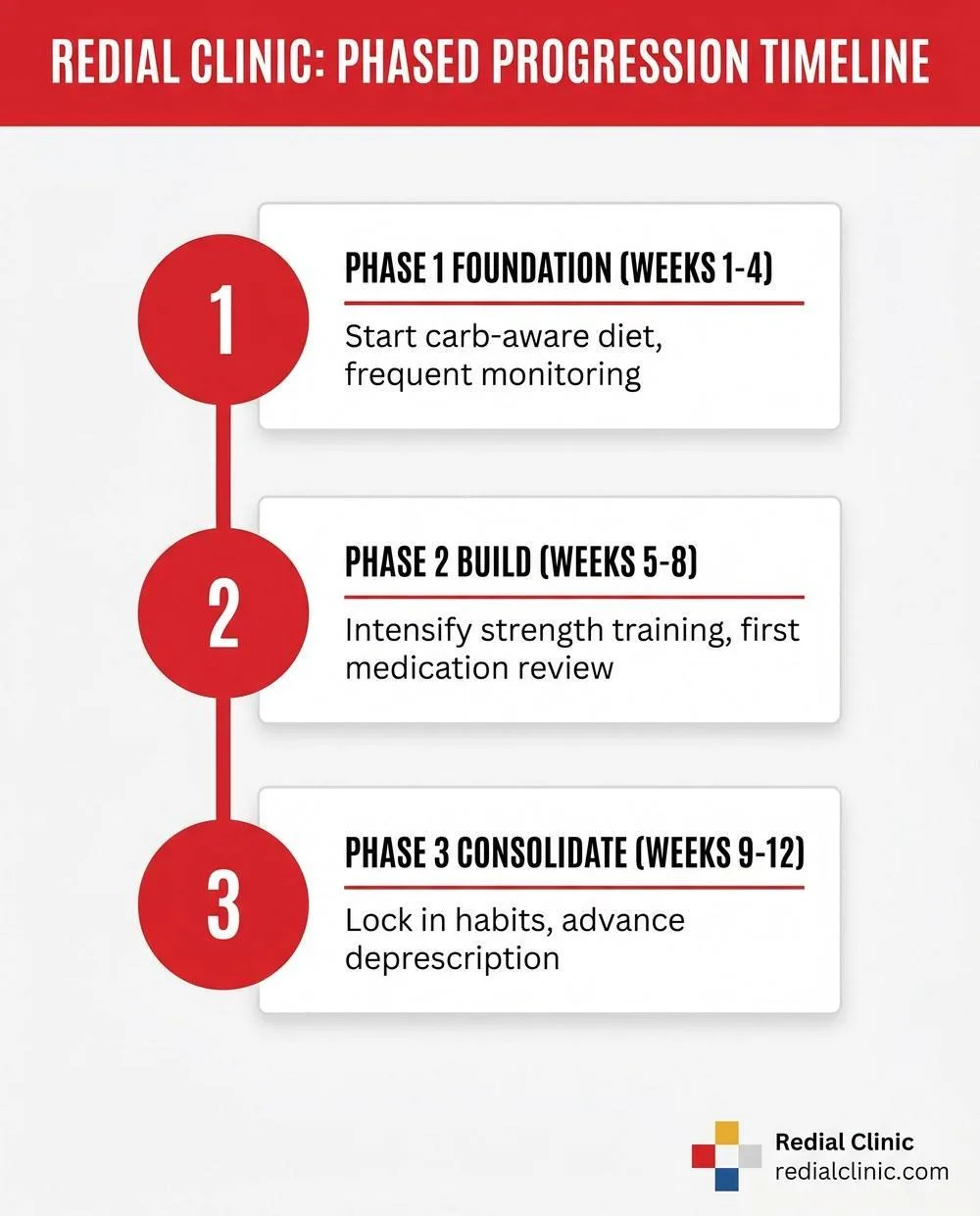
Infographic of the three phases of a 12-week diabetes reversal programme
What happens to my diabetes medication during reversal?
As your sugar improves, medication doses calibrated to your old, higher glucose can become excessive and cause hypoglycaemia. So medication is reduced — but only by your doctor, step by step, guided by your readings. Never lower or stop diabetes medicine, especially insulin or sulfonylureas, on your own.
This is the single most important safety point in any reversal attempt. When you reduce glucose supply and build muscle, your body needs less pharmacological help. Continuing a high dose into an improving metabolism does not keep you safe — it creates the risk of dangerous lows.
Deprescription is therefore a planned, monitored medical act, not a reward you give yourself. Some patients reduce medication within weeks; others over months. Reversal achieved this way — with the doctor, not against the prescription — is what makes it sustainable. Read more on diabetes reversal without medication and how supervised tapering works.
| A common pattern we see: a patient on insulin and a sulfonylurea starts the programme, and within two to three weeks reports morning lows. That is not a setback — it is the signal we watch for, and it is when we begin tapering. Patients who try this without supervision are the ones who get into trouble. |
How do you make diabetes reversal permanent and not temporary?
Remission lasts as long as the metabolic repair holds. Permanence comes from maintaining the habits that produced it — keeping refined carbohydrates low, protecting muscle mass, sleeping well and managing stress — plus periodic monitoring so any early drift is caught and corrected.
The DiRECT data make this concrete: people who regained weight and liver fat tended to relapse, while those who maintained the change stayed in remission. The body has a memory for metabolic stress.
Permanence is not about perfection or never eating a sweet again. It is about a sustainable default — most meals built around protein, vegetables and controlled carbohydrate, regular strength work, and an annual metabolic review. Reversal is powerful; keeping it is a long game played with small, repeatable habits.
Frequently Asked Questions
Can type 2 diabetes be reversed permanently?
It can be put into lasting remission for many people, particularly when diabetes is recent and the pancreas still has reserve. Doctors use “remission” rather than “permanent cure” because the tendency to high sugar can return if the underlying metabolic changes are reversed by old habits. The more durable the lifestyle change, the more durable the remission.
How long does it take to reverse type 2 diabetes?
Many people see major improvements in 3 to 6 months of a structured programme, and some reduce medication within weeks. The exact timeline depends on disease duration, weight and liver fat, medication load, and consistency. Early, intensive change tends to produce faster results.
Does reversed diabetes come back?
It can, if the metabolic changes that drove remission are undone — typically through weight and liver-fat regain. This is why maintenance habits and periodic HbA1c checks matter. Catching an early upward drift allows quick correction before full relapse.
Can you reverse diabetes without medication?
Some people reach remission and come off glucose-lowering medication entirely under medical supervision; others still need some medication but at a much lower dose. The decision to reduce or stop any medicine is your doctor’s, not a personal experiment — especially with insulin or sulfonylureas, which carry hypoglycaemia risk.
Next step
| If you have had type 2 diabetes for a few years and want to know whether remission is realistic for you, the first step is a full metabolic assessment of your insulin resistance, liver fat and pancreatic reserve. Book a Metabolic Assessment at Redial Clinic, Green Park, New Delhi. |
Medical disclaimer: This article is for informational purposes only and does not constitute medical advice. Always consult a qualified healthcare professional before making changes to your diet, exercise, medication, or treatment plan.
References
1. Riddle MC, Cefalu WT, Evans PH, et al., “Consensus Report: Definition and Interpretation of Remission in Type 2 Diabetes,” Diabetes Care, 2021. https://doi.org/10.2337/dci21-0034
2. Lean MEJ, Leslie WS, Barnes AC, et al., “Primary care-led weight management for remission of type 2 diabetes (DiRECT): an open-label, cluster-randomised trial,” The Lancet, 2018. https://doi.org/10.1016/S0140-6736(17)33102-1
3. Lean MEJ, Leslie WS, Barnes AC, et al., “Durability of a primary care-led weight-management intervention for remission of type 2 diabetes: 2-year results of the DiRECT open-label, cluster-randomised trial,” The Lancet Diabetes & Endocrinology, 2019. https://doi.org/10.1016/S2213-8587(19)30068-3
4. Taylor R, “Type 2 Diabetes: Etiology and Reversibility,” Diabetes Care, 2013. https://doi.org/10.2337/dc12-1805
5. DeFronzo RA, Tripathy D, “Skeletal Muscle Insulin Resistance Is the Primary Defect in Type 2 Diabetes,” Diabetes Care, 2009. https://doi.org/10.2337/dc09-S302
6. Anjana RM, Unnikrishnan R, Deepa M, et al., “Metabolic non-communicable disease health report of India: the ICMR-INDIAB national cross-sectional study (ICMR-INDIAB-17),” The Lancet Diabetes & Endocrinology, 2023. https://doi.org/10.1016/S2213-8587(23)00119-5

 Facebook
 Instagram
 LinkedIn