



What is fatty liver disease, and what do Grade 1, 2 and 3 mean?
Fatty liver disease is the accumulation of excess fat inside liver cells — clinically, hepatic steatosis. When it occurs alongside metabolic factors such as excess weight, insulin resistance, type 2 diabetes, high blood pressure or disturbed lipids, and not as a result of alcohol, it is now formally called MASLD — metabolic dysfunction-associated steatotic liver disease. You may know it by its older name, non-alcoholic fatty liver disease, or NAFLD. The name changed in 2023 to put the word “metabolic” where the cause actually sits.
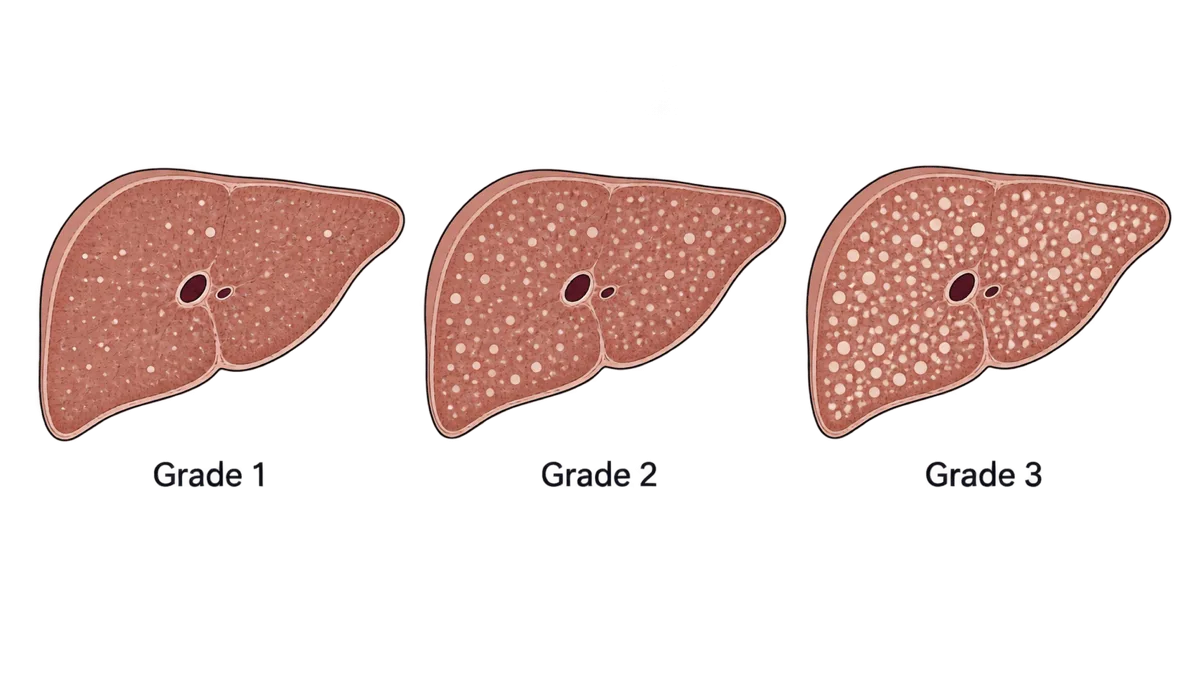
The grading on your ultrasound report describes how much fat the radiologist can see, not how much damage has been done:
- Grade 1 (mild) — fat is visible but the liver’s internal structures are still clearly seen. Frequently reported as an incidental finding.
- Grade 2 (moderate) — fat obscures the liver’s blood vessels on the scan. This is the grade most patients arrive with.
- Grade 3 (severe) — fat obscures the deeper structures of the liver entirely.
Two things follow from that, and neither is usually explained at the time.
First, the grade tells you about fat, not about scarring. A patient with Grade 3 fat and no fibrosis is in a better position than a patient with Grade 1 fat and established fibrosis. Grade alone does not tell you which of those you are, which is why fibrosis assessment matters as much as the grade does.
Second, the grade is a snapshot of something that moves. It is not a fixed classification. Grade 2 is a description of your liver on the day of the scan, under the metabolic conditions that were running at the time. Change those conditions and the description changes with them.
What causes fatty liver if you do not drink?
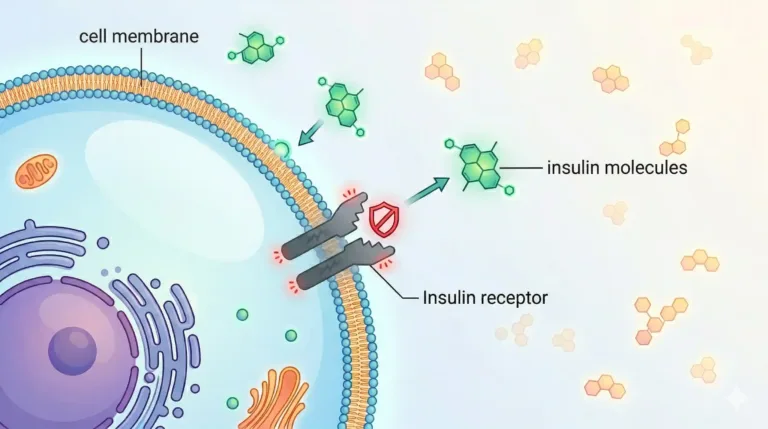
If you do not drink alcohol and barely touch fried food, the fat in your liver is not arriving from outside. Your liver is manufacturing it. When you routinely eat more refined carbohydrate than your body needs — rice, roti, sugar, biscuits, fruit juice, sweetened chai — the liver converts the surplus into fat and stores it. That process is called de novo lipogenesis, and it runs harder in the presence of insulin resistance, which is the reason it keeps running in the first place.
That is why the standard advice underperforms. Cutting oil addresses a fat you are eating. It does not address the fat your liver is making.
The drivers we see most often in Indian patients, in rough order of how much they explain:
- Insulin resistance — the body’s declining response to its own insulin. It is upstream of almost everything else on this list, and almost nobody with a fatty liver report has ever been tested for it.
- Visceral fat — the fat around the abdominal organs, which is metabolically active and drains directly into the liver. Waist circumference predicts this far better than weight does.
- A high refined-carbohydrate, low-protein diet pattern — the standard Indian breakfast is a clean example: poha, upma, idli or toast, almost no protein, a sharp glucose rise before 9 AM.
- Fructose load — packaged fruit juice, sweetened drinks, and large daily quantities of sugar in chai. Fructose is processed almost entirely by the liver and is a direct substrate for liver fat.
- Rapid weight gain — particularly the ten or twelve kilos that arrive quietly across a decade of desk work.
- Poor sleep and chronic stress — both raise cortisol and worsen insulin resistance, which feeds the same loop.
- Some medications — long-term steroids, tamoxifen, methotrexate, amiodarone and a few others can cause or worsen steatosis. Worth reviewing rather than assuming.
- Alcohol, where it is present — alcohol-related fatty liver is a separate diagnosis, and the two can coexist. We ask honestly and without judgement, because the treatment differs.
Can fatty liver be reversed?
Yes. For most patients with fat alone and no advanced scarring, liver fat can be meaningfully reduced and in many cases cleared, under medical supervision. The liver is among the most regenerative organs in the body, and hepatic steatosis is one of the more reversible conditions in metabolic medicine. That is the good news, and it is real.
The honest ceiling matters just as much, because it decides what your treatment is aiming at. What is reversible depends on where you already are:
Fat alone (simple steatosis)
Highly reversible in most patients. Liver fat responds to correction of the metabolic driver faster than most other markers — often before weight change is dramatic. This is the large majority of patients who come to us with a fatty liver report.
Inflammation (steatohepatitis / MASH)
Fat plus active liver inflammation. Still treatable, and resolution is achievable in a meaningful proportion of patients with sustained metabolic correction. The published evidence links it closely to the degree of weight reduction achieved — patients reaching around 10% body-weight reduction show the highest rates of resolution.
Early fibrosis (F1–F2)
Scarring, but early. Early fibrosis can regress with sustained treatment — this is well documented and is one of the more encouraging findings in the field. It takes longer than clearing fat and requires the metabolic correction to hold, not just happen.
Advanced fibrosis (F3) and cirrhosis (F4)
Here the answer changes. Advanced fibrosis sometimes improves but often does not. Cirrhosis is not reversible. What treatment can still do at this stage is halt progression, reduce complication risk, and protect the liver function that remains — which is worth doing, and which requires hepatology involvement alongside metabolic care. We will tell you if this is where you are, and we will say so before you commit to anything.
The purpose of the initial assessment is to find out which of these four you have. Almost nobody arrives knowing, because an ultrasound alone cannot tell you.
Why normal liver enzymes do not mean your liver is fine
A large proportion of people with fatty liver have SGPT (ALT) and SGOT (AST) readings inside the normal range. Normal enzymes mean the liver is not currently leaking much into the bloodstream. They do not mean there is no fat, and they do not mean there is no fibrosis. Patients are reassured by a normal LFT every day, and it is the wrong test to be reassured by.
This is the most consequential misunderstanding on this page, so it gets its own section.
Equally, a raised SGPT is not nothing. In a patient with metabolic risk factors, a mildly elevated SGPT is one of the more common early signals of a fatty liver — and it is routinely written off as “slightly high, repeat in three months.”
What actually establishes the picture is imaging for fat and a fibrosis assessment for scarring — a FibroScan with CAP and stiffness readings where available, or a calculated fibrosis score such as FIB-4 combined with ultrasound where it is not. Enzymes are a supporting data point. They were never the test.
How long does it take to reverse a fatty liver?
For suitable patients, liver fat typically begins to fall within the first 8 to 12 weeks of structured treatment, and a meaningful reduction is usually visible on repeat imaging between 3 and 6 months. Where fibrosis is present and early, regression takes longer — commonly 12 months or more of sustained metabolic correction.
These are typical ranges, not promises. The actual timeline depends on your starting grade, whether fibrosis is present, how much visceral fat there is to lose, whether diabetes or hypothyroidism is running alongside, and how consistently the plan is followed. The assessment is what lets us give you a timeline based on your own data rather than a brochure average.
Typical progression in suitable patients
- Weeks 2–6: Improved energy, reduced post-meal heaviness, fewer afternoon crashes. Waist circumference begins to move. Nothing visible on a scan yet — liver fat is falling before it is measurable.
- Months 2–4: Measurable reduction in waist and visceral fat. SGPT and SGOT usually begin to fall where they were raised. Early improvement in fasting insulin and triglycerides.
- Months 3–6: Repeat imaging typically shows meaningful reduction in liver fat in suitable patients — often a full grade, sometimes more. Metabolic markers consolidate. In patients with clustered conditions, this is usually the point at which diabetes or blood pressure medication is reviewed, under supervision.
- Months 6–18: Where early fibrosis was present, this is the window in which stiffness readings tend to improve. The work here is holding the metabolic correction rather than adding to it.
- Beyond 18 months: Maintenance. Periodic re-imaging, because a liver that cleared once will fill again if the conditions that filled it return.
What we actually assess — and why it differs from a routine ultrasound
A standard fatty liver workup in India is an ultrasound and a liver function test. That tells you there is fat and that the enzymes are or are not raised. It does not tell you why the fat is there, whether there is scarring, or what to treat. We assess all three.
How the fatty liver treatment program works
The program runs on four levers in parallel. None of them is a liver treatment in the sense of treating the organ directly — all of them treat the metabolic conditions that fill it, which is how the fat actually leaves.
Nutrition — the primary lever, built around Indian food
The target is the carbohydrate load your liver is converting into fat, not the oil in your sabzi. Three structured meals with no snacking between them, so insulin falls between them. A real protein source at every meal — eggs, paneer, curd, fish, chicken — because one katori of dal contributes 8 to 9 grams of protein and a meal needs 25 to 30. Refined carbohydrate portioned down rather than eliminated. Sugar in chai audited honestly; three cups a day at two teaspoons each is 25 grams of sugar before you have eaten anything. Packaged fruit juice removed entirely — it is the most direct dietary route to liver fat available. Ghee in place of refined seed oils. It is Indian food throughout. Nothing imported, nothing your kitchen does not already have.
Strength and movement
Muscle is where the body disposes of most of its glucose. Building or preserving it reduces the surplus reaching the liver in the first place, and resistance training improves liver fat independently of weight loss. The prescription is calibrated to what you can actually sustain — for some patients structured resistance work, for others progressive walking and bodyweight work to start.
Sleep, stress and alcohol
Short sleep and chronic stress raise cortisol, worsen insulin resistance, and feed the same loop that is filling the liver. Where alcohol is part of the picture, it is addressed directly rather than politely — the liver does not distinguish between a metabolic insult and a social one.
Reviewing the medication you are already on
There is no routine medication that clears a fatty liver, and we do not pretend otherwise. What most of our fatty liver patients do have is a cluster — type 2 diabetes, high blood pressure, disturbed lipids — each with its own prescription. As the metabolic picture improves, those medications are reviewed and adjusted where the data supports it, always under supervision and never independently. Where a drug you are taking may itself be contributing to liver fat, we look at whether there is a reasonable alternative.
Fatty liver in the Indian patient — why South Asian context matters
Roughly 38.6% of Indian adults have fatty liver on pooled prevalence data, and it sits higher again in people with type 2 diabetes. India was also the first country in the world to fold fatty liver into its national non-communicable disease programme, which tells you how large the burden is considered to be. But prevalence is not the interesting part. The interesting part is that Indian livers accumulate fat under conditions that would look unremarkable in a European patient.
BMI thresholds are lower here. ICMR classifies BMI ≥23 kg/m² as overweight and ≥25 kg/m² as obese in Indian adults, against WHO cutoffs of 25 and 30. A patient at BMI 26 who has been told they are “only slightly overweight” is, by Indian criteria, obese — and frequently has a fatty liver to go with it.
Waist matters more than weight. Visceral fat drains directly into the liver through the portal vein. Waist circumference tracks that far better than the number on the scale, which is why we measure it and why it is one of the first things to move.
Lean fatty liver is real and it is common here. A clinically meaningful share of Indian fatty liver occurs in people who are not overweight at all — normal BMI, no visible belly, a scan that still shows fat. The South Asian phenotype carries more fat and less muscle at any given body weight, and stores that fat viscerally. If you are thin and your scan says fatty liver, the report is probably not wrong. It is telling you something about your body composition that the weighing scale cannot.
The carbohydrate load is the Indian-specific driver. Rice and roti at both main meals, a carbohydrate-only breakfast, sweetened chai several times a day, and fruit juice treated as a health food. None of these needs to be eliminated. All of them need to be counted, and almost none of them are.
Fatty liver is frequently the first domino. In a large share of patients who go on to develop type 2 diabetes, a fatty liver was visible on a scan years earlier and was recorded as an incidental finding. That is the warning most people are given and almost nobody is told to act on.
Who this program is for, and who it is not for
This program is designed for
- Adults with a fatty liver diagnosis on ultrasound, FibroScan or an incidental scan, who want the cause investigated rather than another six-month wait
- Patients told they have Grade 1, Grade 2 or Grade 3 fatty liver and given no plan beyond "lose some weight"
- Patients who do not drink and cannot understand why their liver has fat in it
- Lean patients with normal BMI whose scan shows fat anyway
- Patients with fatty liver alongside type 2 diabetes, prediabetes, high blood pressure, high triglycerides or PCOS — where the conditions share a driver and should be treated as one problem
- Patients with raised SGPT or SGOT who have been told to repeat the test in three months, twice
- Patients with early fibrosis who want it addressed while regression is still realistic
This program is not designed for
- Alcohol-related liver disease as the primary diagnosis, which requires a different treatment pathway including addiction support where appropriate
- Viral hepatitis, autoimmune hepatitis, or inherited liver disease as the primary cause — these need hepatology-led care, and we will refer
- Decompensated cirrhosis or established liver failure, which requires specialist hepatology and, in some cases, transplant assessment
- Patients looking for a liver detox, a cleanse, a tonic or a supplement protocol — we do not offer these and do not consider them treatment
- Patients unwilling to change food patterns, movement or sleep. There is no medication that substitutes for this in fatty liver, and we would be taking your money to tell you otherwise.
Why patients choose Redial over a gastroenterology referral, a liver tonic, or an app
A gastroenterology referral is the right call when the question is whether the liver is damaged, and we refer when it is. But once serious liver disease has been excluded, most fatty liver patients are handed back with a diet sheet, because the driver is metabolic and the metabolic work is not what a hepatology clinic is built to deliver. The gap between “your liver is not in danger” and “here is how the fat leaves” is where most patients get stranded.
The alternative on offer — liver tonics, milk thistle, detox programmes, cleanse teas — is not treatment. None of it has evidence of clearing liver fat, and the entire category exists because the medical pathway left a vacuum.
Redial sits in between: metabolic medicine delivered by a doctor, with the diagnostic depth to find the driver and the follow-through to measure whether it moved.
We test for the cause. Fasting insulin, HOMA-IR, body composition and fibrosis assessment — not an ultrasound and a diet sheet.
We measure the result. Baseline imaging and repeat imaging. You find out whether it worked, rather than being told.
We treat the cluster, not the organ in isolation. Fatty liver, blood sugar, blood pressure and lipids share one driver and are treated together.
We are honest about the ceiling. If you have advanced fibrosis, you will hear that at the assessment and not after you have paid for a programme.
No detox vocabulary, ever. This is metabolic medicine under a physician, and it is the most medical version of what you are looking for.
Continuity. The same clinician across your treatment.